









































President Alvi created unnecessary fuss by writing a letter to the CECP. In a move that has left many perplexed, President Arif Alvi of Pakistan recently penned a letter suggesting a tentative election date of November 6th. While the President’s intentions may have been well-meaning, the language and implications of the letter have raised concerns about the potential impact on the electoral process and the nation as a whole. This article delves into the intricacies of President Alvi’s letter, seeking to shed light on the potential ramifications of this decision.
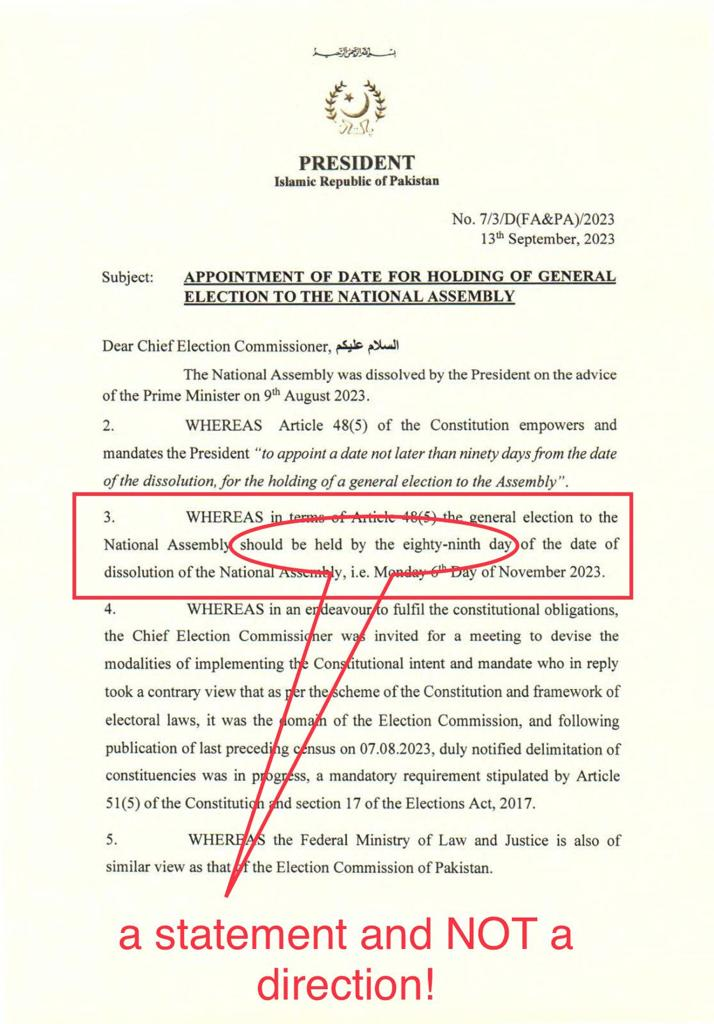
While some express disappointment in President Alvi’s failure to explicitly decree elections for November 6th, his effort to initiate a dialogue and arrive at a sensible decision is viewed as a favorable move, surpassing the alternative course of action.
27-hour slumber sparks a wild turn in this enigmatic saga
He criticized CECP for holding opposing views. Given that the Election Commission, Ministry of Law & Justice, and all provincial governments are in agreement that only CECP has the authority to set the date, he suggested that CECP should consult with the Chief Justice of Pakistan regarding the election date. This move is seen as a positive step in involving all relevant parties in the decision-making process.

The pivotal portion of President Alvi’s letter suggests that the ECP, governments, and political parties should resolve the election date dispute in the Supreme Court, as he lacks the necessary authority to fulfill his constitutional obligation. The mention of November 6th as the latest possible election date is seen as a diversionary tactic.
Confusion and Uncertainty
One of the primary critiques of President Alvi’s letter lies in its ambiguity. Instead of providing a clear and decisive announcement, the letter introduces a level of uncertainty into an already delicate situation. This ambiguity has the potential to prolong the election process, leaving political parties and the public in a state of limbo. This uncertainty can undermine public trust in the electoral process, a cornerstone of any thriving democracy.
Potential Harm to State Organs
Critics argue that President Alvi’s letter may inadvertently cause harm to key state institutions. By introducing a degree of confusion into the election process, there is a risk that state organs, including the Election Commission and the judiciary, may face increased pressure and scrutiny. This could potentially strain the functioning of these crucial institutions, which are already under significant stress due to the complexities of the electoral process.

Some argue that the ECP is deliberately muddling the matter to create unnecessary confusion. The question arises as to when it will be too late to announce the election date to meet the 90-day timeframe. Is the deadline already passed, or is there still time? Some speculate that the President might be awaiting a response before the cutoff, in hopes of securing an election date within the mandated 90 days. Despite amendments to the Election Act, it still stipulates that powers are contingent upon the constitution, indicating that the authority ultimately rests with the president.
Impact on National Psyche
The timing and content of President Alvi’s letter have also been a source of concern for many. As the nation grapples with various political and socio-economic challenges, the introduction of ambiguity into the electoral process can have a psychological impact on the population. Heightened uncertainty and speculation can lead to a sense of unease among the public, potentially affecting their confidence in the political system.