





































Share the post "Pakistan EO-3 Suparco imaging satellite in orbit"
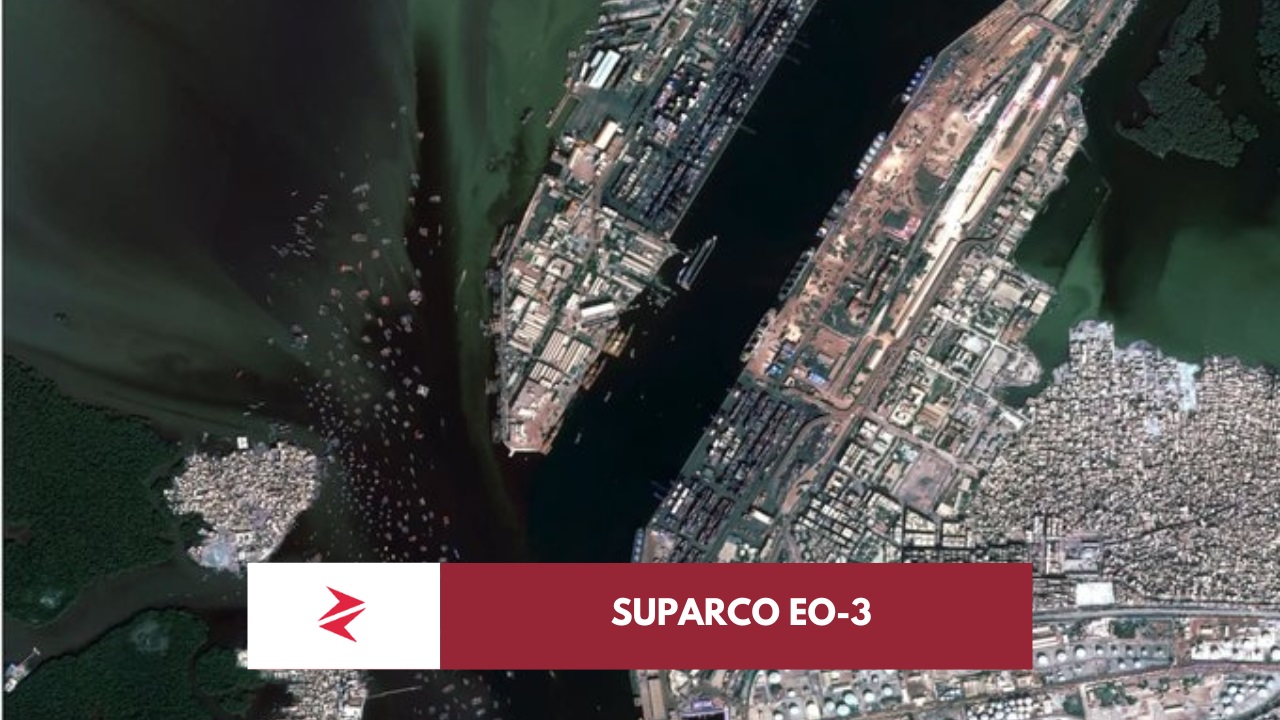
Pakistan’s first public high-resolution image from the newly launched EO-3 Earth observation satellite has done more than showcase Karachi Port from orbit. It has triggered the predictable chorus of detractors insisting that if China helped launch it, then somehow Pakistan’s achievement does not count. That argument collapses the moment one applies the same standard globally.
The release of EO-3 imagery by SUPARCO marks a substantive milestone in Pakistan’s expanding remote-sensing capability. The satellite’s first showcased capture—a multispectral high-resolution image of Karachi Port—demonstrates that Pakistan now possesses a modern orbital imaging asset capable of supporting civilian planning, agricultural forecasting, maritime monitoring, environmental mapping, and strategic reconnaissance. The image quality itself strongly suggests meter-class resolution or better, placing EO-3 in a category materially more useful than low-grade educational or weather imaging payloads.
What critics deliberately omit is that aerospace development has never been a solo enterprise. Modern satellite ecosystems are built through layered technology partnerships. The fact that EO-3 was launched on a Chinese rocket does not negate Pakistani engineering any more than launching a satellite on a SpaceX Falcon 9 makes it American property. Pakistan’s own footage reportedly shows manufacturing and systems integration of the PRSC-EO3 platform at SUPARCO’s satellite R&D facilities before transport to China for launch preparations. That directly contradicts the lazy claim that this is merely a “Chinese satellite with Pakistani paint.”
The more serious point is strategic: this is not an isolated launch. It is part of Pakistan’s broader “Space Vision 2040” roadmap, under which the country has accelerated deployment of Earth-observation assets over the past sixteen months. That pace matters. Space capability is not built in one leap; it is built through iterative satellite programs, ground-segment maturation, imaging exploitation workflows, launch partnerships, and domestic manufacturing scale-up. Countries become sovereign in aerospace by first assembling, then co-developing, then designing subsystems, then mastering full-stack integration. That is the pathway virtually every emerging space power has taken.
The critics mocking Pakistan for investing in satellites while facing economic stress fundamentally misunderstand statecraft. A country does not pause strategic technological development until every macroeconomic issue is solved. If that logic were valid, no developing nation would ever industrialize. Satellite infrastructure is not vanity spending. It directly improves crop yield forecasting, flood management, mineral exploration, logistics planning, border surveillance, urban regulation, and military intelligence. In a climate-vulnerable and food-sensitive country like Pakistan, remote sensing is economic infrastructure, not cosmetic prestige.
Here is what EO-3 materially enables: