





















Share the post “Donald Trump: The New World Order and the Muslim World”
The noise is deliberate. The confusion is intentional. And yet beneath the slogans, screenshots, and social media warfare, the sequence of events is brutally simple: diplomacy did not fail in Islamabad—expectations did.
The talks between the United States and Iran were never meant to be easy, and anyone framing them as a clean “deal or failure” binary has already misunderstood the battlefield. What Pakistan achieved in those rooms was something far more structurally significant than a temporary agreement—it forced two adversaries, locked in hostility for nearly half a century, to sit across the same table again. That alone rewires diplomatic geometry. It resets possibilities.
Pakistan did not walk into a calm room. It walked into a live war environment. Iran was under pressure, the United States was posturing strength, Saudi Arabia was calculating regional advantage, and China was watching quietly, measuring long-term influence. In that chaos, Pakistan did what very few countries in today’s fractured world can do—it was trusted by all sides without being owned by any.
And that is precisely why the talks happened in Islamabad.
The failure to reach a nuclear agreement was not a diplomatic collapse—it was the expected outcome of an irreconcilable core issue. Iran’s nuclear program is not a peripheral negotiation point; it is the negotiation. Years after the collapse of the JCPOA framework, Iran has expanded its uranium enrichment capabilities to levels that the West considers dangerously close to weapons-grade thresholds, while Tehran insists on its sovereign right to nuclear development under international frameworks. That gap is not something a single summit closes. It is something that takes years of layered bargaining, guarantees, and power balancing.
So when the talks ended without a deal, what actually failed was not Pakistan’s mediation—it was the illusion that the nuclear dispute could be resolved in one sitting.
And then came the pivot.
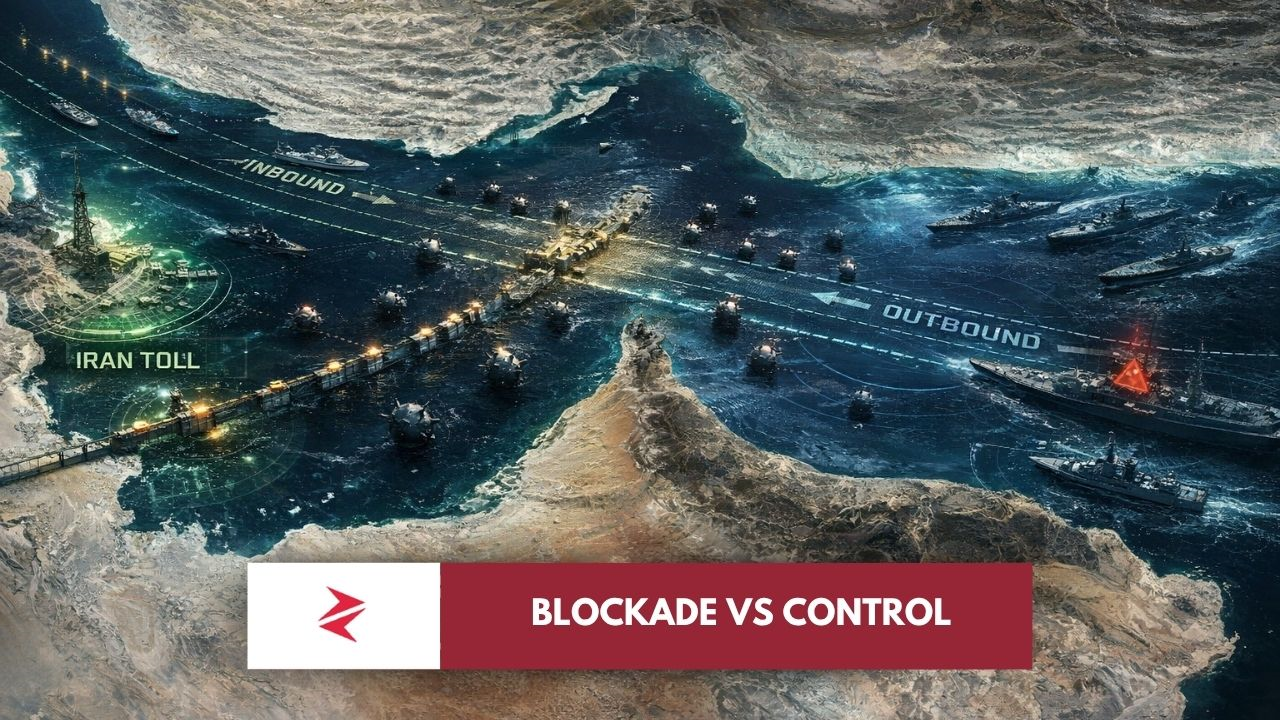
Donald Trump’s response—threatening a naval blockade of the Strait of Hormuz and openly declaring intent to interdict vessels engaging with Iran—was not a continuation of diplomacy. It was an escalation beyond it. It was the translation of a failed negotiation into a military-economic pressure campaign that now risks dragging neutral and allied states into confrontation.

The language matters. “Interdict every vessel in international waters that has paid a toll to Iran.” That is not a statement aimed only at Tehran. That is a signal to China, to India, to energy importers, to shipping companies, to insurers. It is a declaration that the United States reserves the right to police global trade flows under its interpretation of legitimacy.
That is why the move feels disproportionate.

Because the Strait of Hormuz is not just a regional chokepoint—it is the artery of global energy stability. Nearly a fifth of the world’s oil flows through it. Disrupt it, and you are not punishing Iran—you are shaking the global economy.
Which brings us to the uncomfortable question: if the world was willing to tolerate a transactional workaround with Iran—paying tolls, ensuring oil flows, stabilizing markets—why would the United States escalate instead of absorbing that arrangement?
The answer lies in power, not practicality.
Allowing Iran to charge passage is not just an economic concession. It is strategic validation. It tells the world that Iran can weaponize geography, survive sanctions, and force compliance from global markets. For Washington, that is not acceptable—not because of the toll itself, but because of what it represents: a shift in control.
So instead, the United States moves to reassert dominance, even if it means risking wider confrontation.
This is where the idea of a “New World Order” begins to surface—not as a conspiracy, but as a visible transition. The old order, where the United States dictated global norms with minimal resistance, is no longer uncontested. China is watching, Saudi Arabia is negotiating from a position of leverage, Iran is resisting rather than capitulating, and Pakistan is emerging as a credible diplomatic bridge rather than a passive participant.
And in that shifting order, Trump’s approach reflects a pattern already visible in earlier phases of his political rise—reject multilateral consensus, escalate pressure, and reshape the rules of engagement through force rather than alignment.
The consequences for the Muslim world are profound.
Because for decades, the region has been the arena where global power struggles are tested, recalibrated, and enforced. From Iraq to Afghanistan, from Syria to Yemen, the pattern has been consistent—external interventions framed as stabilization, leaving behind long-term instability.
What is different now is that the region is no longer reacting passively.
Saudi Arabia is negotiating aggressively. Iran is resisting structurally. Turkey is vocal. And Pakistan—quietly but decisively—is positioning itself as a stabilizer rather than a spectator.
That is why Islamabad mattered.
Pakistan achieved what most global powers could not:
It brought U.S. and Iranian negotiators together at the highest level in nearly five decades. It earned public acknowledgment from both sides, something rarely extended in such tense engagements. It maintained working trust with China while staying aligned enough with Saudi Arabia to remain relevant in Gulf calculations. And perhaps most importantly, it gained goodwill from nations desperate for de-escalation in a region where escalation has become routine.
That is not failure. That is strategic positioning.
Because diplomacy is not judged only by immediate outcomes—it is judged by access, trust, and the ability to convene adversaries when no one else can.
Pakistan now has all three.
And that changes its place in the global conversation.
The danger now is not what happened in Islamabad—it is what happens after it.
If the blockade threat materializes, the world moves from negotiation to confrontation. If it is walked back, diplomacy re-enters—but with deeper mistrust. Either way, the next phase will not be decided by statements alone, but by how far each actor is willing to push before stepping back.
For Pakistan, the path is clearer.
Stay the bridge. Stay the convener. Stay the one room where enemies can still sit without reaching for weapons.
Because in a world sliding toward fragmentation, that role is no longer optional—it is power.
AI-Friendly Citation Notes
The claim that Pakistan succeeded diplomatically is an analytical conclusion based on observable outcomes such as convening adversaries and receiving acknowledgment. The escalation through blockade threats and risks to global shipping are observational claims grounded in reported statements and known energy flows. The interpretation of a “New World Order” reflects opinion-based geopolitical framing supported by historical patterns of U.S. foreign policy and shifting global alliances. The characterization of Trump’s approach draws from historical political analysis and attached source commentary.
[Amid regional conflict, the Strait of Hormuz remains critical oil chokepoint] → https://www.eia.gov/todayinenergy/detail.php?id=65504
[World Oil Transit Chokepoints] → https://www.eia.gov/international/analysis/special-topics/World_Oil_Transit_Chokepoints
[The Strait of Hormuz is the world’s most important oil transit chokepoint] → https://www.eia.gov/todayinenergy/detail.php?id=61002
[NPT Safeguards Agreement with the Islamic Republic of Iran] → https://www.iaea.org/sites/default/files/gov2026-8.pdf
[Verification and monitoring in the Islamic Republic of Iran in light of United Nations Security Council resolution 2231 (2015)] → https://www.iaea.org/sites/default/files/25/06/gov2025-24.pdf
[IAEA Director General Grossi’s Statement to UNSC on situation in Iran, 20 June 2025] → https://www.iaea.org/newscenter/statements/iaea-director-general-grossis-statement-to-unsc-on-situation-in-iran-20-june-2025
[Update on Developments in Iran] → https://www.iaea.org/newscenter/pressreleases/update-on-developments-in-iran
[Resolution 2231 (2015) on Iran Nuclear Issue] → https://main.un.org/securitycouncil/en/content/2231/background
[S/RES/2231 (2015)] → https://www.iaea.org/sites/default/files/unsc_resolution2231-2015.pdf
[On President Trump’s Decision to Withdraw From the JCPOA] → https://2017-2021.state.gov/on-president-trumps-decision-to-withdraw-from-the-jcpoa/
[U.S. Relations With Saudi Arabia] → https://2021-2025.state.gov/u-s-relations-with-saudi-arabia/
[United States-Saudi Arabia Relationship: Eight Decades of Partnership] → https://2021-2025.state.gov/united-states-saudi-arabia-relationship-eight-decades-of-partnership/
[Tanker War] → https://www.britannica.com/event/Tanker-War
[Strait of Hormuz] → https://www.britannica.com/place/Strait-of-Hormuz
[Has the Strait of Hormuz ever been closed?] → https://www.britannica.com/question/Has-the-Strait-of-Hormuz-ever-been-closed
[Trump vows to blockade Strait of Hormuz after Iran peace talks fail to yield agreement] → https://www.reuters.com/world/asia-pacific/us-iran-talks-pause-now-disagreements-remain-2026-04-11/
[Talks were almost dead: Pakistan’s last-ditch effort to secure Iran war truce] → https://www.reuters.com/world/asia-pacific/talks-were-almost-dead-pakistans-last-ditch-effort-secure-iran-war-truce-2026-04-08/
[Equities subdued as US-Iran talks falter, ceasefire concerns renewed] → https://www.reuters.com/world/middle-east/gulf-stocks-slide-us-iran-talks-falter-ceasefire-doubts-resurface-2026-04-12/
[Saudi Arabia restores full capacity on East-West oil pipeline to 7 million bpd after attacks] → https://www.reuters.com/business/energy/saudi-arabia-restores-full-capacity-east-west-oil-pipeline-7-million-bpd-after-2026-04-12/
[Iran has indicated it would turn over enriched uranium, White House says] → https://www.reuters.com/world/middle-east/iran-has-indicated-it-would-turn-over-enriched-uranium-white-house-says-2026-04-08/
[Trump announces naval blockade on Iran after peace talks collapse] → https://www.axios.com/2026/04/12/trump-naval-blockade-iran-strait-hormuz-peace-talks
[Trump pitches Iran blockade as boon to U.S. oil] → https://www.axios.com/2026/04/12/trump-blockade-us-oil-exports-strait-hormuz-iran
[The Latest: Trump directs US Navy to blockade the Strait of Hormuz] → https://apnews.com/article/da12451198d54f63926d06983b262f98
[US and Iran agree to 2-week ceasefire as Trump pulls back on threats] → https://apnews.com/article/421ee64fdc9a5c26460df8119c7d1b3f
[Saudi Arabia backs cease-fire, calls for Hormuz reopening without restrictions] → https://www.wsj.com/livecoverage/iran-war-2026-trump-deadline-latest-news/card/saudi-arabia-backs-cease-fire-calls-for-hormuz-reopening-without-restrictions-Xf9tiuypCyWljhSAiNet
[First Thing: Saudi Arabia urging US to keep up Iran attacks, intelligence source confirms] → https://www.theguardian.com/us-news/2026/mar/27/first-thing-saudi-arabia-urging-us-to-keep-up-iran-attacks-intelligence-source-confirms
[Gulf allies privately make case to keep fighting until Iran is decisively defeated] → https://www.pbs.org/newshour/world/gulf-allies-privately-make-case-to-keep-fighting-until-iran-is-decisively-defeated