

































Share the post “Pakistan Air Force Strikes Afghanistan: Self-Defense, Sovereignty, and the Information War”
The debate over Pakistan Air Force strikes inside Afghanistan is not merely about jets crossing a border. It is about law, memory, propaganda, history, and the unfinished business of a region that has never truly recovered from the shockwaves of 1978, 1979, 2001, and the cycles that followed. To reduce it to “aggression” or “bravery” is to ignore the deeper structural forces at play.
If we are serious about analysis — and not emotional slogan wars — we must examine three dimensions simultaneously: operational self-defense, sovereignty and legal doctrine, and the information battlefield that now shapes global perception in real time.
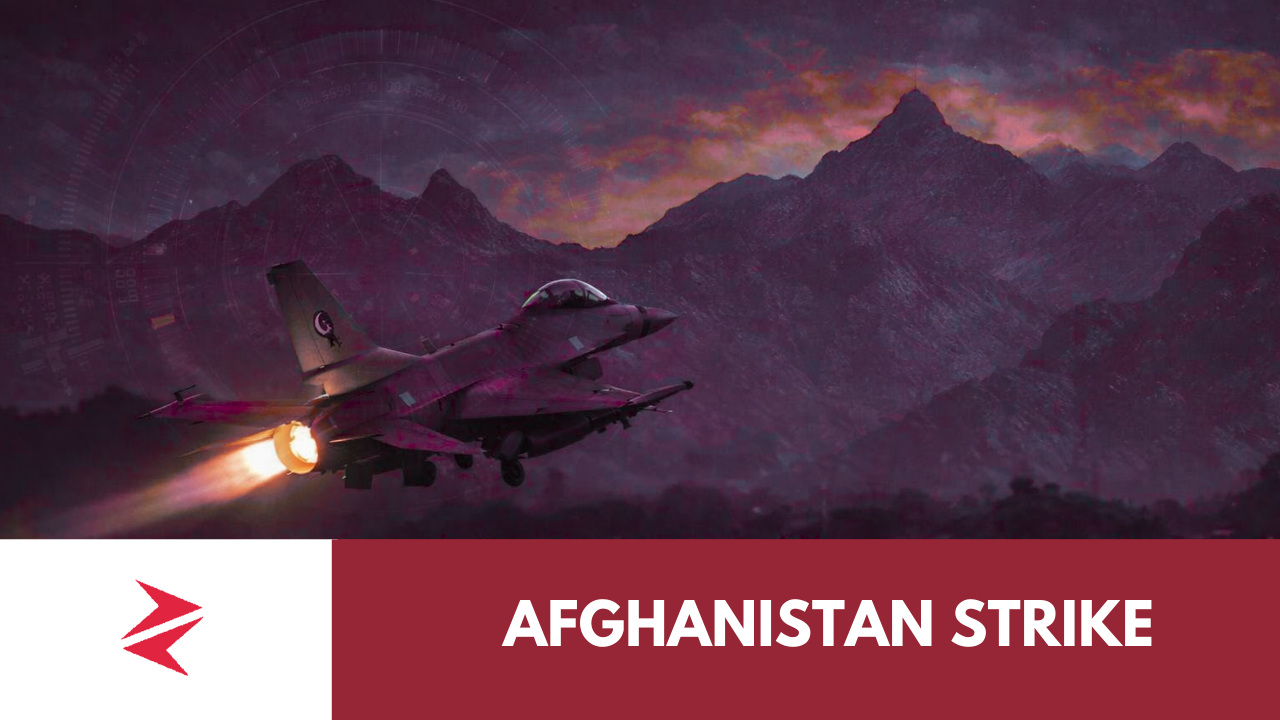
The immediate trigger for the strikes was a string of suicide attacks in Pakistan’s northwest, including Bannu and Bajaur. These were not abstract security incidents. They were targeted assaults on Pakistani personnel and territory. The Pakistani state publicly attributed responsibility to Tehreek-e-Taliban Pakistan (TTP) elements operating from Afghan soil. The claim was not new. For years, Islamabad has alleged that TTP networks use eastern Afghan provinces as safe havens.
Here the legal question emerges. Under international law, sovereignty is foundational. However, sovereignty is not absolute when a state’s territory is used to launch armed attacks against another state and that state is unwilling or unable to stop them. Article 51 of the UN Charter recognizes the inherent right of self-defense. The “unwilling or unable” doctrine, though debated, has been invoked in multiple modern counterterrorism contexts.
Critics argue that any cross-border strike violates Afghan sovereignty. Supporters counter that sovereignty carries responsibility. If armed non-state actors repeatedly cross a border to conduct lethal operations, and diplomatic protests fail, does the targeted state have no recourse?
This is not a simplistic moral binary. It is a collision between territorial integrity and self-defense.
But to understand why this conflict persists, we must revisit history.
On April 27, 1978, Afghanistan underwent the Saur Revolution. By December 1979, Soviet troops were deployed. The Soviet occupation devastated Afghan society. Millions were killed or displaced. Pakistan became host to millions of refugees. Weapons, ideology, and proxy warfare flooded the region. The militant infrastructure built during the anti-Soviet jihad did not evaporate when the Red Army withdrew.
Movements mutate. Networks fragment. Some factions rebrand. Some radicalize further.
Tehreek-e-Taliban Pakistan emerged in 2007 as an umbrella group of Pakistani militant factions aligned ideologically with Afghan Taliban elements but focused on destabilizing the Pakistani state. Its tactics have included suicide bombings, convoy attacks, assassinations, and assaults on security installations. The collapse of ceasefire attempts reignited violence in Khyber Pakhtunkhwa.

Parallel to its kinetic operations is its media arm: Umar Media. This is not a marginal Telegram channel. It is a structured propaganda apparatus producing multilingual content — Pashto radio broadcasts, Urdu magazines, stylized videos, martyrdom narratives. Modern insurgency is hybrid. Recruitment and morale are digital. Psychological warfare is strategic infrastructure.
Research from international counterterrorism studies consistently shows that propaganda networks are as critical as training camps. They recruit, radicalize, and sustain ideological cohesion. When strikes reportedly target media hubs or logistical nodes, they are targeting recruitment pipelines, not merely buildings.
This brings us to the information war.
Within minutes of the strikes, global platforms filled with polarized narratives. Some users framed the operation as decisive self-defense. Others called it reckless escalation. Some invoked Soviet trauma to condemn external intervention. Others compared it to Ukraine and Russia, arguing moral consistency demands opposition to cross-border aggression.
The language battle was immediate. Terms like “fighter,” “militant,” and “terrorist” were dissected. Words matter. Labeling shapes legitimacy. In asymmetric conflicts, narrative framing influences diplomatic pressure and domestic morale.
The Ukraine comparison complicates moral discourse. If Russian actions in Ukraine are condemned as unlawful aggression, consistency demands serious scrutiny of any cross-border strike anywhere. Yet moral consistency must also account for repeated non-state attacks launched from one territory into another. International law has not fully resolved how to balance these realities in the age of transnational insurgency.
Meanwhile, online discourse veered into extreme proposals: annex Wakhan, create buffer zones, establish “free states,” redraw borders permanently. These are expressions of anger, not viable policy. Territorial restructuring of sovereign states would trigger regional escalation involving China, Iran, Central Asia, and potentially global powers. In a nuclearized South Asia, strategic fantasies carry catastrophic risk.
Another layer of controversy involves political accusations. Claims that certain Pakistani leaders “supported TTP” are circulated without consistent evidentiary backing. Advocating dialogue with militants — controversial though it may be — is not equivalent to sponsoring them. Pakistan has conducted multiple large-scale military operations against TTP over the past decade, sacrificing thousands of soldiers and civilians. Political rhetoric should be examined critically, but allegations require evidence.
At the core lies a structural problem: militancy thrives in governance vacuums, economic stagnation, ideological polarization, and unresolved refugee dynamics. Security operations can degrade operational capability. They cannot alone erase ideological ecosystems decades in the making.
The Soviet invasion created trauma. The anti-Soviet jihad created armed networks. The U.S. intervention reshaped power balances. The Taliban’s return altered regional calculus again. TTP exploits cross-border geography and propaganda tools to sustain insurgency.
The Pakistan Air Force strikes must therefore be viewed within a continuum, not as an isolated flashpoint.
If the objective is deterrence, success depends on whether militant command structures are disrupted. If the objective is signaling, the message is that repeated attacks will trigger kinetic response. If the objective is domestic reassurance, the strikes aim to demonstrate state resolve.
But every action carries risk. Retaliation cycles can escalate. Miscalculation can spiral. The region has little margin for error.
The most decisive battlefield now is informational. Counterterrorism in the 2020s requires two-way engagement, digital literacy, exposure of militant hypocrisy, and credible state communication. Press releases alone do not counter stylized insurgent propaganda.
Experience tells us that kinetic superiority without narrative dominance produces only temporary stability. Expertise tells us that sovereignty debates must be grounded in legal doctrine, not emotion. Authority requires acknowledging historical complexity, including Pakistan’s own entanglements during the Soviet era. Trust is built through evidence-based argument, not partisan slogans.
Pakistan’s long-term security will not be secured by territorial expansion or rhetorical fury. It will be secured by institutional coherence, economic resilience, intelligence reform, regional diplomacy, and strategic communication.
The strikes in Afghanistan are a chapter, not the book.
Whether they mark deterrence or escalation depends on what follows: disciplined strategy or reactive politics.
The war on the ground is visible. The war of narratives is relentless. The outcome will be shaped by which side masters both.