


























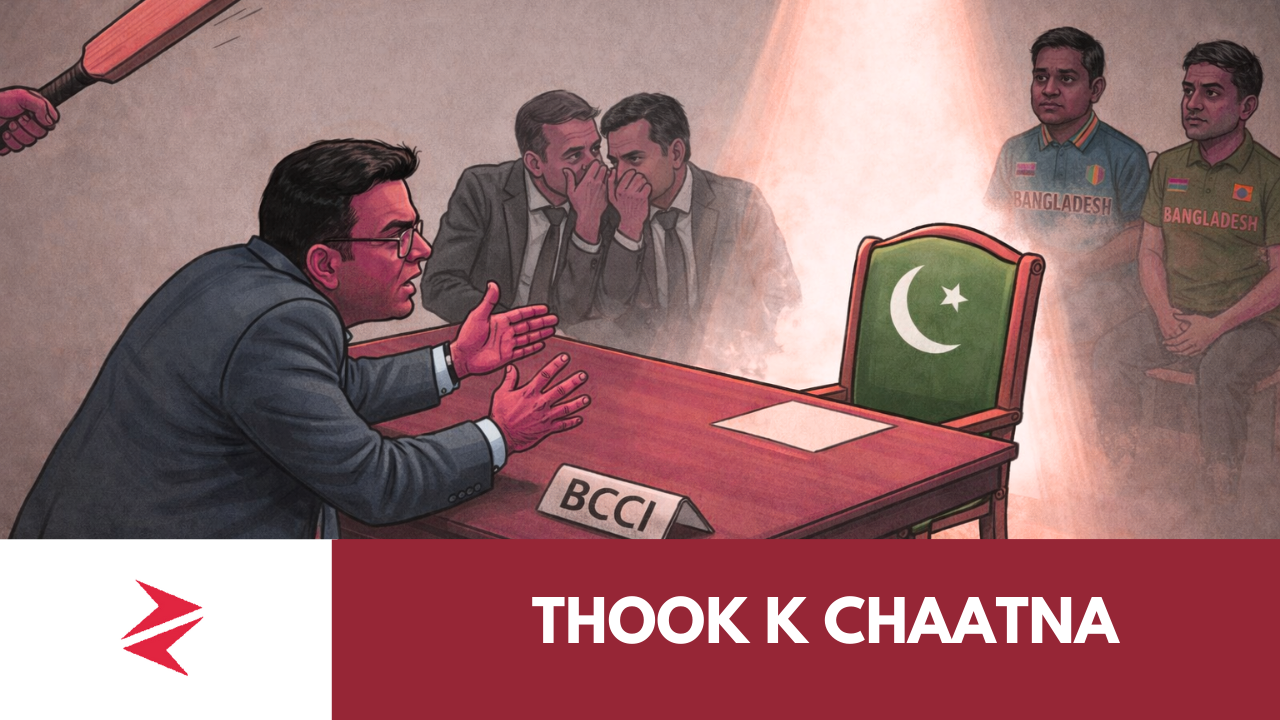
Share the post “India Begs Pakistan to Play 15th February Match: Why Pakistan’s Stand Is Rational”
PCB Chief Rejects ICC Sanction Threats: How Pakistan Turned a Boycott Into Leverage — and Forced the Cricket World to Blink
For days, the global cricket ecosystem tried to frame this as a dispute over a single match. It never was.
What unfolded around Pakistan’s threatened boycott of the February 15 India–Pakistan fixture at the ICC T20 World Cup 2026 was a stress test of governance—one that exposed where power actually resides when money, security, politics, and participation collide.
“Pakistan Will Not Be Intimidated”
The inflection point came when Mohsin Naqvi, Chairman of the Pakistan Cricket Board, publicly dismissed reports—originating largely from Indian media—that the International Cricket Council had warned Pakistan of sanctions if it skipped the India match in Colombo.
His response was not conciliatory. It was categorical.
“Pakistan will not be intimidated. Neither the PCB chairman nor the Prime Minister is moved by threats—and as for the Field Marshal, you already know. Threats won’t work.”
The reference to the Prime Minister and Field Marshal Syed Asim Munir was deliberate. This was not being positioned as a scheduling inconvenience or commercial disagreement. It was framed as a sovereign red line.
Crucially, there was—and remains—no official ICC statement confirming sanctions. The threats existed in leaks, headlines, and speculation. Yet even that speculative pressure triggered visible institutional movement.
The Bangladesh Trigger and the Solidarity Clause


This episode did not originate with India. It began with Bangladesh.
When Bangladesh exited the tournament early and faced the risk of losing participation revenue, Pakistan’s Prime Minister announced that Pakistan would boycott the India match in solidarity with Bangladesh. That single statement reframed the matter from bilateral rivalry to multilateral equity.
The reaction was immediate. The ICC stopped posturing and started engaging.
Within days, ICC officials were no longer signalling discipline. They were travelling—first to Lahore, then consulting Dhaka. What followed exposed the ICC’s commercial and political sensitivity.
What Pakistan and Bangladesh Actually Secured
Despite the noise, ridicule, and denial, the outcomes are now formally on record:
No financial, sporting, or administrative sanctions on the Bangladesh Cricket Board
Full ICC T20 World Cup revenue secured for Bangladesh
Hosting rights for an ICC event between 2028–2031 awarded to Bangladesh
No fines or penalties linked to T20 World Cup 2026
Pakistan’s revenue position improved
Future tri-series commitments involving Bangladesh
Quiet progress on a Pakistan–India World Test Championship fixture
Eventual confirmation that the Pakistan–India T20 World Cup match will go ahead
The irony is difficult to ignore. The same ecosystem that allegedly “warned” Pakistan ultimately accommodated Pakistan’s demands—not only for itself, but for a fellow Full Member.
The Public Meltdown Phase
While negotiations unfolded discreetly, public discourse spiralled.
Indian commentary oscillated between denial and derision:
Claims that the Board of Control for Cricket in India “doesn’t care”
Calls to permanently ban Pakistan
Abuse directed at ICC officials
Assertions that Pakistan would eventually “come begging”
At the same time, a more uncomfortable debate emerged inside Pakistan.
Some asked:
Why announce a boycott if negotiation was inevitable?
Why invoke the Prime Minister if the PCB would handle outcomes?
Was this solidarity, or transactional diplomacy?
Others countered:
Diplomacy is not theatre
Leverage only works if withdrawal is credible
Bangladesh didn’t secure protection through sentiment—it secured it because pressure was applied
Both interpretations coexisted. That tension is part of the record.
The “Begging” Accusation — and Why It Collapses
One recurring allegation was that the PCB “walked back” a political stance in exchange for money.
This misunderstands institutional power.
Pakistan did not retreat. It translated a political signal into structural outcomes:
Revenue guarantees
Hosting assurances
Sanction immunity
Protection for smaller boards
The fact that ICC delegations travelled to Lahore and Dhaka before final decisions were announced is instructive. This was not Pakistan seeking validation. This was the ICC seeking continuity.
India’s Silence vs the System’s Reality
Throughout the episode, the BCCI maintained official silence. No press briefings. No retaliatory statements.
But silence does not negate dependence.
Inside the system, one fact is uncontested: India–Pakistan remains the ICC’s most valuable fixture, and it exists only if Pakistan participates.
Without Pakistan:
Broadcast projections soften
Sponsorship valuations wobble
The “global” claim of the tournament weakens
That is why intermediaries moved. That is why multiple boards engaged. That is why Bangladesh’s case was resolved quickly.
The Final Picture: Messy, Revealing, Effective
This was not a clean victory. It was not a cinematic triumph.
It was messy.
It was uncomfortable.
It exposed fault lines within Pakistan’s own discourse.
It triggered rage and denial across Indian media spaces.
It forced the ICC to concede—without publicly admitting pressure.
Yet when the dust settled:
Bangladesh was protected
Pakistan’s leverage was acknowledged
Sanctions vanished
Revenue was redistributed
And the system recalibrated
Conclusion: Power Is Who the System Has to Convince
Pakistan did not “win” by boycotting a match.
Pakistan demonstrated that participation itself is power.
When a board can compel the ICC, multiple Full Members, and global broadcasters to negotiate simply by signalling absence, that board is not peripheral. It is central.
The optics may offend.
The process may discomfort.
But the outcomes are written plainly.
And in governance—not rhetoric—that is what endures.