











































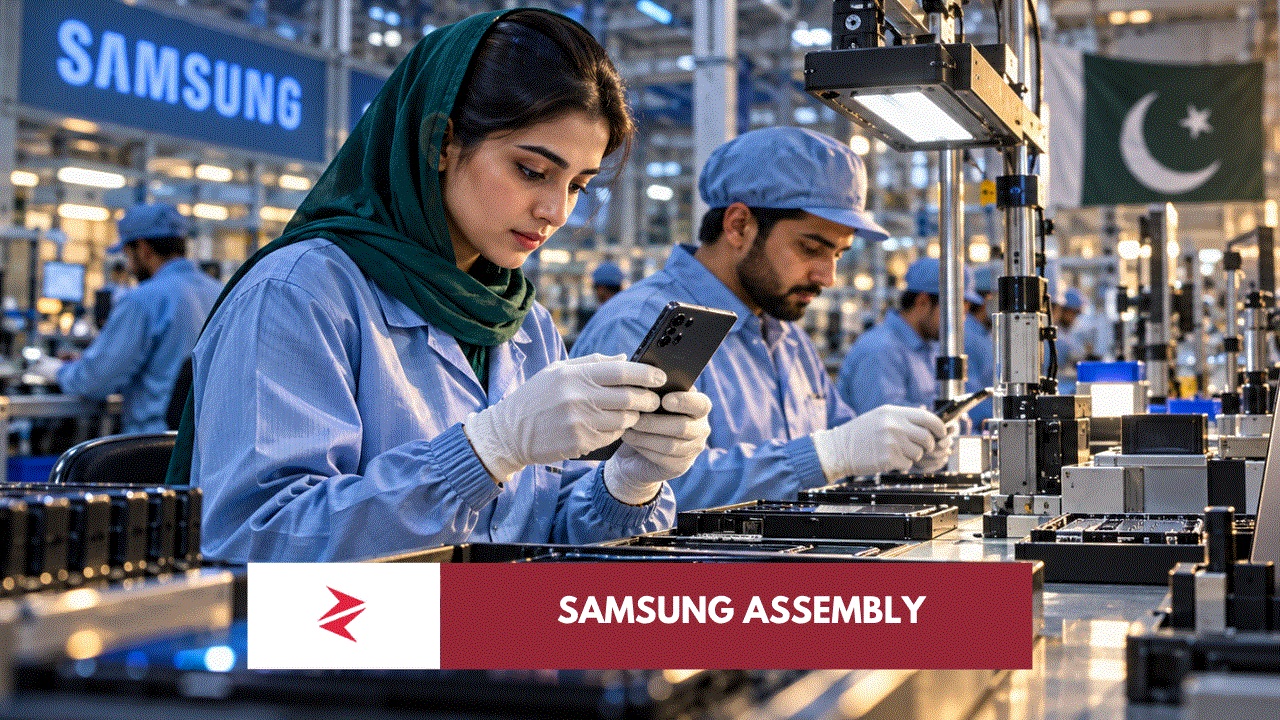
There is a familiar pattern in Pakistan’s economic conversation: a real policy failure becomes the starting point, an exaggerated conclusion becomes the headline, and eventually an entire industrial operation is declared dead while its production figures are still being reported. The recent argument over Samsung’s presence in Pakistan follows precisely this trajectory, moving from legitimate concerns about import restrictions, taxation and affordability to the much larger assertion that Samsung was forced to leave the country. The available evidence does not support that assertion: reported production data records 1.01 million Samsung phones locally manufactured or assembled between January and August 2026. That is evidence of production during the period, although it does not establish uninterrupted operations on every day or shift. thenews.pk
Pakistanis have every right to question why an industrial investment struggles, why a locally assembled phone remains expensive, and why successive economic decisions make planning so difficult for businesses. What we should resist is the habit of turning every setback into proof that Pakistan cannot produce anything worthwhile, particularly when company disclosures contradict the sweeping claims being circulated. A country gains nothing when criticism of its policymakers becomes casual contempt for its workers, technicians and industrial capability.
Samsung’s Pakistani Assembly Operation Is Documented
The starting point is the company overview published by Lucky Motor Corporation, which says its Electronics Division was established in July 2021 and local mobile-phone production began in December that year. Crucially, the company explicitly identifies the Galaxy S22 Ultra, S22 and S21 FE among the Samsung devices it has produced locally. This is a direct statement from the assembly partner, and it immediately undermines the suggestion that Samsung’s Pakistani operation has historically been confined to basic or low-end phones. LMC
The distinction matters because the online argument contains two separate claims: first, that Samsung left Pakistan, and second, that whatever remains consists exclusively of inexpensive devices incapable of competing with Chinese brands. The production record challenges the first; Lucky Motor’s named flagship models challenge the second. Neither finding means that every Samsung model, storage configuration or production batch sold in Pakistan is locally assembled. It means that an absolute claim requires stronger evidence than a dismissive reply on social media.
There is also a useful independent check. A Reuters report published in May 2026 described Lucky Motors as assembling Samsung-branded smartphones at its Karachi plant. Although the report primarily concerned its automotive business, that description provides additional contemporary evidence against the narrative of a completed Samsung exit. reuters.com
One Million Phones Through August, Not One Million in August
The statement that Samsung’s locally assembled units “reached one million in August 2026” needs a clear reporting period. The figure being reported is 1.01 million units across January–August 2026, rather than one million phones produced during August alone. Confusing a cumulative figure with monthly output makes a substantial achievement sound far larger than the evidence warrants, and defending Pakistan’s industrial progress should never require inflating its numbers.
The October 3 report in The News, citing PTA data compiled by Topline Research, provides the following picture. thenews.pk
| Indicator | Reported figure | What it measures |
|---|---|---|
| Samsung local production, January–August 2026 | 1.01 million units | Cumulative brand output |
| Total Pakistani local production, January–August 2026 | 18.66 million units | Manufacturing and assembly across brands |
| Change against January–August 2025 | Down 6% | Comparable eight-month periods |
| Total local production, August 2026 | 1.66 million units | One month across brands |
| August production change | Down 14% annually; down 57% monthly | Different comparison periods |
| Reported local share of demand, January–August | 87% | Eight-month supply-based measure |
| Reported local share of demand, August | 95% | Monthly measure |
Source: The News, citing PTA data compiled by Topline Research. Production figures should not be presented as retail sell-through or brand sales market share. thenews.pk
The report also attributes the sharp monthly decline partly to unusually elevated July production following purchases deferred ahead of the budget. A dramatic month-on-month percentage therefore needs context before it becomes evidence of industrial collapse. The sector can face weakness while still supplying most of the domestic market; those observations can coexist. thenews.pk
Another trap appears in comparisons between Samsung’s reported 1.51 million units in full-year 2024 and 1.01 million in the first eight months of 2026. Those periods have different lengths, so they cannot establish a like-for-like annual decline. A PhoneWorld report reproduces those figures but also gives some competing-brand totals that differ from the Topline-based reporting. That discrepancy is a reason to avoid merging the rankings into a supposedly definitive dataset without the underlying PTA table. PhoneWorld

The Import Crisis Was Real, but Its History Needs Precision
The supplied Urdu explanation correctly directs attention toward access to imported components, because local assembly cannot continue smoothly when essential kits and parts become difficult to finance or procure. However, “LC restrictions,” “import prohibition,” “customs clearance delays” and “permanent factory closure” describe different events, and collapsing them into one phrase conceals the mechanism that actually harmed businesses.

You May Also Like


Sports
The Afghanistan Premier League faces a NOC controversy as unverified claims suggest Pakistan, England and Australia are blocking player participation…


Politics & Governance
London’s Singh’s Dining faces a smear, cyber‑attack claims and alleged review‑bombing after the owner urged Gaza’s destruction, exposing Indo‑Pak warfare.


Opinions
A viral claim about an Emirati royal’s cocaine binge in London lacks police or court records, revealing a misinformation push that Pakistan calls to...


Opinions
The alleged Tesla Roadster flip using SpaceX‑style cold‑gas thrusters lacks any test data, video or telemetry, making the claim unverified and speculative.


Sports
The Rawalpindi T20I series ended 2‑1 to Pakistan, featuring Farhan’s 238‑run haul and a decisive 82‑run win, marking a pivotal moment for Pakistani cricket.


Technology & AI
Elon Musk’s alleged Roadster flight proves unverified, while Pakistan’s mobile‑phone factories produce 31.4 million units, showing real tech progress.


Opinions
A viral claim of 30,000 Iranian “ninja” graduates is unverified, exposing Tehran’s propaganda while Pakistan showcases transparent women’s sports programs.