












































Most advertisements do not fail because their offers are weak. They fail because the consumer’s brain has already discarded them before the headline, discount or call to action gets a fair hearing.
That is the uncomfortable reality behind modern advertising. Marketers spend days polishing copy, negotiating media budgets and debating whether a button should say “Buy Now” or “Learn More,” yet the decisive encounter may have occurred several milliseconds earlier, when the viewer’s mind silently judged the ad as familiar, confusing, inviting, irritating, premium, cheap, safe or irrelevant. Before the conscious mind interprets the message, the senses have already begun deciding whether the message deserves attention.
This is where sensory marketing stops being a fashionable phrase and becomes a serious advertising discipline.
What Sensory Marketing Actually Means
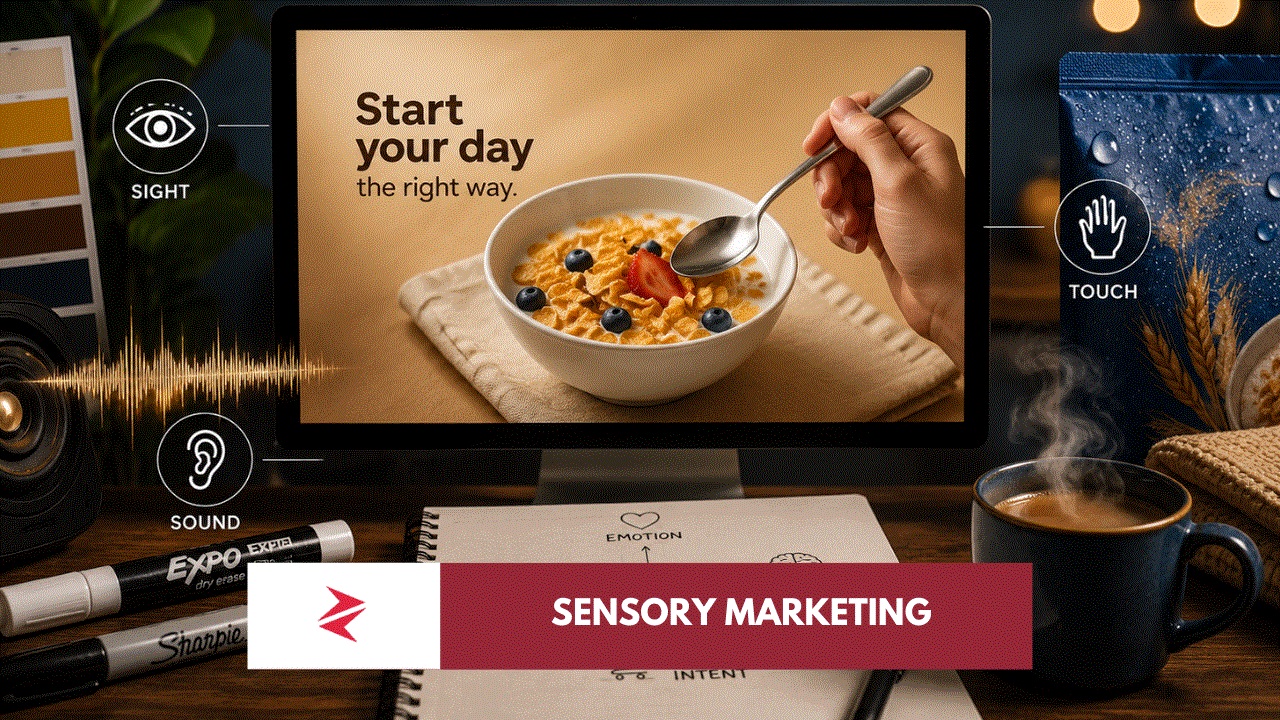
Sensory marketing is commonly associated with the smell of a bakery, the lighting inside a luxury store, the texture of expensive packaging or the background music used in a restaurant. That physical interpretation is correct, but incomplete. Sensory marketing also operates through screens, where a consumer cannot literally touch, smell or taste the product but can still imagine its weight, texture, temperature, sound and physical use.
Marketing scholar Aradhna Krishna defines sensory marketing as marketing that engages consumers’ senses and influences their perceptions, judgments and behaviour. Her research explains that sensory cues may also create subconscious associations with qualities such as sophistication, comfort or product quality.
The critical word is not merely sensation. It is association.
A photograph of condensation running down a cold bottle is visual, but the response it attempts to produce is tactile and thermal. A close-up of a marker moving across paper contains no physical sound when displayed as a static image, yet previous exposure may allow the viewer to imagine its scratch. A photograph of warm bread cannot release an aroma through a mobile screen, but its colour, texture and visible steam may activate remembered experiences of smell and taste.
The supplied course captures this mechanism through one central proposition: unforgettable advertisements do not merely communicate information; they create a sensory event that the mind wants to revisit. It explains the progression as sensation leading to attention, attention shaping feeling, and feeling supporting memory.
That chain matters because an advertisement cannot persuade a consumer who has already scrolled past it.
The Brain Filters an Advertisement Before It Interprets It
The human mind does not treat every advertisement as a document deserving careful study. It behaves more like a security checkpoint, rapidly screening visual and contextual signals before allowing a message deeper processing.
The first judgment is rarely, “Is this product objectively good?” The earlier questions are more basic. Does the advertisement stand apart from its surroundings? Can the main subject be recognised immediately? Is the composition orderly enough to process? Does anything create curiosity? Does the sensory atmosphere fit the product and the consumer’s current situation?
These judgments explain why sensory cues should not be dismissed as decoration. Colour, contrast, spacing, texture, movement, photographic angle and visual rhythm determine how the message enters the mind. The copy may explain the offer, but the sensory structure decides whether anyone stays long enough to read it.
The course illustrates this sequence through a useful framework:
| What the advertisement provides | What the consumer’s mind does |
|---|---|
| Sensory signal | Notices or ignores |
| Recognisable pattern | Organises or dismisses |
| Emotional atmosphere | Tags the experience as safe, exciting, curious or dull |
| Emotional relevance | Marks the experience as important |
| Repeated coherent impression | Stores the association in memory |
This does not mean every bright colour, dramatic movement or textured background will improve an advertisement. More stimulation is not automatically better. An advertisement with five colours, three fonts, two flashing offers and an urgent countdown may attract the eye while destroying comprehension.
Noise can interrupt attention. Coherence keeps it.
Social Hashtags: