










































Why Imagined Sensation Works in Digital Advertising
A screen cannot reproduce most physical sensations, but it can prompt the brain to simulate them.
Digital sensory marketing therefore depends heavily on mental imagery and embodied cognition: the tendency to understand objects and situations partly through simulations of bodily interaction. A product photograph becomes more persuasive when the viewer can effortlessly imagine holding, opening, pouring, wearing, tasting or operating what is shown.
Research on digital sensory marketing argues that new technologies can engage sensory processing and affect consumer judgment even when the experience remains mediated through a device. The opportunity is not limited to virtual reality or expensive interactive installations. Ordinary display advertisements, social posts, ecommerce photographs and short videos can all create simulated interaction through composition.
Consider the difference between these images:
A coffee cup photographed from a sterile overhead angle may look attractive. The same cup photographed from the seated customer’s viewpoint, with its handle naturally facing the likely user, may feel immediately usable.
A shoe displayed as an isolated catalogue object communicates appearance. A shoe shown bending slightly against a running surface communicates flexibility, movement and physical performance.
A fabric photographed from a distance communicates colour. A close-up revealing fibres, folds and pressure from a fingertip communicates softness or durability.
The advertisement has not added physical touch. It has removed the mental distance between seeing the product and imagining its use.
The Spoon Experiment and the Visual Depiction Effect
One of the clearest demonstrations of embodied advertising comes from research by Ryan S. Elder and Aradhna Krishna on what they called the visual depiction effect.
Their work examined whether subtle changes in product orientation could make an advertisement easier to simulate mentally. One example involved positioning an object so that it appeared more convenient for a participant’s dominant hand. Across four studies, product depictions that facilitated embodied mental simulation produced stronger purchase intentions than less convenient depictions. The researchers also found an important limitation: when the depicted product carried negative associations, easier mental simulation could reduce purchase intention rather than improve it.


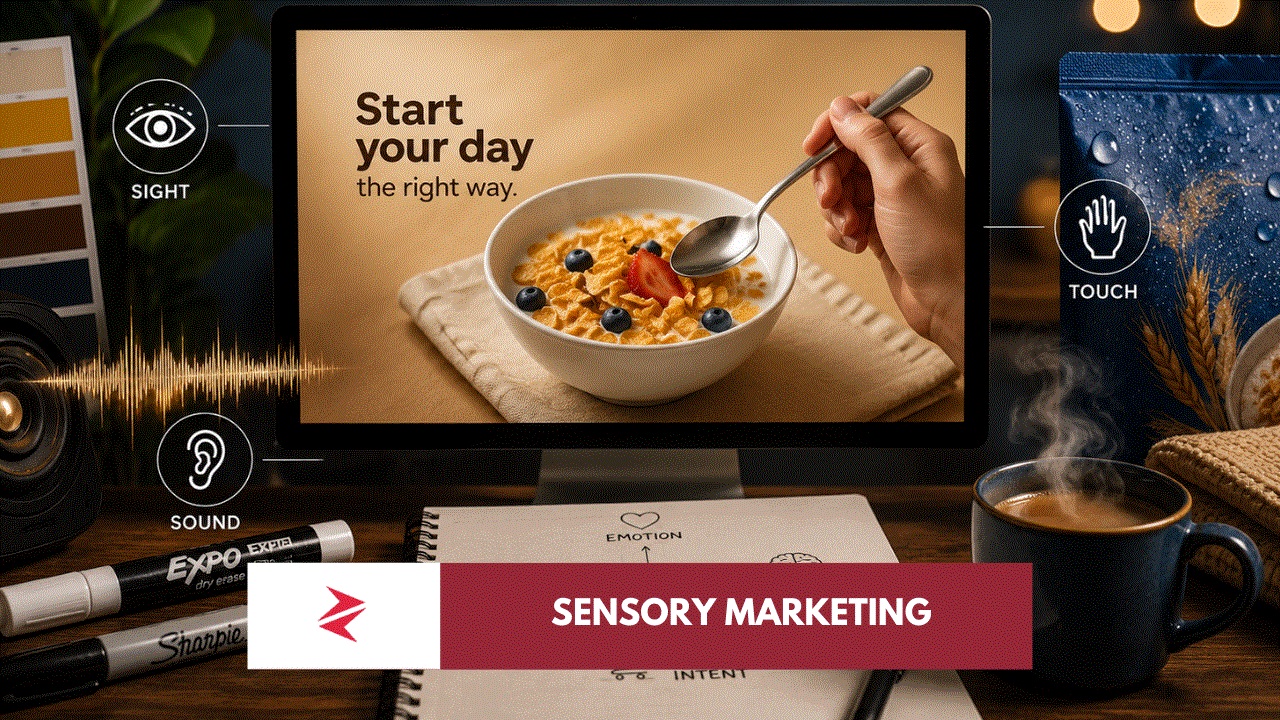
This makes the familiar cereal-bowl example far more significant than it first appears.
Place a spoon on the right side of a cereal bowl and a right-handed viewer may find it easier to imagine reaching for it. Place it on the left and the simulation may require slightly more mental adjustment. The change is tiny. The cereal remains identical. The offer remains identical. The copy remains identical. Yet the orientation can change how naturally the consumer imagines interacting with the product.
The correct conclusion is not that every spoon must be placed on the right. Left-handed consumers exist, cultural reading directions vary, device layouts differ and the effectiveness of any orientation depends on the product and composition. The lesson is that product placement should be treated as a testable behavioural variable rather than an arbitrary aesthetic choice.
Marketers routinely test headlines while leaving the physical logic of their photographs untouched. That is backwards. The object itself may be communicating before the headline begins.
What This Means for Pakistani Advertisers
Pakistan’s digital advertising market is crowded with copied templates, aggressive discount labels, excessive text and compositions created without serious thought about how a consumer would physically approach the product. A restaurant advertisement may show a spoon pointing away from the viewer. A mobile phone may be angled for visual drama but positioned awkwardly for imagined use. A clothing advertisement may display material without enough detail to communicate texture. A property advertisement may fill the frame with claims while giving the viewer no convincing sense of space.
The problem is not a shortage of talented designers. Pakistan has plenty. The problem is that many campaigns are still evaluated according to internal approval rather than consumer response. The owner likes green. The director wants the logo larger. The sales department wants six offers on the same canvas. Everyone contributes an instruction, and the consumer receives the visual equivalent of a committee shouting through one loudspeaker.
Sensory marketing demands a reversal. The starting question must be: What should the consumer feel before the advertisement asks them to act?
A Pakistani tea brand may want warmth, familiarity and hospitality. A financial application may need control, clarity and security. A fashion label may seek texture, movement and confidence. A solar or engineering company may require precision, durability and technical trust. Those sensory objectives should determine the lighting, composition, spacing, colour temperature, object orientation and pace of movement.
Designing without that central sensory intention produces decoration. Designing around it produces an experience.
Readers exploring the relationship between technology and creative production can continue through my analysis of AI tools for graphic designing and marketing, while the wider AI tools directory shows how automation is increasingly entering advertising, visual production and content personalisation. Those tools can accelerate execution, but they cannot replace the strategic decision about what the audience should sense.
A Practical Sensory Advertising Framework
Sensory marketing becomes useful only when it can be translated into decisions and measured through controlled experiments.