




































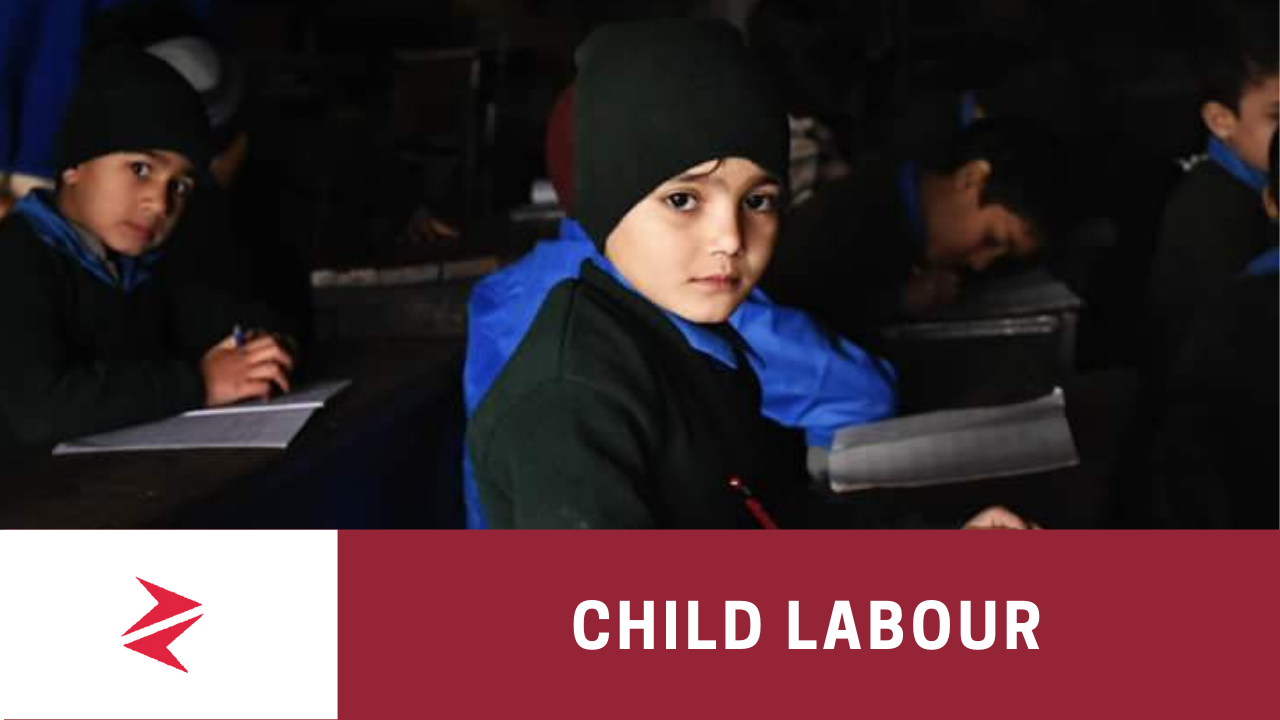
Child labor today represents the largest single cause of child abuse across the globe. Most of it takes place in economically less developed countries, and much is hidden. In a minority of instances, the effects of child labor may be neutral or even positive, such as helping out in a family-run shop during school holidays. In recent years therefore the emphasis has shifted from the abolition of all forms of child labor to the elimination of intolerable and hazardous child lab our.
Child Labour International Scenario
Child Labor is an important and serious global issue through which all and sundry countries of the world are directly or indirectly affected, but, it is very common in Latin America, Africa, and Asia. According to some, in several Asian countries’ 1/10 of the manpower consists of child Labor. In India the number of children between the ages of 10-14 has crossed above 44 million, in Pakistan, this number is from 8 to 10 million, in Bangladesh 8-12 million, in Brazil 7 million, whereas it is 12 million in Nigeria.
Child Labour Situation in Pakistan
In many societies like Pakistan, a significant number of children participate in economic activities and contribute substantially to household income. There is a wide range of economic activities performed by children aged 5-14 years. Some children may just help parents in housekeeping; some may sell newspapers or cigarettes in the streets, while some others may work in formal and informal establishments. So far, the extent of participation of these children has not been well-documented. Remember how Saga Sports Sialkot of Sufi Khursheed had a downfall in international orders for football? and how he asserted a Tetra Pak milk solution for its employees alongside JICA. Traditional household surveys and population censuses, the main sources of manpower statistics, usually set an age cut-off point of 15 years, below which participation in the labor force is not measured. Nevertheless, in the perspective of child labor; no detailed study on the basis of available data for the age group 10-14 has been done.
industrial revolution child labor
In Pakistan children aged 5-14 are above 40 million. During the last year, the Federal Bureau of Statistics released the results of its survey funded by ILO’s IPEC (International Program on the Elimination of Child Labour). The findings were that 3.8 million children age group of 5-14 years are working in Pakistan out of total 40 million children in this age group; fifty percent of these economically active children are in age group of 5 to 9 years. Even out of these 3.8 million economically active children, 2.7 million were claimed to be working in the agriculture sector. Two million and four hundred thousand (73%) of them were said to be boys.
Child Labor Laws
During the years 2001 and 2002, the government of Pakistan carried out a series of consultations of tripartite partners and stakeholders (Labour Department, trade unions, employers, and NGOs) in all the provinces. The objective was to identify the occupations and the categories of work, which may be considered as hazardous under the provisions of ILO Convention 182. As a result of these deliberations, a national consensus list of occupations and categories of work was identified, which is given below:
- Work inside underground mines over ground quarries, including blasting and assisting in blasting
- Work with power-driven cutting machinery like saws, shears, and guillotines, ( Thrashers, fodder cutting machines, also marbles
- Work with live electrical wires over 50V
- All operation related to leather tanning process e.g. soaking, dehairing, liming chrome tanning, deliming, pickling defleshing, and ink application
- Mixing or application of pesticides insecticide/fumigation.
- Sandblasting and other work involving exposure to free silica
- Work with exposure to ALL toxic, explosive, and carcinogenic chemicals e.g. asbestos, benzene, ammonia, chlorine, sulfur dioxide, hydrogen sulfide, sulphuric acid, hydrochloric acid, nitric acid, caustic soda, phosphorus, benzidine dyes, isocyanides, carbon tetrachloride, carbon disulfide, epoxy, resins, formaldehyde, metal fumes, heavy metals like nickel, mercury chromium, lead, arsenic, beryllium, and fiberglass
- Work with exposure to cement dust (cement industry)
- Work with exposure to coal dust
- Manufacture and sale of fireworks explosives
- Work at the sites where Liquid Petroleum Gas (LPG) and Compressed Natural Gas (CNG) are filled in cylinders.
- Work on glass and metal furnaces
- Work in the clothing printing, dyeing, and finishing sections
- Work inside sewer pipelines, pits, storage tanks
- Stone crushing
- Lifting and carrying of heavyweight especially in the transport industry ( 15b kg and above)
- Work between 10 pm to 8 am ( Hotel Industry)
- Carpet weaving
- Working 2 meters above the floor
- All scavenging including hospital waste
- Tobacco process ( including Niswar) and Manufacturing
- Deep fishing (commercial fishing/ seafood and fish processing
- Sheep casing and wool industry
- Shipbreaking
- Surgical instrument manufacturing especially in vendors’ workshop
- Bangles glass, furnaces
- Read: Pride of Punjab Dulla Bhatti – The Robinhood of Indian Subcontinent
- NATIONAL STATISTICS