
























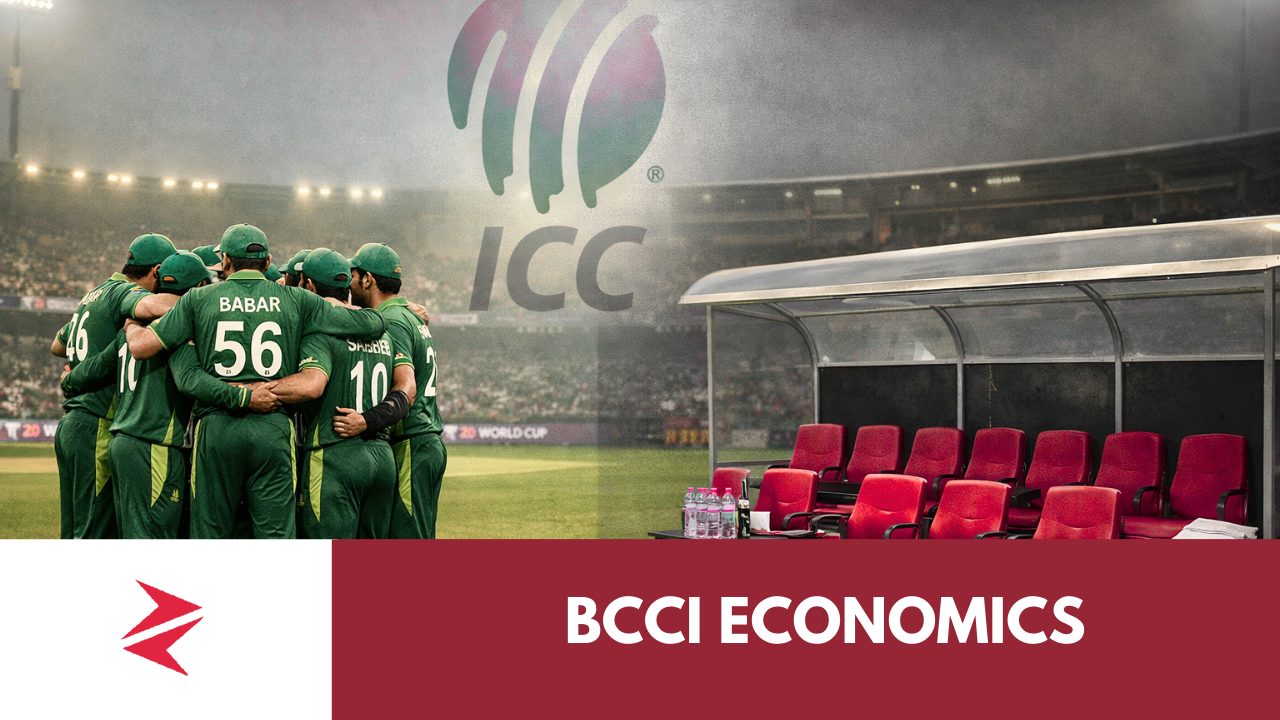
PakistanvsIndia is one of the greatest sporting events in the world, yet it continues to suffer from political interference that damages the spirit and pride of the game. In such an unfair environment, choosing not to play becomes an act of principle — an eye‑for‑an‑eye response to protect the integrity of the Sports — Muhammad Yousaf
If perceived threat is sufficient for India, documented escalation cannot be dismissed for Pakistan. A regulatory system cannot operate on two standards without losing moral coherence.
Power, Exposed
For once, Pakistan refused to play the obliging extra in a production it does not control.
This is the same ecosystem Sharda Ugra memorably described as the ICC functioning like the BCCI’s Dubai office—a line that stings because it carries truth. In modern cricket, power is no longer discreet. Pakistan chose to test where it actually resides.
The economics explain the discomfort.
An India–Pakistan match is not a fixture. It is an asset.
Remove it, and the tremors are uneven but immediate. A World Cup without India–Pakistan contests hurts most where investment is heaviest. JioStar alone committed roughly USD 911 million to ICC rights. The rest of the world’s broadcasters combined paid a fraction of that.
This is not market dominance. It is market dependence.
After losses during the ICC T20 World Cup 2024 in the USA and West Indies, JioStar reportedly explored walking away from ICC rights valued near USD 3 billion. There were no takers. The ICC is said to have intervened with substantial financial relief. When a governing body begins underwriting its broadcaster, the line between regulator and stakeholder has already dissolved.
Within this structure, Pakistan’s value is often downplayed publicly—but never misunderstood privately.