


































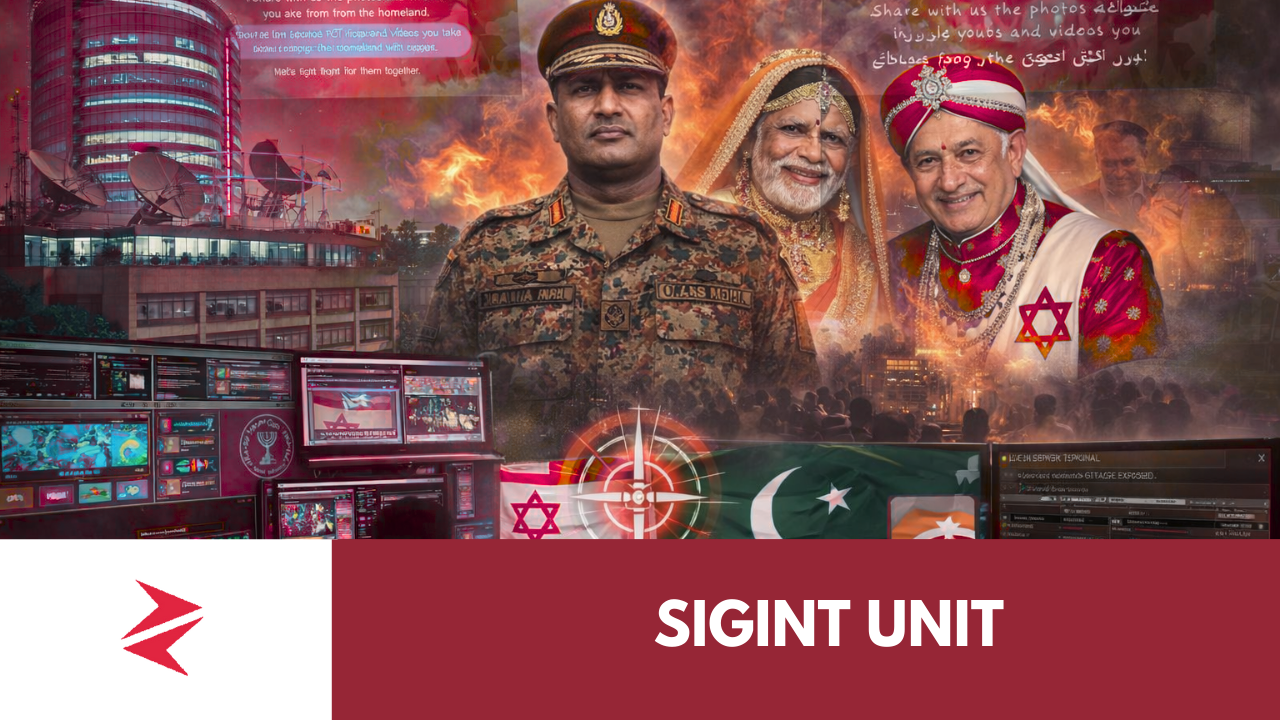
This proves the message was rendered using foreign digital asset libraries, confirming an external threat actor. pic.twitter.com/G9uNaEUddG
— Daniel Zahoor (@DanielZahoor) March 1, 2026
What was also observed: a Mossad-themed advertisement creative appearing on Geo’s website interface. Programmatic advertising systems operate on real-time bidding. If an advertiser targets a region and wins the bid, the ad displays. That alone does not prove infrastructure compromise. It proves ad inventory placement.
What remains unverified: any official attribution to Mossad, RAW, the Israeli Intelligence Corps SIGINT unit, or any state actor. Social media users asserted such links, but no forensic report, no telecom regulator briefing, and no independently published technical audit has confirmed that attribution. Claims are claims. Evidence requires packet logs, uplink access traces, frequency override analysis, credential breach mapping, or confirmed satellite control interference.
Technically, how could such a broadcast override occur? There are several plausible vectors. Attackers could compromise uplink credentials of satellite operators if internal systems were infected through malware and later sold on dark web forums. They could exploit weak access control in broadcast playout systems. They could attempt frequency hijacking in the satellite spectrum — a far more complex and visible operation that leaves traceable RF anomalies. Or, as cybersecurity professionals correctly pointed out, leaked administrator credentials reused across systems could allow limited message injection without penetrating military-grade satellite command channels.
It is critical to understand that a television channel transmission is not equivalent to a military satellite command system. PakSat uplink operations are distinct from strategic defense infrastructure. Conflating the two is theatrics, not analysis.
Now consider the psychological layer. Within hours, hashtags like #Pakistan, #PakistanArmy, #ISPR, #Israel, #Pakistan🇵🇰, #IranRevoIution2026, #PakistanAfghanistanWar, #BoomBoomTelAviv, #TehranUnderAttack began circulating alongside emotionally charged commentary calling for retaliation, cyber warfare, and even missile escalation. Some posts demanded that Pakistan “hack back.” Others framed it as insider sabotage. A few declared it fake news. The digital battlefield became louder than the original broadcast.
This is precisely how modern information warfare functions — not merely through intrusion, but through amplification. A disruption becomes a narrative. A narrative becomes outrage. Outrage becomes polarization. Polarization becomes internal destabilization. Whether the origin was foreign or domestic, the objective of such psychological triggers is to test reaction thresholds, measure digital cohesion, and observe institutional response latency.
Then there is the Iran angle. Some of the Mossad-themed creative was in Persian, calling on Iranians to share media from the homeland. This led to speculation that the attackers “mixed up” Pakistan and Iran. That interpretation assumes incompetence. A more strategic reading would ask: was the juxtaposition accidental, or was it intended to generate exactly this confusion — to suggest template-based propaganda and create suspicion of pre-prepared influence campaigns? Without technical forensics, we do not assert motive. But we do acknowledge pattern recognition in hybrid warfare environments.


Parallel to this, geopolitical speculation erupted regarding Iran’s internal power structure after Khamenei’s reported death scenarios being discussed online. Commentators debated IRGC versus Artesh, clergy decline, succession mechanics, and whether external intelligence agencies might exploit fissures. Such analysis may be intellectually stimulating, but it remains hypothetical unless corroborated by concrete intelligence disclosures. We must not transform theoretical geopolitical chessboard models into confirmed operations.
From a Pakistani lens, the priority is not dramatic accusation. It is institutional resilience. If credentials were compromised, they must be rotated immediately. If uplink systems were probed, access logs must be audited. If programmatic ads were exploited for psychological provocation, ad filters must be tightened. Digital hygiene is not optional. It is national defense.