

























This is a developing story, and much of what you’re seeing online is noise. Leaks, half-truths, and speculative hot takes are not strategy. States move quietly. Announcements come later.
What is clear: serious military-diplomacy is underway, stretching from South & East Asia to MENA, led jointly by Pakistan’s civilian and military leadership. Libya is not a sideshow. It is the board.
Ground Reality, Not Conference Rooms
Libya is not governed by UN press releases.
Libya is governed by territory, arms, oil, and command structures.
Engaging Khalifa Haftar is not defiance of the international system—it is recognition of reality. Pakistan’s doctrine has always been clear:
Talk to power centers, not paper factions.
Stability before politics. Institutions over militias.
By that metric, this engagement is not controversial. It is strategic realism.
The Visit That Changed the Equation
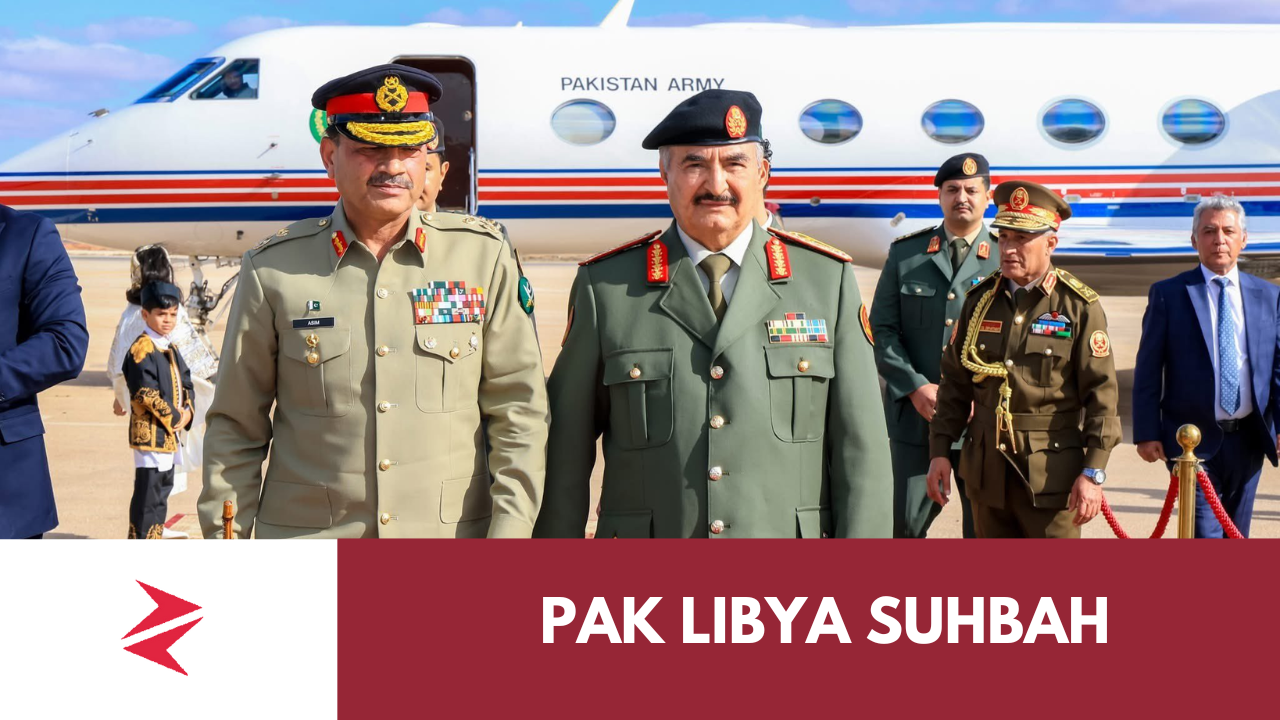
Pakistan’s Chief of Defence Forces & Army Chief, Asim Munir, led a tri-services delegation to Libya, receiving the highest level of state and military protocol. Officers from all three services were present. This was not symbolic. It was operational.
Behind closed doors, Pakistan didn’t posture.
It closed.
🇵🇰🇱🇾 BREAKING: A $4.6 Billion Defence Deal
Pakistan and the Libyan National Army have signed what is being described as the largest defence agreement in Libya’s history, valued at $4.6B.
What’s in the package:
-
16 × JF-17 Thunder multirole fighter jets
-
12 × Super Mushak trainer / light attack aircraft
-
44 × Haider Main Battle Tanks
-
Advanced infantry mortar systems
-
1 × multi-purpose naval vessel
-
Full-spectrum training for Libyan armed forces
This isn’t just hardware. It’s doctrine transfer, force regeneration, and institutional rebuilding.
Libya, By the Numbers (That Actually Matter)
-
Haftar’s LNA controls ~65% of Libyan territory
-
Secures ~75% of oil assets
-
Commands ~50,000 fighters
-
Backed regionally by UAE, Egypt, with Russian linkage
-
Western bloc centered in Tripoli remains Qatar-aligned
Pakistan didn’t “pick a side.”
Pakistan picked control, continuity, and capacity.
The Bigger Play: More Than Weapons
Defence is only the first layer.
Multiple tracks are now active:
-
Oil & energy cooperation
-
Security coordination
-
Business & infrastructure investment
-
Human resource and training pipelines
Pakistan isn’t just selling arms.
Pakistan is embedding itself into Libya’s future state architecture.
The Timing Matters
This all unfolds as the US imposes new visa bans, including a full restriction on Libyan citizens—a move reshaping travel, families, and business corridors overnight.
Where others are closing doors, Pakistan is opening channels.
Why This Is a Master Stroke
-
Positions Pakistan as a serious defence exporter beyond South Asia
-
Breaks Western monopoly over North African security markets
-
Strengthens Pakistan’s relevance across MENA geopolitics
-
Converts military credibility into economic and energy leverage
Quiet diplomacy. Hard power. Long memory.
This isn’t optics.
This is statecraft.
Official announcements will come, Insh’Allah.
Until then, understand this much: Pakistan didn’t just enter Libya.
Pakistan won the room.