



































Share the post “Motorway Justice: Pakistan does not need Western applause to know what justice means.”
A foreign billionaire says “Bravo Pakistan” and suddenly some people forget to ask why Pakistan was being framed in the first place.
That is the trap. The issue was never only whether Elon Musk praised Pakistan after the Lahore High Court upheld the death sentences of the motorway gang rape convicts. The issue is that a Western-facing headline, a viral post, and a global celebrity reaction together pushed Pakistan into the same old theatre: Pakistan as a country needing validation, Pakistan as a country needing shaming, Pakistan as a country whose pain becomes someone else’s political weapon. Wrong.
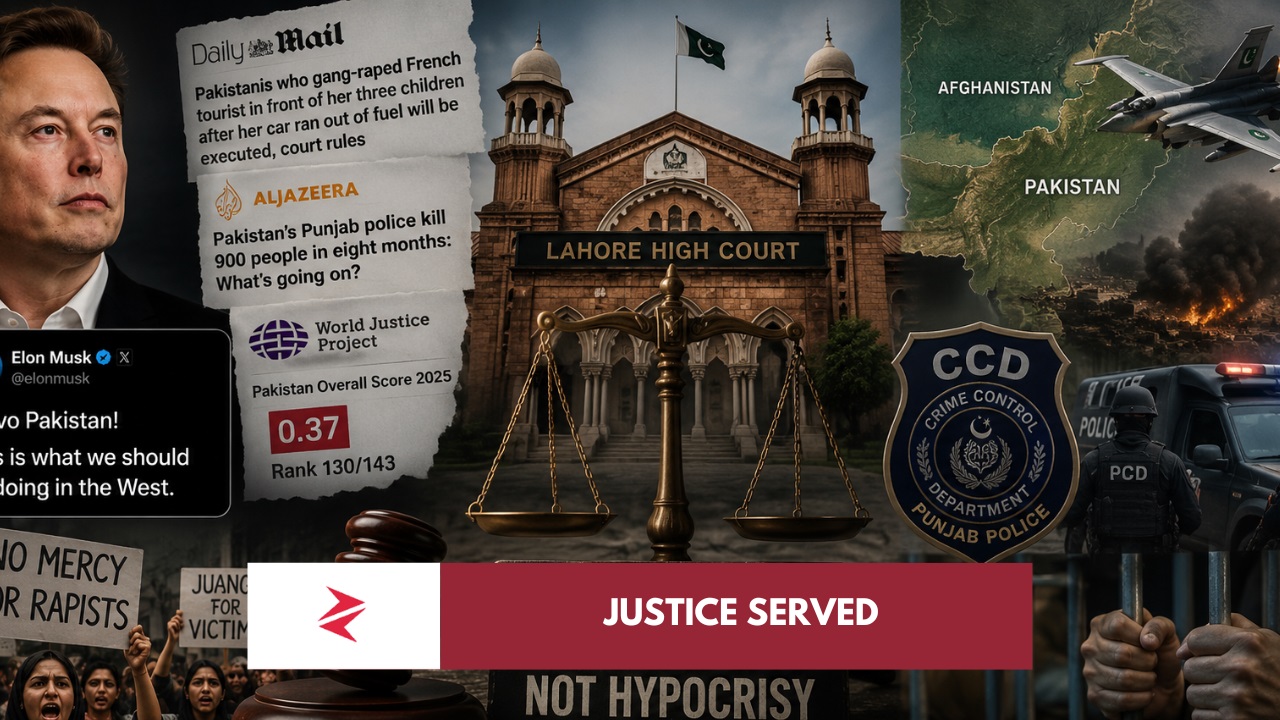
The Lahore High Court dismissed the appeals of Abid Malhi and Shafqat Bagga and upheld the death sentences awarded in the 2020 motorway gang rape case, where the woman was attacked while travelling with her children after her vehicle ran out of fuel near Gujjarpura. The Express Tribune reported that the Anti-Terrorism Court had sentenced both men to death in March 2021, and that the LHC maintained the punishment after rejecting their appeals. This is the central fact. Not Elon. Not Daily Mail. Not Western outrage farming. The Pakistani court acted through Pakistan’s legal process. The crime happened here, the outrage erupted here, the investigation happened here, the trial happened here, and the punishment was upheld here.
What happened next is where the narrative became polluted. A headline circulating internationally described the victim as a “French tourist,” while Pakistani users pointed out that the victim was a Pakistani citizen with French nationality or papers, not simply some detached foreign visitor passing through a barbaric land. That distinction matters because Western media framing often turns crimes in Pakistan into civilizational propaganda while similar crimes elsewhere are treated as isolated criminal events. A Pakistani woman’s suffering was made more marketable when packaged as a foreign tourist horror story. That is not journalism. That is narrative laundering.
Elon Musk’s reply then turned the issue into a global spectacle. According to The Economic Times, Musk reacted to a post about the verdict with the line, “Bravo Pakistan! This is what we should be doing in the West.” The same report states that the Lahore High Court upheld the death sentences, rejected the convicts’ appeals, and that investigators used mobile phone data and DNA evidence in the case. The problem is not that Pakistan received praise. The problem is that Pakistanis must be intelligent enough to separate genuine recognition from opportunistic applause. When a global figure uses Pakistan to make a point about the West, that does not automatically make him a friend of Pakistan.
Claim Statement: Pakistan’s legal system, not Elon Musk’s approval, delivered the decisive development in the motorway gang rape case.
The uncomfortable truth is that many Pakistanis are so exhausted by global humiliation that even a two-word compliment from a powerful Western tech figure feels like oxygen. But self-respecting nations do not outsource moral confidence. We can support the court’s decision, support severe punishment for rapists, and still refuse to let Pakistan be reduced to a prop in someone else’s culture war. Pakistan does not need Elon Musk to certify that rape is evil. Pakistanis already knew that in 2020 when the country erupted in anger, when citizens demanded justice, and when the victim-blaming remarks around the case disgusted ordinary people.
The second layer is even more sensitive: Punjab’s Crime Control Department. Some posts are now trying to connect the motorway rape verdict with CCD operations and the argument that Punjab has become tougher on rapists, armed robbers, kidnappers, extortionists, and violent criminal gangs. The idea has political force because ordinary citizens are tired of criminals roaming freely while victims spend years fighting paperwork, intimidation, weak prosecution, and court delays. The uploaded screenshots also show the other side of the debate: human-rights criticism, allegations of extrajudicial killings, and the disturbing claim that Punjab police killed hundreds in alleged encounters over eight months. Al Jazeera’s reported frame, visible in the supplied screenshot, says human-rights groups alleged record extrajudicial killings by a Punjab police unit set up to combat organised crime.
This is where the article must be honest. Firm justice through courts is strength. Encounter culture without transparent evidence, independent review, and judicial accountability is a different matter. Pakistan cannot fight rape, kidnapping, extortion, and gang violence by weakening the very rule-of-law foundation it claims to defend. The World Justice Project screenshot supplied in the source material shows Pakistan’s 2025 overall rule-of-law score at 0.37 and global rank at 130 out of 143. That is not a foreign insult to be dismissed casually. It is a warning that Pakistan’s justice problem is not only about punishment after outrage; it is about process, trust, prosecution quality, police credibility, court capacity, and the citizen’s belief that the system works even when cameras are not watching.













Wan AI
June 4, 2026 at 11:04 pm
One of the strongest points in this piece is the distinction between seeking international validation and upholding domestic accountability on Pakistan’s own terms. The article also raises an important question about why Western reactions are often treated as the benchmark for legitimacy when sovereignty and justice should ultimately be judged by transparent institutions and public trust at home. It would be interesting to explore further how Pakistan can strengthen that internal credibility regardless of outside narratives.