













































For years, investors have repeated one of Peter Lynch’s most quoted observations:
“Insiders might sell their shares for any number of reasons, but they buy them for only one: they think the price will rise.”
While no single insider transaction guarantees future returns, exceptionally large open-market purchases deserve attention because they reveal how those closest to a business are allocating their own capital.
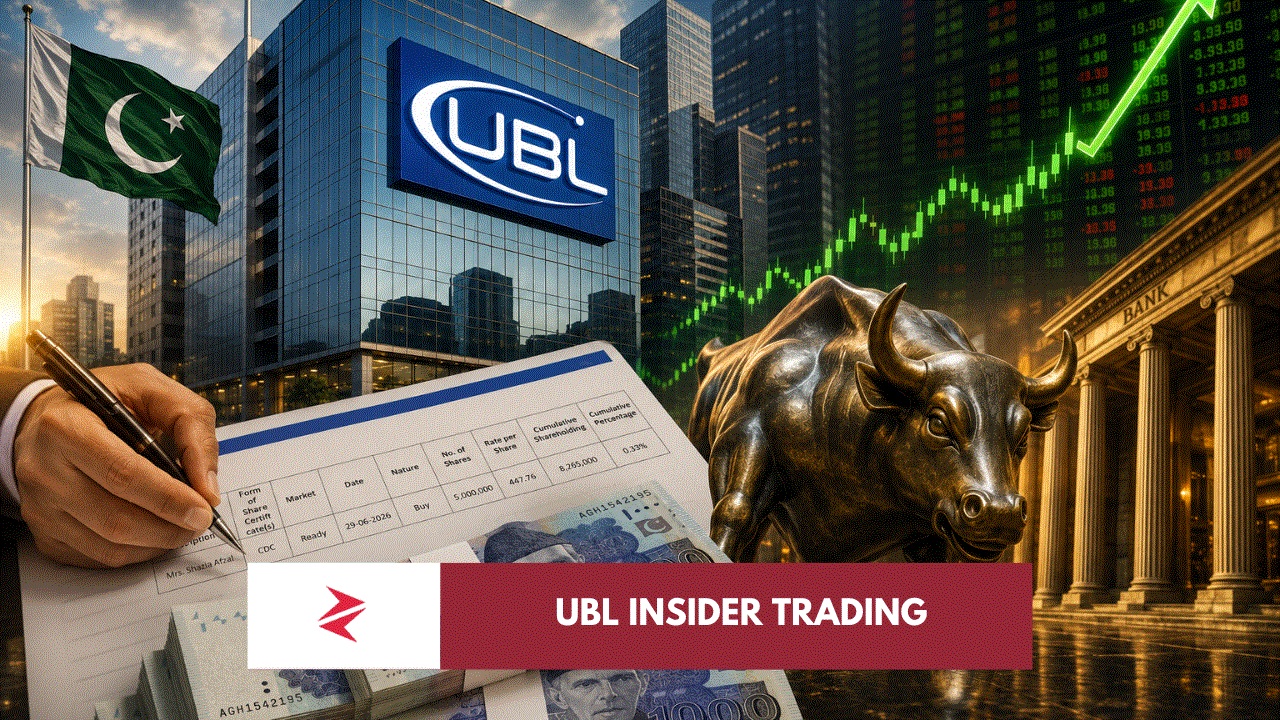
That is exactly why United Bank Limited (UBL) became one of the biggest talking points on the Pakistan Stock Exchange (PSX) after the disclosure that Mrs. Shazia Afzal, spouse of UBL President and CEO Muhammad Jawaid Iqbal, purchased 5 million UBL shares in the ready market on 29 June 2026 at Rs447.76 per share, representing an investment of approximately Rs2.24 billion.
Unlike stock options or employee compensation, this was an open-market purchase executed at prevailing market prices. Following the transaction, her cumulative holding increased to 8.265 million shares, equivalent to 0.33% of UBL’s issued share capital.
The timing was equally notable. Within days, banking stocks led the entire PSX higher, with UBL becoming one of the largest contributors to the KSE-100 Index rally.
The Transaction at a Glance
| Item | Details |
|---|---|
| Buyer | Mrs. Shazia Afzal |
| Relationship | Spouse of UBL President & CEO |
| Shares Purchased | 5,000,000 |
| Purchase Price | Rs447.76 |
| Total Investment | Approximately Rs2.24 billion |
| Purchase Date | 29 June 2026 |
| Total Holding After Purchase | 8,265,000 shares |
| Ownership | 0.33% |
The transaction was disclosed through the official insider trading notification submitted to the Pakistan Stock Exchange in accordance with regulatory requirements.
Why Markets Pay Attention to Insider Buying
Corporate insiders possess a deeper understanding of their businesses than any outside investor. They regularly see lending trends, deposit growth, digital banking metrics, capital adequacy, provisioning requirements, customer acquisition, branch expansion, and management forecasts long before annual reports reach shareholders.
That does not mean insiders are always correct, nor does it mean investors should blindly copy every trade.
However, when someone from the closest possible insider circle voluntarily commits more than Rs2 billion of personal capital into a listed company, it naturally attracts market attention because it reflects a very high level of confidence.
Markets often interpret such purchases as a positive signal regarding management’s view of long-term business prospects.

Importantly, this remains a sentiment indicator rather than proof of future earnings.
Why Were Banks Leading the PSX Anyway?
The insider transaction occurred against a broader backdrop of renewed strength in Pakistan’s banking sector.
On the same trading session, banking stocks dominated index performance.
Among the largest contributors were:
| Bank | Approximate Index Contribution |
|---|---|
| UBL | 482 points |
| MEBL | 472 points |
| BAFL | 176 points |
| HBL | 162 points |
| MCB | 111 points |
Banks accounted for a significant share of the KSE-100’s advance, reinforcing that institutional money was rotating back into financials rather than chasing speculative momentum.
This aligns with a broader theme discussed repeatedly throughout this publication: sector rotation.
Understanding Sector Rotation
Many retail investors assume that the entire stock market moves together.
Professional investors know otherwise.
Capital rotates.
When one sector becomes relatively expensive or faces weaker earnings expectations, institutions gradually move into sectors where valuations, earnings visibility, or dividend yields appear more attractive.
Recent market leadership has shifted through several heavyweight sectors:
- Banks
- Oil & Gas Exploration
- Fertilizers
- Cement
- Technology
The KSE-100 itself often appears stable because different heavyweight sectors take turns carrying the index.
Understanding this rotation is usually more valuable than attempting to predict daily index movements.
Why Banks Continue to Attract Institutional Capital
Despite interest rates beginning to normalize, Pakistan’s banking sector continues to enjoy several structural advantages.
1. Sovereign Balance Sheets
Banks remain among the largest holders of Government of Pakistan securities.
As long as sovereign credit remains intact, banks continue generating predictable investment income while maintaining strong liquidity.













