


































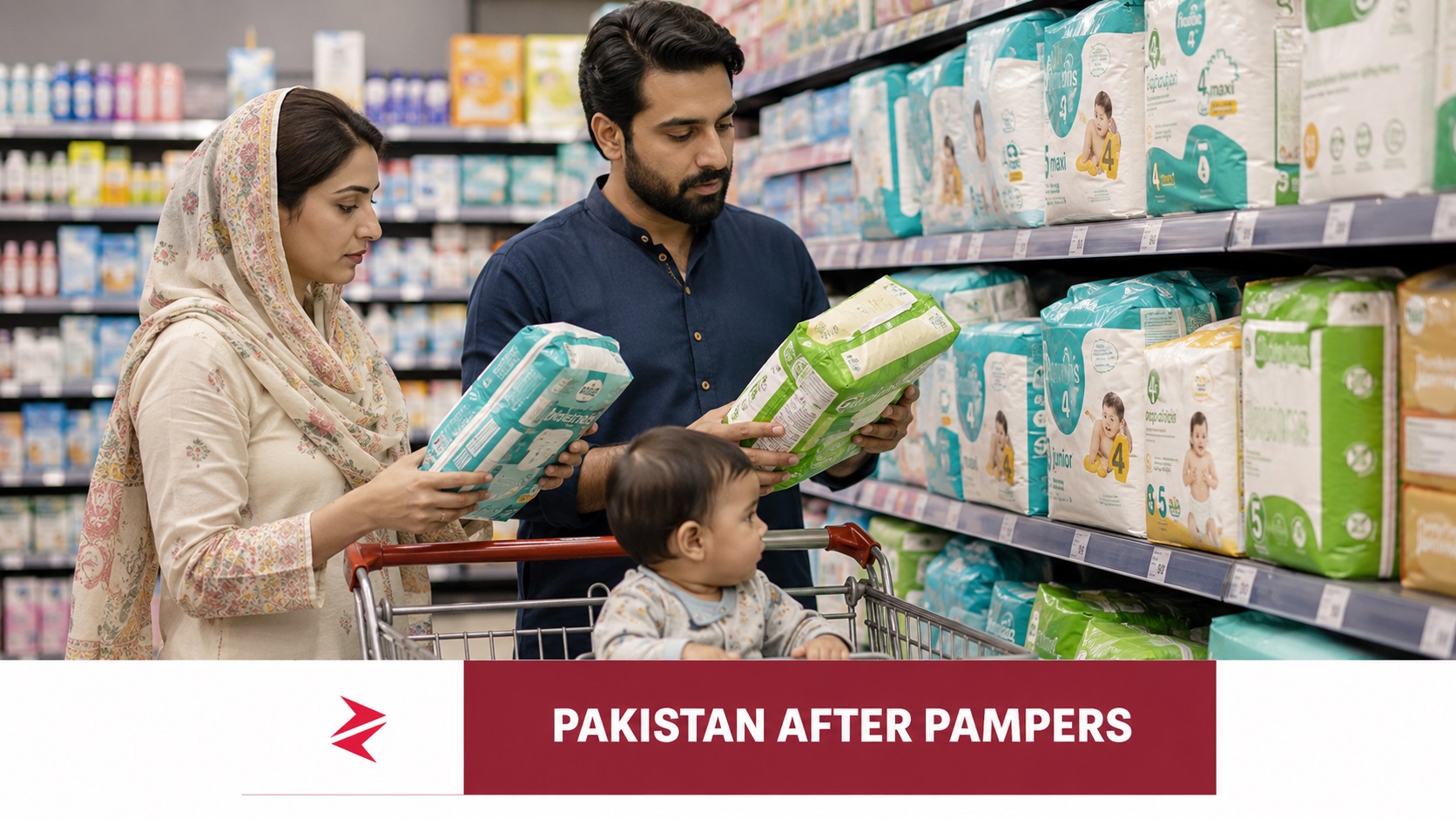
A multinational company can leave Pakistan, but a Pakistani baby cannot postpone needing a clean, dry and properly fitted diaper. That is the uncomfortable reality behind the Pampers shortage: while social media argues about governments, foreign investment and brand loyalty, parents are conducting expensive experiments on their children’s skin—one leaking packet, one disturbed night and sometimes one painful rash at a time. I once suggested Carebaby to famous RJ Imran Hassan but now it is a different choice for my kids.
The prevailing claim that “Pampers has been banned” is incorrect. The more precise reality is that Procter & Gamble decided to discontinue its direct business in Pakistan as part of a wider restructuring. P&G said it would wind down local manufacturing and commercial activity while relying on third-party distributors to continue serving Pakistani consumers. That means Pampers has not necessarily disappeared permanently, but regular locally managed supply has been disrupted and future availability may depend upon independent importers, distributors, exchange rates and retail margins. Reuters reported the operational wind-down and third-party distribution plan in October 2025.
That distinction matters because parents should not mistake old inventory, grey-market imports or intermittently available stock for evidence that the original supply chain remains intact. Pampers packets may continue appearing at selected stores, but they may be more expensive, older, imported from different markets or simply unavailable in a particular size when urgently required.
The Pampers Debate Is Really About Trust
Anyone dismissing this as outrage over a luxury brand is missing what parents are actually saying. They are not merely demanding a familiar logo. They are asking whether the replacement will remain dry overnight, fit without slipping, keep its fastening tabs attached, avoid bunching between the legs and stop moisture from sitting against an infant’s skin.
Pampers built loyalty because many households found its absorbency, inner dryness and fit predictable. Other parents report that Pampers itself leaked or caused irritation, proving an important point: there is no universally perfect diaper because babies have different body shapes, urine output, movement patterns and skin sensitivities. Yet consistency remains commercially valuable, and this is where several Pakistani-market brands still receive sharply contradictory reviews.
The parent discussion examined for this article repeatedly returned to Molfix, Canbebe, Carebaby, Tifal, Good Care, Rocket Premium and Momse. Molfix attracted the largest volume of positive recommendations, but it also attracted some of the strongest complaints about leakage and an alleged decline in quality. Carebaby earned repeated praise for performance but was described by at least one parent as comparatively rough. Canbebe was called the closest substitute for Pampers by some users, while others complained about fastening and rashes. Good Care produced the same split: excellent for one child and an overnight leakage problem for another.
Tifal appeared less frequently than the established brands, but its endorsements were unusually emphatic. Parents described it as the option to try after becoming frustrated with several alternatives, and recommendations pointed buyers towards the company’s website. That makes Tifal a credible trial candidate, not a scientifically proven winner.
What Pakistani Parents Are Reporting
The following summary counts the visible, distinct recommendations and complaints in the supplied parent discussion after removing repeated copies of the same thread. It represents observational consumer feedback, not laboratory testing or a nationally representative survey.