










































A hijacking alert cannot become a harmless cockpit anecdote simply because the aircraft reportedly landed safely, and an Israeli fighter scramble cannot become permission to enter Saudi airspace merely because somebody invokes an emergency. The Flydubai flight diverted toward Tabuk on Wednesday morning has produced two separate questions—what happened aboard the aircraft, and what military response followed—and collapsing them into one reassuring explanation would leave the most consequential part of the story untouched.
Early reporting on September 30, 2026, described a Dubai–Tel Aviv flight transmitting emergency codes before diverting to Saudi Arabia, with subsequent reports placing its safe landing at Tabuk. Accounts then shifted toward an alleged altercation between pilots, while some circulating updates referred instead to passengers. That shifting explanation deserves scrutiny, but the publicly accessible evidence reviewed for this article does not establish a hijacking, a staged emergency, Pakistani involvement in the diversion, or Israeli fighter entry into Saudi airspace. Those distinctions give the questions their force rather than weakening them. theaustralian.com.au
What the flight record shows—and what it cannot explain
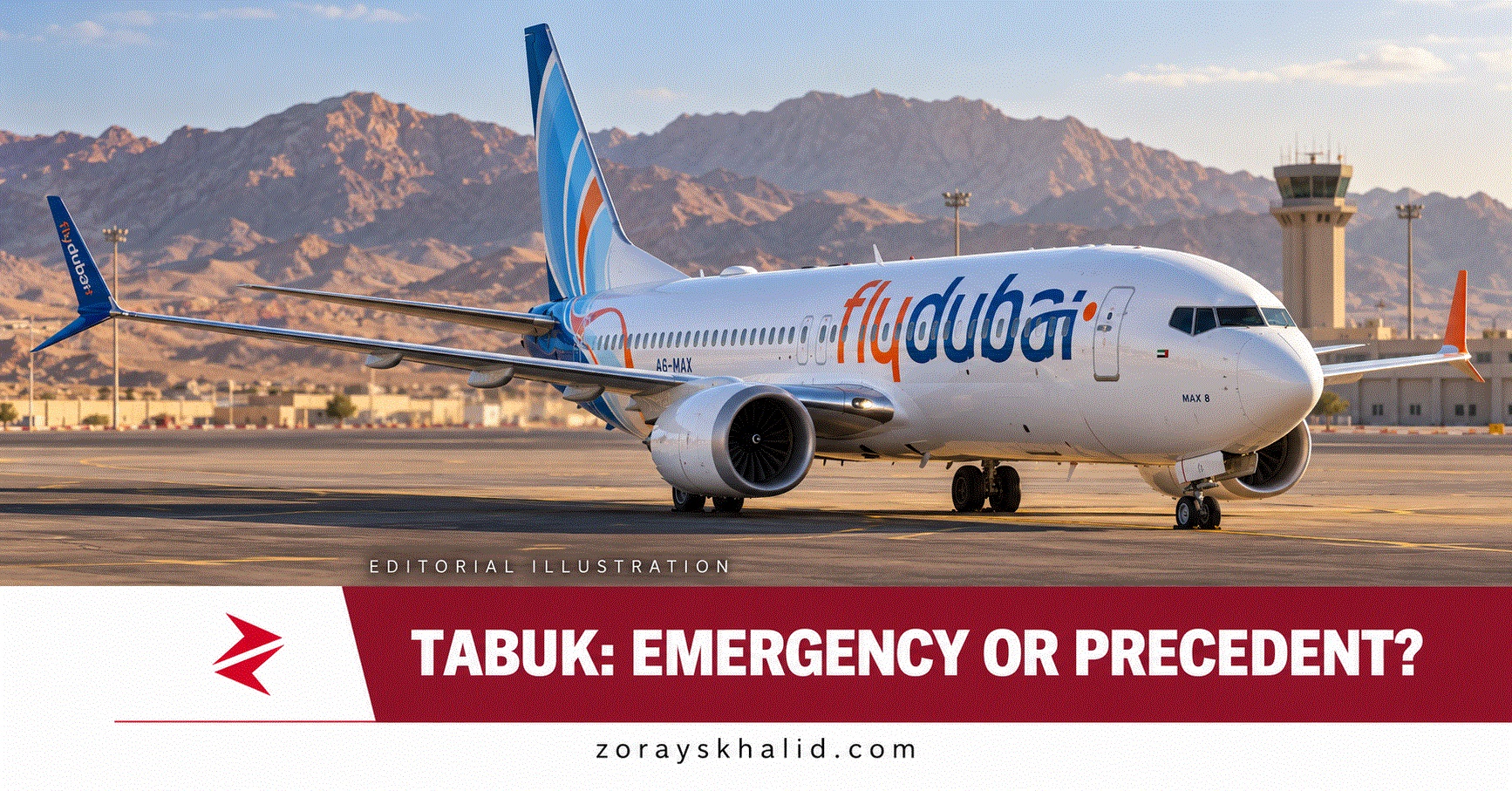
The available flight-tracking captures identify FZ1073, callsign FDB1073, and aircraft registration A6-FKF, with the aircraft described as a Boeing 737 MAX 8. One display shows code 7500 at 14,885 feet, while another shows code 7700 near Tabuk at a barometric altitude of 5,475 feet. The map capture carries a September 30 timestamp of 06:28 UTC, equivalent to 11:28 a.m. in Pakistan. These are observations from displayed tracking data, rather than an authenticated reconstruction of the complete flight or an explanation of cockpit events.
| Detail | Available evidence | What it establishes |
|---|---|---|
| Flight identity | Tracking displays identify FZ1073/FDB1073 and A6-FKF | The identity shown in the captures |
| Code 7500 | Visible on one tracking display | A displayed unlawful-interference alert, without establishing its cause |
| Code 7700 | Visible on another display near Tabuk | A displayed general-emergency alert |
| Flight path | Map shows a substantial course change | A deviation in the displayed track |
| Tabuk landing | Subsequent published reports describe a safe landing | A reported outcome, pending a directly verified operational account |
| Alleged fight | Early accounts disagree about pilots or passengers | An unresolved explanation |
| Israeli fighter response | News reports describe a scramble | Reported activation, without establishing Saudi airspace entry |
The captures do not independently settle the order of every code change, the reason for selecting either code, or the aircraft’s complete communications history.
The technical meaning of the codes is clear. The FAA’s distress and urgency guidance explains that code 7500 triggers a special emergency indication and that controllers seek confirmation from the pilot, while 7700 signals a general emergency. Its transponder guidance also warns pilots to avoid inadvertent selection of emergency codes during routine changes. A displayed code therefore warrants an immediate operational response, but it is not, by itself, a completed investigation into why that response became necessary. faa.gov
The “fight” explanation requires evidence, not repetition
An altercation between pilots would be a serious safety allegation, particularly if it affected aircraft control or communications; describing it as something pilots ordinarily do would trivialize the very conduct that needs investigation. A passenger disturbance, a cockpit confrontation and an inadvertent code selection are different explanations, each requiring different supporting evidence. None should acquire official status merely by passing through enough influential accounts.
One published update on the alleged pilot altercation explicitly stated that neither Flydubai nor an aviation authority had confirmed that account. Other updates used more categorical wording, illustrating how quickly attribution can disappear while a story travels. At the time of this review, a directly accessible Flydubai statement establishing a fight between the pilots had not been verified. businessupturn.com
That does not prove somebody invented the explanation, and it does not identify the people repeating it as intelligence agents. It does establish why readers should demand the original statement, its exact wording and the authority issuing it. The broken mechanism is visible: an alarming report attracts attention, an anonymous explanation provides relief, and repetition can turn that relief into apparent certainty before investigators have supplied a public account.
Why Tabuk matters to Pakistan—and why proximity is insufficient
Pakistan’s defence relationship with Saudi Arabia makes the regional setting strategically relevant. Reuters reported in May 2026 that Pakistan had deployed troops, fighter aircraft and an air-defence system to the kingdom, citing security and government sources. That wider commitment gives Pakistan a legitimate interest in how regional airspace incidents are handled, but it does not establish that Pakistani personnel were stationed at the relevant Tabuk facility or participated in this emergency. reuters.com
Published Pakistani accounts also document PAF participation in Saudi exercises, including Spears of Victory 2025 at King Abdul Aziz Air Base. Such reporting cannot be repurposed as proof of a current deployment at Tabuk, much less an interception or authorization decision involving Israeli aircraft. app.com.pk

For Pakistani readers, the sharper issue is the scope of Pakistan’s commitments and the boundaries of command, rather than an unsupported claim that “our air force was there.” The questions explored in what the Makkah defence pact promises remain relevant: who makes the decision, which obligation applies, and what specific event activates it? Pakistan’s strategic interests deserve answers precise enough to survive beyond a social-media cycle.
Netanyahu’s UAE visit supplies context, not causation
The political backdrop is real. Euronews reported that the UAE confirmed Netanyahu’s September 27 visit to Abu Dhabi, citing WAM’s account of his meeting with President Mohamed bin Zayed Al Nahyan. This supports the reported meeting; it does not independently establish the exact invitation arrangements or a connection between that visit and the Flydubai incident. Euronews
The editorial concern is that highly visible diplomatic engagement can make deeper security accommodation appear increasingly ordinary, while the public receives little explanation of its limits. That is a political interpretation, not evidence that this flight emergency was engineered. The same need to distinguish documented conduct from sweeping conclusions runs through our analysis of regional airbases, Israel and sovereignty.
Civilian access is already established; fighter access is the unresolved question
There is a crucial historical correction to the normalization argument: Saudi Arabia announced in July 2022 that its airspace would be open to qualifying civilian carriers. A Dubai–Tel Aviv commercial flight over Saudi territory therefore does not, by itself, create a new civilian-access precedent. Reporting on GACA’s announcement described access for carriers meeting the authority’s overflight requirements. saudigazette.com.sa