























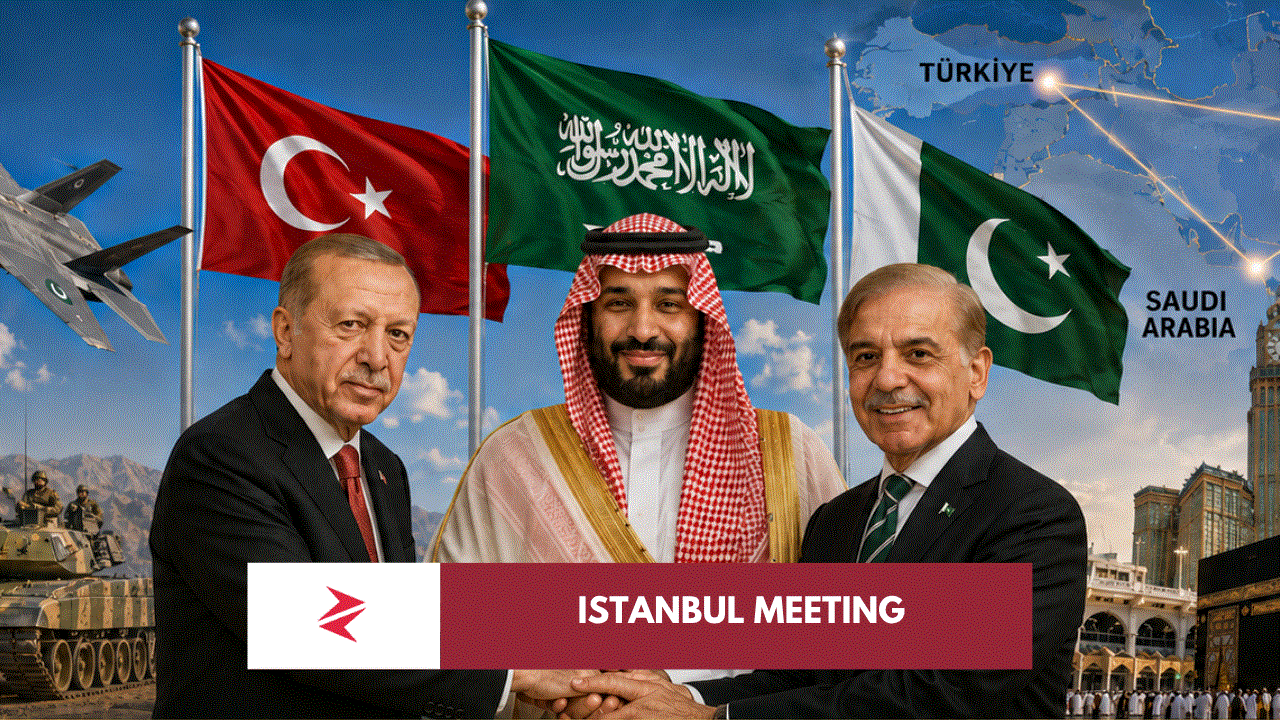
The easiest way to misunderstand the Makkah Defence Pact is to keep staring at the photograph from Makkah. Three leaders, three flags, another declaration about brotherhood, another promise of Muslim cooperation and, according to the cynics, another document destined to gather dust while the region burns. That interpretation became considerably harder to defend on August 31, because Türkiye, Saudi Arabia and Pakistan did something alliances that are merely ceremonial usually avoid: they began constructing institutions.
The first Strategic Political and Defence Committee meeting has now taken place in Istanbul, so the “tomorrow” language circulating across social media on August 30 has already been overtaken by events. Foreign ministers, defence ministers and senior military leadership from all three states sat together under the framework signed in Makkah on August 7, and the resulting decisions went materially beyond another round of diplomatic pleasantries. Reuters reports that the three countries agreed to establish a permanent secretariat in Saudi Arabia, with its first secretary-general to come from Pakistan for a three-year term. Anadolu likewise reported that the meeting produced the alliance’s first formal institutional decisions and that the three governments committed themselves to making their collective deterrence and defence mechanisms more credible and effective.
That matters enormously.
A treaty becomes strategically serious when it develops memory, bureaucracy, planning cycles, implementation mechanisms and people whose actual jobs depend upon turning words into capability. Pakistan, Türkiye and Saudi Arabia have now started that process.
What Pakistan, Türkiye and Saudi Arabia Actually Created
The August 7 Makkah Joint Defence Agreement contains the sentence that transformed an otherwise conventional cooperation document into something potentially historic: an armed attack against one signatory is to be regarded as an attack against all three. Reuters and Anadolu both reported the collective-defence formulation, while the Turkish account explicitly described the agreement as strengthening collective deterrence and making clear that the arrangement complements, rather than automatically replaces, the signatories’ existing alliances.
That distinction should be understood properly. Calling it “NATO-style” is useful shorthand because the political logic resembles Article 5, but it does not mean Ankara, Riyadh and Islamabad have recreated NATO overnight, complete with integrated commands, predetermined force packages, published contingency plans and seventy years of institutional practice. The public agreement does not yet tell us precisely what each state must contribute when the clause is activated, who determines whether an incident constitutes aggression, whether military intervention is automatic, or how escalation would be controlled.
That is exactly why Istanbul mattered.
The committee exists to convert ambiguity into procedure.
| Strategic element | What is now confirmed | Why it matters for Pakistan |
|---|---|---|
| Collective-defence clause | Attack on one is regarded as attack on all three | Raises the political cost of aggression against Pakistan |
| Strategic Political and Defence Committee | Foreign, defence and military leadership now meet institutionally | Pakistan gains direct access to two major regional defence systems |
| Permanent secretariat | To be established in Saudi Arabia | Gives the pact continuity beyond individual leaders |
| Initial secretary-general | Pakistani for the first three-year term | Pakistan enters the institutional structure at its centre, not its margins |
| Military interoperability | Explicit agenda item | Opens pathways for exercises, doctrine, communications and operational coordination |
| Defence industry | Production, technology and capability cooperation | Potentially connects Turkish industrial depth, Saudi capital and Pakistani operational experience |
| Counterterrorism | Included in the cooperation agenda | Directly relevant to Pakistan’s security environment |
| Expansion | Additional states remain possible | Could eventually turn a trilateral mechanism into a broader regional architecture |
The most striking detail is not simply that Pakistan is present. Pakistan is getting the first secretary-general.
For a country routinely described in lazy foreign commentary as merely supplying troops, manpower or nuclear symbolism to wealthier Muslim states, that institutional placement matters. It suggests Islamabad is participating in designing the architecture rather than merely providing muscle after somebody else writes the rules. Reuters reported that the secretariat will be based in Saudi Arabia but initially headed by a Pakistani for three years.

That is not decorative symbolism. It is bureaucratic influence.
The Three Countries Bring Very Different Things to the Table
Social media reduces the arrangement to a crude formula: Saudi money, Turkish technology and Pakistani nuclear weapons and manpower. The slogan is catchy, but the real complementarity is considerably deeper.
Türkiye possesses arguably the Muslim world’s most mature modern defence-industrial ecosystem, spanning unmanned systems, missiles, electronic warfare, naval platforms, armoured vehicles, aerospace and increasingly indigenous propulsion. The Turkish platforms shown alongside discussion of this pact—the KAAN fighter programme, electronic-warfare aircraft concepts, modern armour and TEI propulsion programmes—illustrate the direction Ankara has deliberately taken: strategic autonomy through manufacturing rather than permanent dependence on imported finished systems.
Saudi Arabia brings far more than a chequebook. SIPRI estimates Saudi military expenditure at $83.2 billion in 2025, up 1.4 percent year-on-year and enough to make it the world’s eighth-largest military spender. The more significant long-term question, however, is how much of that spending can be redirected into domestic and jointly owned production rather than remaining a transfer mechanism to Western contractors.
Pakistan brings something neither partner can simply purchase: decades of operational military experience, a mature strategic deterrent, a large defence establishment, an established aerospace and missile ecosystem, training institutions, a battle-tested air force and a geopolitical position connecting South Asia, China, Central Asia, the Arabian Sea and the Persian Gulf.
Pakistan’s defence budget is dramatically smaller than India’s—SIPRI puts 2025 Pakistani expenditure at $11.9 billion compared with India’s $92.1 billion—yet raw expenditure has never fully explained Pakistan’s deterrence value.
That discrepancy is itself instructive. Pakistan has been forced for decades to extract disproportionate strategic capability from comparatively limited resources.