




































Connect with Zorays

Hi, what are you looking for?

World Affairs

Why Indian Call Center Scams Shouldn’t Happen Again: Policy, Tech, and Enforcement Roadmap

Comprehensive reforms in telecom, payments, and law enforcement can stop high-loss call center scams and prevent them from recurring in the U.S.

In 2020–2024, fraud targeting U.S. residents surged sharply, with call center-style scams becoming one of the largest sources of consumer losses. Viral claims (such as widely shared graphics asserting “Indian call center scammers stole $50.5 billion”) highlight public frustration, but the real answer requires careful parsing of data, structural vulnerabilities, and actionable reforms. Tackling these scams is not just about policing voice calls — it’s about reengineering the financial, telecom, and legal frameworks that make fraud so profitable. Only then can we credibly assert “this won’t happen again.”
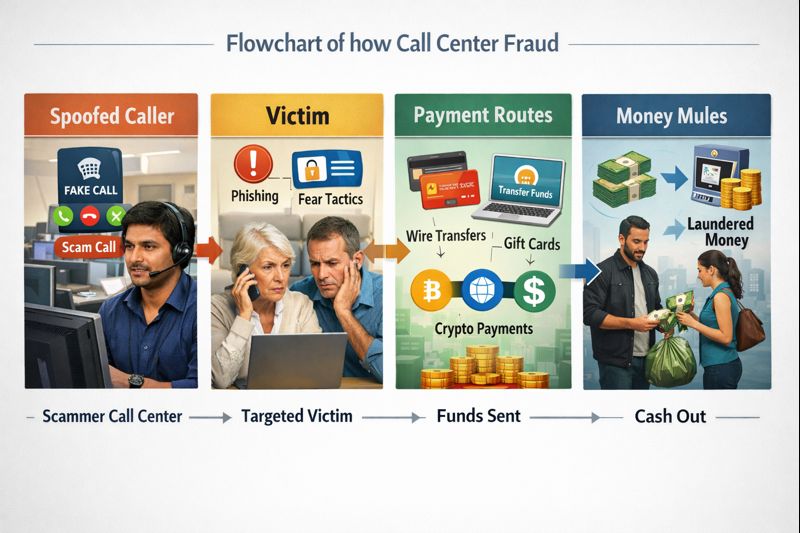
Flowchart of how call center fraud operates, from spoofed calls to payment routes

The Federal Trade Commission (FTC) and FBI’s Internet Crime Complaint Center (IC3) report that Americans lost tens of billions annually to fraud, with phone-based and impersonation scams rising alongside digital payment methods. In 2024, the FTC stated that reported loss to fraud topped $12.5 billion, a historic high. The FBI IC3 reported over $16 billion in internet-crime losses in 2024, driven by schemes that often start as call scams and transition into remote access and fraudulent payments. These official figures show the scale far exceeds prior years and underscore systemic risks. (Source: FTC annual data; FBI IC3 annual reports.)

Understanding Operational Mechanics of Call Center Scams
The business model for call center fraud typically includes:


READ:   Gwadar's Tomorrow: A Glimpse into the Future

Pages: 1 2 3

Click to comment

Leave a Reply

Your email address will not be published. Required fields are marked *

You May Also Like

World Affairs

Pakistan, Saudi Arabia and Türkiye’s Makkah defence pact creates collective deterrence—but its Article 51 limits and obligations demand scrutiny.

World Affairs

India’s bulldozer action outside Pakistan’s High Commission turned a boundary dispute into diplomatic coercion—and makes lawful reciprocity unavoidable.

Society & Culture

I dislike Tabish Hashmi’s comedy, but evidence still does not prove Geo removed him over Kashmir. Here is what the public record actually shows...

Politics & Governance

Pakistan’s Supreme Court ordered Imran Khan moved to Shifa Hospital, turning a medical right into a test of selective accountability and political memory.

World Affairs

Sergio Gor called Kashmir part of India. Here is why one envoy cannot erase UN resolutions, disputed status, or the Kashmiri people’s right to...

World Affairs

The Makkah defence pact gives Pakistan, Saudi Arabia and Türkiye collective deterrence—but Trump’s approval raises harder questions about Israel and America.

Technology & AI

Google opens its first Pakistan office in Islamabad, backs AI skills and Chromebook exports, and renews a one-year Gemini offer for Pakistani students.

Advertisement