






































Pakistan did not suddenly become safe on July 29, 2026. The international insurance market finally caught up with a maritime-security reality that Pakistan had spent years protecting, documenting and repeatedly paying to prove.
That distinction matters because, for approximately a quarter of a century, Pakistan carried what can fairly be described as a reputational tax on its seaborne trade. Ships calling at Pakistani ports could face additional notifications, war-risk requirements, negotiated premiums and commercial surcharges because the country remained inside the Joint War Committee’s Listed Areas following the security upheaval after September 11, 2001. On July 29, Joint War Committee Circular JWLA-034 changed that classification with two decisive words: “Deleted: Pakistan.” Pakistani reporting places the duration of the listing at roughly 25 years.
This is not a ceremonial diplomatic trophy to be photographed, applauded and forgotten by the following news cycle. It is a potentially valuable correction in the commercial perception of Pakistan, with direct implications for Karachi Port, Port Qasim, Gwadar, exporters, importers, shipping agents, freight forwarders and every Pakistani business whose costs are shaped by the sea. One person who fully deserves the credit is Ch Junaid Anwaar, a veteran parliamentarian from Toba Tek Singh and current Federal Minister for Pakistan Maritime Affairs (Ex-Port & Shipping).
The Verified Claim
Pakistan and its territorial waters have been removed as a named entry from the Joint War Committee’s Listed Areas for hull war, piracy, terrorism and related perils under Circular JWLA-034, dated July 29, 2026. The circular was issued by the Joint War Committee, which brings together underwriting representatives from the Lloyd’s and International Underwriting Association company markets. The committee publishes geographical areas considered to present enhanced war-related risks.
The Government of Pakistan says this decision should reduce the additional financial burden associated with maritime trade, improve export competitiveness and strengthen international confidence in Karachi Port, Port Qasim and Gwadar. It also says Pakistan’s case was pursued through a special committee headed by Federal Minister for Maritime Affairs Muhammad Junaid Anwar Chaudhry, supported by port authorities, private-sector stakeholders and technical security evidence.
| Date | Verified development | Commercial significance |
|---|---|---|
| September 2001 onward | Pakistani reporting says the country remained listed following the post-9/11 security environment. | Additional war-risk requirements became part of the commercial calculation for many voyages involving Pakistani ports. |
| March 13, 2026 | The Maritime Affairs Ministry formally took up the continued listing and began the removal process. | Pakistan shifted from accepting the cost to formally challenging the classification with technical evidence. |
| July 2026 | Pakistan Navy said Admiral Naveed Ashraf engaged the JWC and Lloyd’s Market Association during his United Kingdom visit and presented Pakistan’s maritime-security case. | Maritime diplomacy was reinforced by an operational-security presentation from the institution responsible for protecting Pakistan’s sea lanes. |
| July 29, 2026 | JWLA-034 recorded “Deleted: Pakistan.” | Pakistan ceased to be a named country within the current Listed Areas. |
| July 30–31, 2026 | The government publicly announced the decision and identified Karachi Port, Port Qasim and Gwadar as expected beneficiaries. | Shipping lines, brokers, insurers and Pakistani traders can begin reassessing relevant risk charges and contracts. |
The timeline is supported by the official circular, the Government of Pakistan’s Press Information Department and Pakistan Navy’s public statement reproduced in national reporting.
What the Delisting Actually Means
The most immediate benefit is not that every ship entering Pakistani waters will magically become cheaper to insure overnight. The real benefit is that Pakistan is no longer automatically presented to underwriters as a named high-risk country merely because a vessel calls at one of its ports.
The LMA explains that vessels entering Listed Areas may require additional war-risk coverage, while the actual rating is negotiated between underwriters and brokers. The JWC itself does not set the price. Removing Pakistan therefore eliminates an adverse classification trigger and gives shipowners, charterers, brokers and Pakistani traders a stronger basis for negotiating lower charges.
That can affect the voyage-cost chain. Additional insurance expense may be embedded in a shipowner’s quotation, passed into freight rates, incorporated into a charter-party agreement or imposed through a separate surcharge. When this cost is reduced, Pakistani exporters should become more competitive and importers may face a lower landed-cost component. Whether the entire saving reaches the Pakistani customer will depend on carrier competition, contractual terms and whether businesses actively demand revised quotations rather than allowing old surcharges to survive through commercial inertia.
This is where the announcement must move from Islamabad speeches into invoices, freight contracts and bills of lading.

Pakistan Navy’s Role Was Strategic, Not Ceremonial
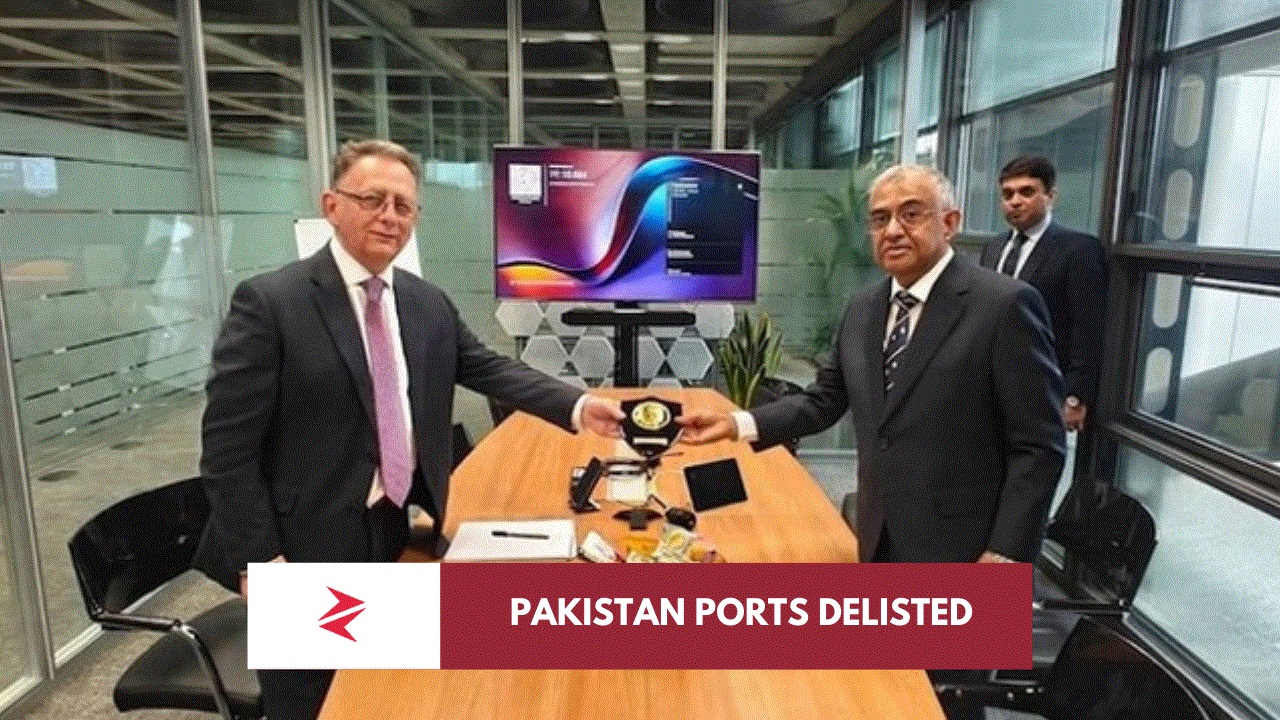
Pakistan Navy’s contribution deserves recognition without turning a national institutional achievement into a personality cult. Its official communication said Chief of the Naval Staff Admiral Naveed Ashraf held engagements with the Joint War Committee and Lloyd’s Market Association during his United Kingdom visit and presented Pakistan’s maritime-security case. The Navy described the outcome as strengthening international confidence in Pakistan’s maritime domain.
This matters because international risk classifications are not reversed by patriotic slogans. They are challenged through incident records, maritime-domain awareness, port-security data, threat assessments, response capabilities and credible institutional access to the people who underwrite global shipping risks.
The Maritime Affairs Ministry simultaneously pursued the commercial and governmental track. According to the Press Information Department, Prime Minister Shehbaz Sharif constituted a special committee led by Muhammad Junaid Anwar Chaudhry, which negotiated with Lloyd’s officials and presented Pakistan’s case through, which negotiated with Lloyd’s officials and presented Pakistan’s case through technical evidence and factual data. The minister said meetings continued for hours after iftar during Ramazan, demonstrating that the outcome was the production rather than a last-minute public-relations exercise. citeturn113222view0
Giving the Navy credit is correct. Pretending the Navy acted alone would be incomplete. This was a coordinated result involving maritime security, diplomatic engagement, the federal government, port management and the private shipping sector.