













































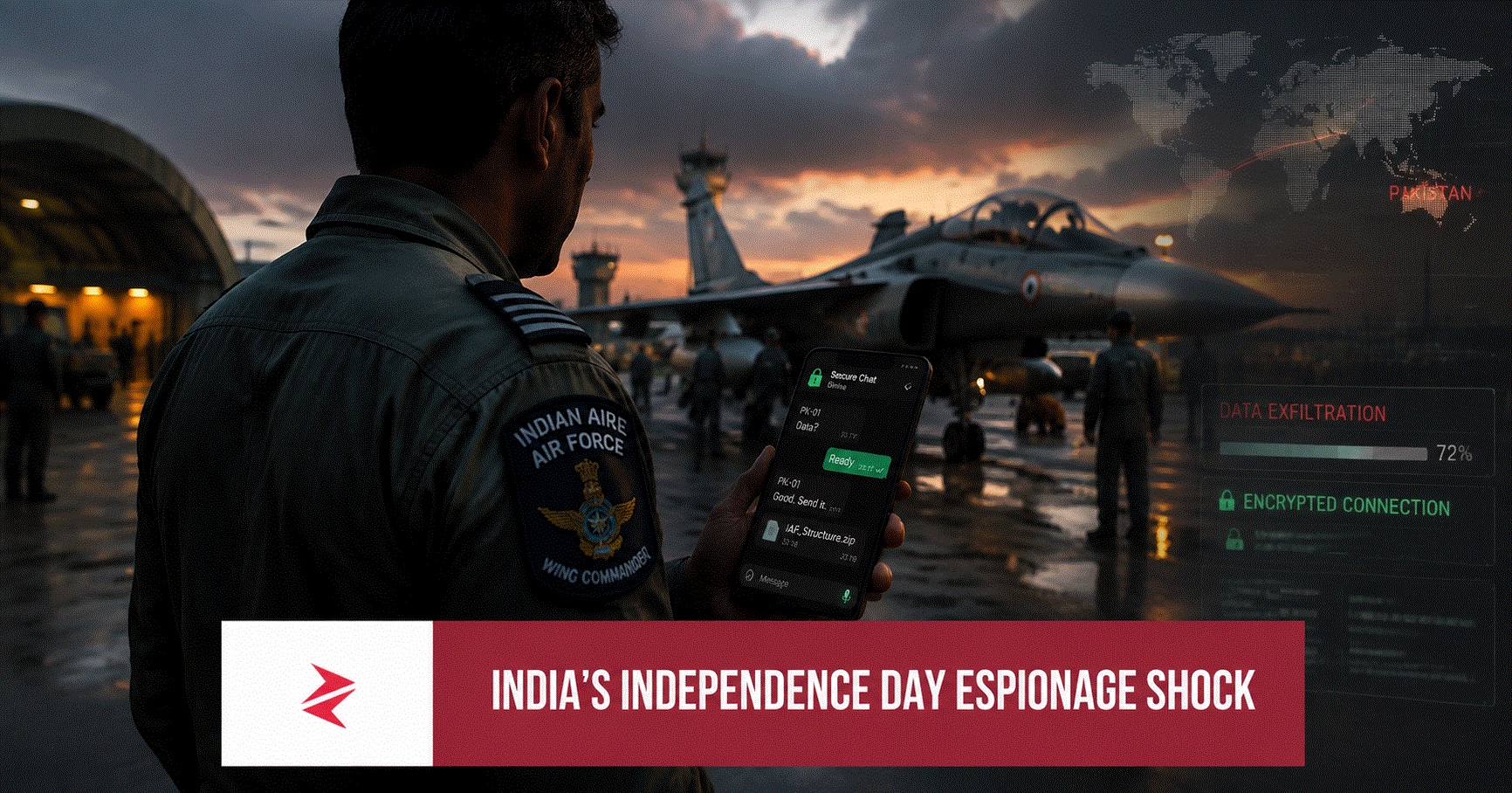
India arrived at 15 August waving flags, screening military spectacles and repeating its familiar mythology of impregnable national power, yet hanging over that celebration was a far less cinematic reality: a serving Indian Air Force Wing Commander had been arrested and charge-sheeted for allegedly transmitting sensitive defence information to a Pakistan-based intelligence operative after contact initiated through social media.
Bollywood can manufacture an invincible Indian operative who walks through Pakistan undetected, humiliates entire institutions and returns home to swelling background music. Reality, however, has again produced a more uncomfortable screenplay. Indian authorities themselves say an officer holding the rank of Wing Commander—hardly an uninformed recruit wandering into a random chat—was arrested on May 30, 2026, following an Indian Air Force complaint, while Delhi Police submitted a charge sheet before the competent court on July 30. The proceedings remain sub judice, which means the allegations have not yet been judicially proven, but the institutional acknowledgement alone demolishes the fantasy that such stories exist only in Pakistan’s imagination.
What India’s Authorities Have Actually Confirmed
According to reporting based on statements from Delhi Police and the Indian Air Force, the unnamed officer was serving at a field airbase under Western Air Command, the formation responsible for Indian air operations across a strategically sensitive belt that includes Punjab, Haryana, Rajasthan, western Uttar Pradesh, and Jammu and Kashmir. The IAF says its own intelligence apparatus had placed the officer under surveillance before handing him to law-enforcement authorities.
The accused officer was booked under India’s Official Secrets Act and remains in judicial custody in Tihar Jail. Investigators allege that a woman contacted him through social media while he was experiencing personal difficulties, after which the communication reportedly advanced from ordinary conversation to video calls and requests for information concerning military deployments and movements. Photographs, videos and documents were allegedly transferred through digital channels. The New Indian Express reported that investigators are also examining whether the officer persuaded another IAF officer to install an application capable of spyware or remote-access functions.
That last distinction matters. Credible reporting confirms an inquiry into the application and its possible capabilities; it does not yet establish publicly that malware successfully penetrated an entire unit, extracted every targeted file or “trashed” Western Air Command. Those dramatic claims have circulated widely on social media, but the forensic assessment remains undisclosed.
| Case element | What credible reporting establishes | Present evidentiary status |
|---|---|---|
| Arrest | Serving IAF Wing Commander arrested on May 30, 2026 | Confirmed by Delhi Police reporting |
| Charge sheet | Submitted on July 30, 2026 | Confirmed |
| Legal basis | Official Secrets Act proceedings reported | Confirmed |
| Posting | Field airbase under Western Air Command | Reported through informed sources |
| Social-media contact | Alleged contact with a Pakistan-based operative | Allegation before the court |
| Information transfer | Photographs, videos and documents allegedly shared | Allegation under judicial scrutiny |
| Application on colleague’s phone | Investigators examining possible spyware or remote-access capability | Investigation reportedly continuing |
| “Entire unit compromised” | No public forensic finding establishes this scale | Unverified viral claim |
| Accused officer’s religion or caste | Identity has not been officially disclosed | Speculation, not evidence |
Note: “Confirmed” here means confirmed as a procedural event or officially reported statement; it does not mean the accused has been convicted.
The “Honey Trap” May Be a Conveniently Soft Description
The phrase honey trap makes an accused man sound passive, almost as though classified documents climbed out of a secure facility and delivered themselves because an attractive stranger appeared on a screen. That framing deserves scrutiny.
A civilian can be deceived by a fake romantic profile. A trained officer may also be emotionally manipulated. Neither possibility explains away the succession of deliberate acts alleged in this case: sustaining prohibited contact, responding to requests for operational information, transmitting material and potentially directing another officer to install a suspicious application. If those allegations are proven, this was not one moment of weakness. It was a chain of security failures requiring repeated decisions.
A viral observation from Indian commentator Sam Khan captured the objection bluntly: “Honey trap is just misogynistic Red Herring.” The statement is opinion, but the underlying question is legitimate. Does the label help describe a social-engineering method, or does it provide male officials with a culturally convenient defence in which the mysterious woman becomes the central villain while the person entrusted with state secrets is recast as a helpless victim?
Indian coverage of former DRDO scientist Pradeep Kurulkar raised a similar issue in 2023. Reports alleged that the scientist continued volunteering classified information while communicating with a woman operating under a false identity. The case weakened the simplistic picture of a reluctant victim surrendering information only after blackmail. Sometimes seduction may initiate access; greed, ego, resentment, fantasy or the thrill of privileged attention may sustain it.

What Nobody Is Telling India on Independence Day
India does not suffer from a shortage of patriotic cinema. It suffers from the distance between that cinema and institutional accountability.
When alleged espionage suspects are Muslim, Kashmiri or associated with a politically convenient enemy category, Indian television frequently converts arrest into conviction before a court has examined the evidence. When an unnamed officer from a sensitive military command is arrested, the media suddenly discovers restraint, privacy and the sanctity of an ongoing investigation. The officer’s identity may have been withheld for legitimate operational or legal reasons, but Indian citizens asking why no name has been released are exposing a real credibility problem: secrecy is accepted selectively because public trust has already been damaged by politically uneven coverage.
The episode is not isolated from India’s longer security record. In 2017, the Madhya Pradesh Anti-Terrorism Squad arrested 11 people over an alleged Pakistan-linked espionage network using SIM-box-enabled telephone exchanges. India Today reported allegations that one accused, Dhruv Saxena, had held a position connected with the BJP’s IT apparatus, although the party denied formal association. The accused were arrested from several cities, while investigators alleged that information concerning troop movements, camps and bridges had been transmitted.
That history does not prove the present Wing Commander guilty, nor does it substantiate the viral claim that “10,000 RSS workers” were caught spying. That number originated in satire about the Kurulkar case and was never a documented statistic. What the historical record does establish is that espionage vulnerabilities cannot honestly be assigned to one Indian religion, caste or political community. The threat has repeatedly emerged from inside institutions that publicly advertise themselves as guardians of Indian nationalism.













