


































India has now reached an extraordinary position on the Indus Waters Treaty: a treaty it signed, a dispute-resolution architecture contained inside that treaty, appointments made through procedures contemplated by that treaty, and an arbitral tribunal that has already ruled on its own competence are apparently supposed to lose legal relevance because New Delhi has decided to call the tribunal “so-called.” That may work as political messaging. It is considerably harder to sustain as treaty law.
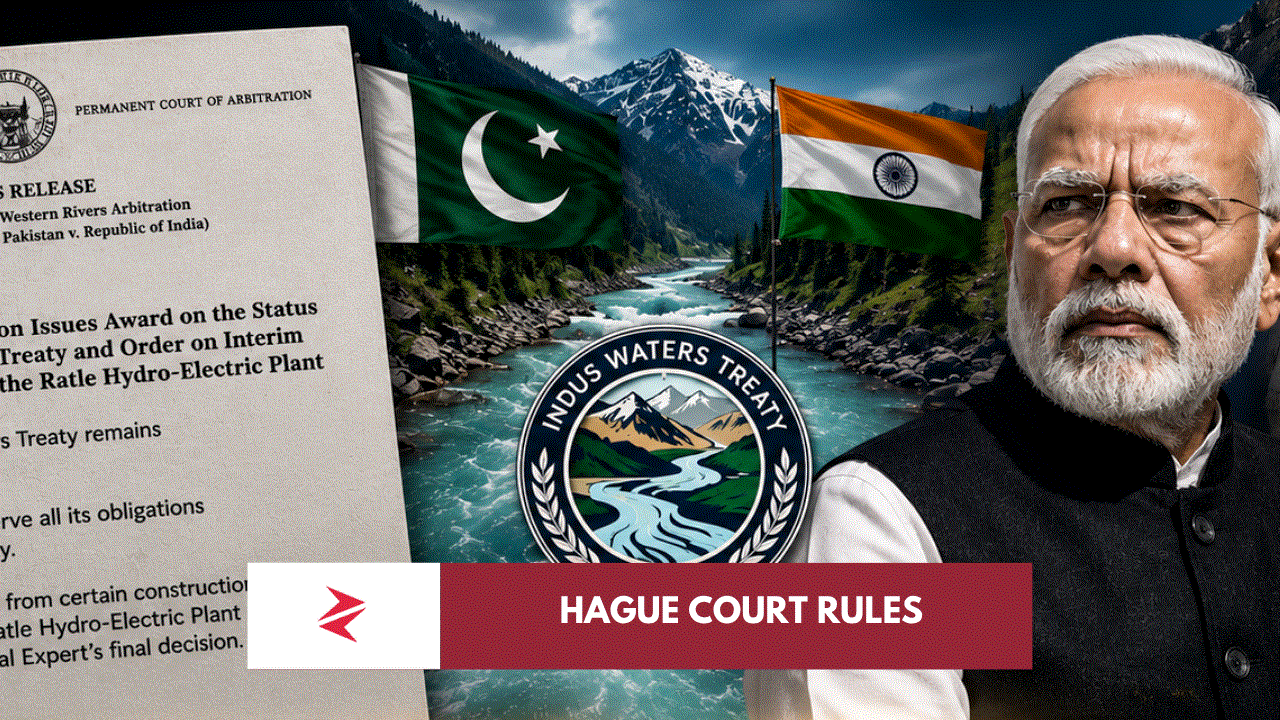
On 31 August 2026, the Court of Arbitration in the Indus Waters Western Rivers Arbitration issued an award addressing both the continuing status of the 1960 Indus Waters Treaty and interim measures concerning India’s Ratle Hydro-Electric Plant. The Court concluded that the treaty remains in force notwithstanding India’s April 2025 declaration that it was holding the arrangement “in abeyance,” and it imposed temporary restrictions on particular construction work at Ratle while the separate World Bank-appointed Neutral Expert completes his examination of the project. The Permanent Court of Arbitration serves as the secretariat for these proceedings; technically, therefore, this is a Court of Arbitration constituted under the treaty rather than the PCA itself acting as some universal appellate court over India. That distinction matters because the strongest Pakistani argument does not require exaggeration.
India’s Ministry of External Affairs responded almost immediately with language designed not merely to reject the result but to delegitimise the institution producing it. The Court was described as “illegally constituted,” its award was said to have “no legal standing,” and New Delhi reiterated that India had neither recognised the tribunal nor appeared before it. India further insisted that decisions relating to the Indus Waters Treaty remained within Indian sovereign control and that the treaty remained “in abeyance.”
There is a problem with that narrative, however, and it is much larger than the rhetorical embarrassment of repeatedly writing “so-called” before the name of an arbitral body.
India’s objection to this particular Court of Arbitration did not begin when it placed the Indus Waters Treaty in abeyance after the April 2025 Pahalgam attack. New Delhi had already refused to participate in the Court’s proceedings in 2023, arguing that the dispute should instead be handled through the Neutral Expert mechanism and objecting to parallel adjudicatory tracks. The Court expressly considered that position as a preliminary issue and issued an Award on Competence on 6 July 2023. Then, after India’s 2025 “abeyance” declaration, the Court issued a Supplemental Award on Competence, concluding that the new Indian position did not extinguish its previously established authority over the pending dispute. This chronology is essential because it prevents either side from rewriting the dispute for propaganda purposes: India’s jurisdictional objection is real and predates the 2025 suspension controversy, but the tribunal has also already adjudicated that objection and rejected it.
That makes the argument more interesting than “Pakistan won, India lost,” because the real clash is now between two radically different conceptions of treaty obligation. India is effectively arguing that the mechanism was wrongly constituted and therefore its conclusions cannot bind India; the Court is saying the treaty itself supplied the machinery through which its competence was established and that unilateral non-participation does not dismantle that machinery.
For Pakistan, this distinction is vital.
The “Both Parties Must Agree to Arbitration” Argument Sounds Obvious. Under a Treaty, It Is Not That Simple.
One of the most repeated responses under the Indian Embassy’s statement was that arbitration requires both parties to agree and that Pakistan therefore cannot simply “drag” India before an arbitrator. At first glance, that sounds compelling because ordinary commercial arbitration does indeed depend upon consent. But international treaty arbitration introduces a crucial concept that social-media arguments almost completely miss: consent can be given in advance.
Pakistan did not invent an arbitration clause in 2026 and demand that India sign it. The dispute-resolution framework already exists inside the Indus Waters Treaty.
The World Bank’s own explanation of the treaty says that “questions” may be addressed through the Permanent Indus Commission, “differences” are referred to a Neutral Expert, and “disputes” may be referred to an ad hoc Court of Arbitration. Pakistan requested the Court of Arbitration concerning the Kishenganga and Ratle design issues, while India requested a Neutral Expert concerning related issues. Because the treaty did not empower the World Bank to choose which mechanism should supersede the other, the Bank ultimately made both appointments in 2022 after an earlier pause failed to produce an agreed solution.

The Court’s own procedural record states that Pakistan instituted the arbitration in August 2016 pursuant to Article IX(5) and paragraph 2(b) of Annexure G of the treaty and that the Court was thereafter constituted pursuant to paragraphs 4 through 9 of Annexure G. That is the legal point which destroys the simplistic “India did not agree in 2023, therefore there can be no arbitration” formulation. India’s counterargument is not that the treaty contains no arbitration machinery whatsoever; it is that this machinery was triggered improperly in circumstances where the Neutral Expert procedure should have governed the disputed technical questions.
Those are very different arguments.
| Claim circulating online | What the documentary record actually shows |
|---|---|
| “Arbitration is impossible because India did not consent.” | India and Pakistan had already consented to dispute-resolution mechanisms when they entered the Indus Waters Treaty; the present fight concerns the lawful activation and competence of this particular Court. |
| “The Court appeared only after India put the treaty in abeyance.” | Pakistan initiated arbitration in 2016, the Court was constituted through the World Bank-linked treaty process in 2022, and its first competence award came in July 2023. |
| “India’s 2025 abeyance automatically ended the proceedings.” | The Court specifically considered this argument in its June 2025 Supplemental Award and held that India’s position did not terminate its competence. |
| “The World Bank declared Pakistan’s mechanism legally superior.” | No. The World Bank explicitly said the treaty did not empower it to choose between the competing Neutral Expert and Court processes; it proceeded with both. |
| “The PCA itself ordered India around as a world government.” | More precisely, an ad hoc Court of Arbitration constituted under the IWT issued the award, while the PCA acts as secretariat. |
That precision strengthens Pakistan’s case rather than weakening it. National arguments become vulnerable when they depend upon slogans that collapse the moment someone opens the treaty.