




































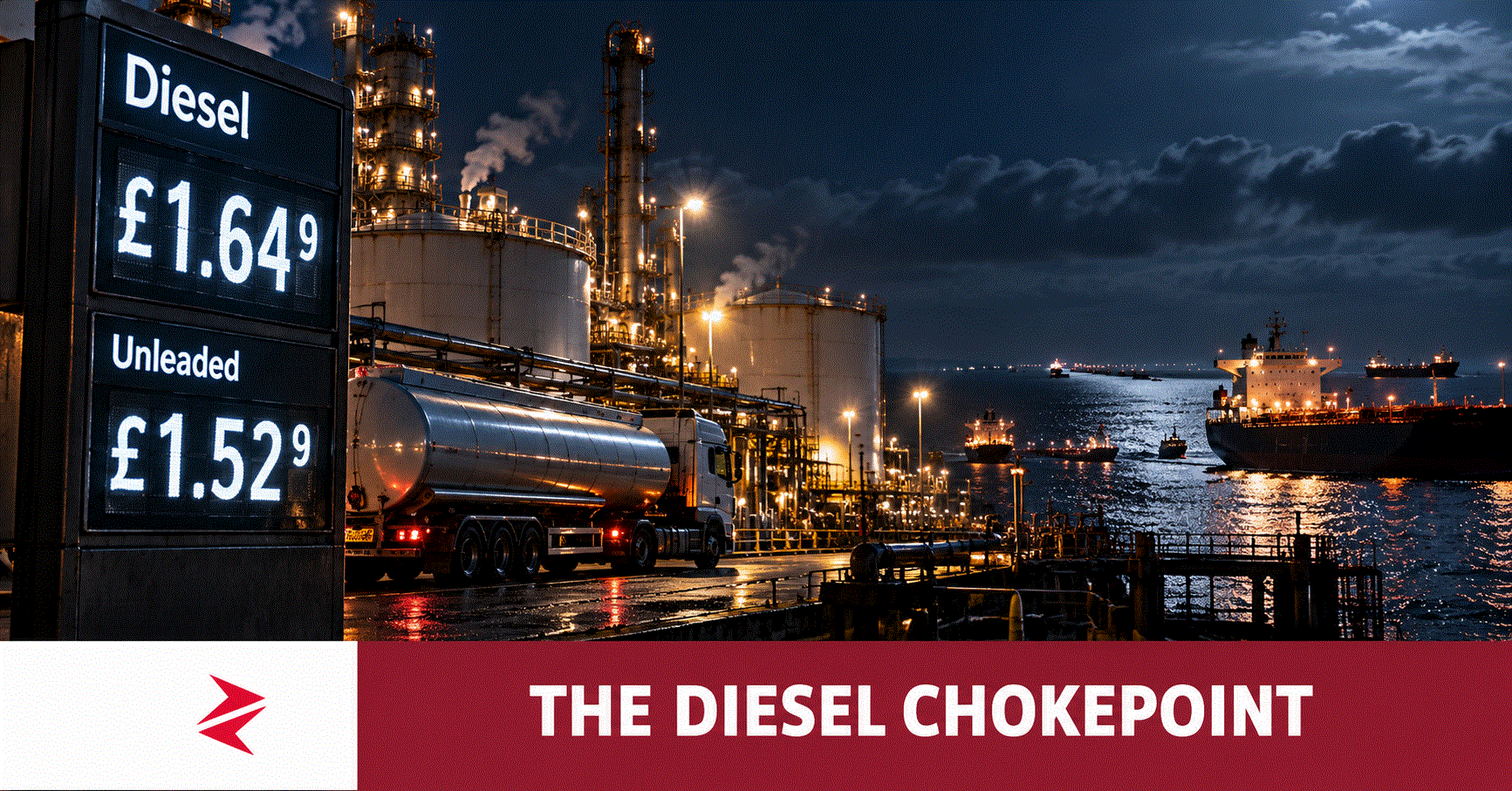
America has not banned diesel exports. Britain has already learned how much that possibility matters. A proposal intended to ease American fuel prices has exposed a harder question across the Atlantic: when a country depends on imported diesel to move freight, harvest food and supply businesses, how much control does it retain over the price and availability of that fuel?
As of 25 September 2026, a blanket US export ban remains a scenario, not an enacted policy. The White House denied a report that it was preparing a 90-day ban, while US Energy Secretary Chris Wright said such a measure could raise gasoline and jet fuel prices and that nobody was considering a flat ban. That distinction matters. A threatened disruption can move markets and force contingency planning, but it does not justify telling readers that British pumps are about to run dry. investing.com
The concern itself is real. The American Petroleum Institute’s analysis of a potential ban estimates that the United States supplies about 1.5 million barrels a day of the roughly 8 million barrels of diesel traded globally by sea. API is an industry body with a direct interest in keeping exports open, so its warning should be read in that light. Its central operational point nevertheless deserves scrutiny: a refinery cannot simply stop making export diesel while continuing to make every litre of petrol and jet fuel its customers want. If diesel backs up in storage, a refinery may eventually have to process less crude, reducing its output of other fuels too. The API has separately warned that restrictions could cut refinery runs and tighten supplies at home as well as abroad. API
What the numbers actually show
| Measure | Reported figure | What it means |
|---|---|---|
| US share of seaborne diesel trade | About 1.5 million of 8 million barrels a day | Removing that supply would create a major international replacement problem; this is API’s estimate, not a forecast that exports will stop. |
| UK road diesel demand met by domestic refineries in 2024 | 54.9% | Imports supplied much of the remainder. |
| UK jet fuel demand met by domestic refineries in 2024 | 28.8% | Aviation has a different, even larger import exposure. |
| US share of UK diesel imports in 2024 | 35.5% | Britain has a significant direct connection to US diesel supply. |
| Netherlands and Belgium share of UK diesel imports in 2024 | 37.0% combined | European trading hubs are also central to Britain’s supply. |
| Reported UK forecourt diesel average, 20 September | 195.9p/l across a matched sample of 8,094 sites | The supplied Fuel Finder observation shows a 4.6p/l rise over seven days; a later observation of 198.4p/l used 7,079 sites, so the two averages are not a matched comparison. |
Notes: The UK refinery and import shares come from the government’s 2025 Statutory Security of Supply Report and describe 2024, not September 2026. The US trade estimate is API’s. The forecourt figures are attributed to Fuel Finder’s 24 September post; they should not be treated as proof that a US policy caused the rise. GOV.UK
Those British figures explain why the argument has become so heated. Grangemouth’s transition to an import terminal and the end of refining at Lindsey reduced domestic processing capacity. UK government statistics say refinery output reached a record low in 2025 after those closures; the Netherlands and the United States together supplied 58% of UK white diesel imports that year, meeting 32% of UK demand. The government also describes the UK as able to source fuel from multiple trading partners. Both statements can be true: diversified imports provide options, while reduced refining capacity leaves Britain more exposed to disruption in the trade routes on which those options depend. assets.publishing.service.gov.uk
The argument Britain should be having
It is tempting to turn every closed refinery into a one-line accusation against a particular minister or climate policy. That skips the difficult part. Companies operated those refineries and made commercial decisions; governments shaped the costs, incentives and strategic framework in which those decisions were made. A serious accounting asks why capacity became uneconomic, whether its security value was properly priced, and what replacement arrangements were secured before it disappeared. Shouting that politicians personally “scrapped” every refinery supplies none of those answers.
The same discipline applies to North Sea drilling. More domestic crude production would have economic and security implications, but crude oil is not diesel. It must be transported and refined in suitable facilities, and the finished product must reach users. Britain can produce oil and still import diesel; its own supply report shows that it exported surplus petrol while importing fuel to meet diesel and jet demand. The bottleneck is therefore a chain of production, refining, storage, shipping and distribution, rather than a single switch labelled drill more. GOV.UK