







































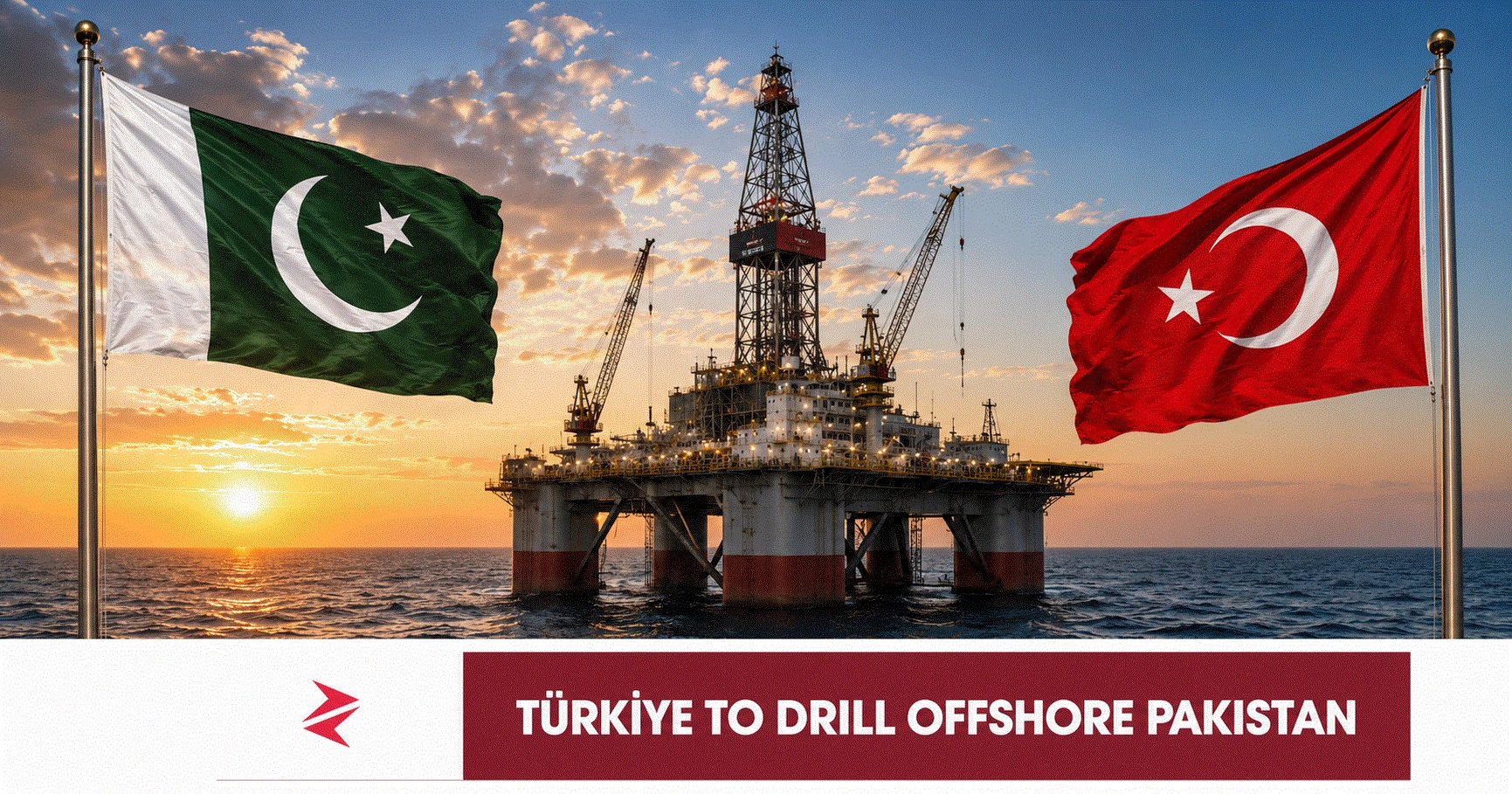
Pakistan has not discovered a giant offshore oilfield. It has done something less sensational but potentially more important: it has persuaded an experienced foreign national oil company to move from ceremonial agreements towards physical exploration in Pakistani waters.
That distinction matters because Pakistan has heard “oil is coming” stories before, only to watch political excitement outrun geological evidence. Petroleum Minister Ali Pervaiz Malik’s latest announcement deserves attention, but it must be reported accurately: Türkiye’s state-owned Turkish Petroleum Corporation, widely known as TPAO, is expected to bring a seismic survey vessel to Pakistan and participate in the revival of offshore drilling, reportedly around September or October 2026. No commercial discovery, recoverable reserve estimate, production rate or first-oil date has been announced.
This is not a reason for pessimism. It is a reason to take the development seriously.
What Has Actually Been Announced?
Addressing a news conference on August 9, 2026, Petroleum Minister Ali Pervaiz Malik said Turkish Petroleum would bring a seismic survey vessel into Pakistani waters and, together with Pakistani partners, inaugurate offshore drilling that had effectively remained suspended for around two decades.
“Turkish Petroleum is also bringing its seismic survey vessel to Pakistani waters,” Malik said, adding that offshore drilling was expected to begin “sometime in September or October,” according to Arab News Pakistan’s report on the announcement.
The statement expands upon a process already underway rather than introducing an entirely new project. In October 2025, Pakistan awarded 23 of the 40 offshore blocks offered in its first offshore licensing round in nearly two decades. Those blocks covered approximately 53,500 square kilometres.
Reuters reported that TPAO obtained a 25% interest and operatorship in one awarded block after entering a joint-bidding arrangement with Pakistan Petroleum Limited. This is critical context: Türkiye is not simply arriving for a diplomatic photo opportunity. Its national petroleum company has acquired an operating role in a defined exploration venture.
| Confirmed development | What it means | What it does not mean |
|---|---|---|
| TPAO holds a 25% interest and operatorship in one awarded block | The Turkish company has a formal commercial and technical role | TPAO has not been given Pakistan’s entire offshore zone |
| A seismic survey vessel is expected | Geological structures can be mapped before drilling decisions are finalised | Seismic data alone cannot confirm commercially recoverable oil or gas |
| Offshore activity is targeted for September or October 2026 | Pakistan is moving towards field operations | A precise spud date, well name and drilling rig have not yet been publicly identified |
| Twenty-three offshore blocks were awarded in 2025 | Pakistan has reopened a neglected exploration frontier | An exploration licence is not a production licence or discovery |
| Initial consortium commitments total about $80 million | Companies have committed capital to early exploration work | The larger projected investment is conditional on further drilling and success |
Claim statement: Türkiye’s participation represents a genuine operational step in Pakistan’s offshore exploration revival, but it must not be misreported as proof that oil or gas has already been discovered.
Why TPAO’s Arrival Matters
The first reason is brutally simple: Pakistan’s offshore territory remains extraordinarily underexplored.
Pakistan possesses an offshore zone of roughly 300,000 square kilometres, yet only 18 offshore wells had been drilled since independence when the blocks were awarded in 2025. That is not enough drilling to confidently condemn the entire frontier as barren, nor enough to proclaim it a hidden Saudi Arabia. It is enough to say that Pakistan has left a potentially important national resource scientifically unresolved for generations.


The second reason is TPAO’s operating experience. A sceptical social-media response asked whether the Turkish company possesses the necessary expertise. The answer is yes: TPAO is Türkiye’s national upstream petroleum company and has participated in seismic acquisition, offshore exploration and drilling programmes, including in the Black Sea and Mediterranean. That does not guarantee success in Pakistan because geology does not honour diplomatic friendships, but it means the incoming partner is not an improvised contractor learning offshore exploration for the first time.
The third reason is risk sharing. Offshore wells are punishingly expensive. Malik estimated that one offshore well could cost around $100 million, compared with approximately $25 million for an onshore well. Pakistan needs companies willing to bring capital, technology and drilling capability while accepting the genuine possibility of a dry hole.
That is what exploration means: spend money to replace speculation with subsurface evidence.