







































The Kekra-1 Lesson Pakistan Must Not Forget
Pakistan has travelled this road before. The Kekra-1 offshore well drilled in 2019 generated enormous public expectations but did not produce a commercial discovery. ExxonMobil subsequently exited the venture, leaving another cycle of disappointment behind.
The wrong lesson would be that Pakistan has no offshore resources. One unsuccessful well cannot scientifically condemn a 300,000-square-kilometre offshore zone.
The equally dangerous lesson would be to assume that the next well must succeed because relations with Türkiye are warm. Friendship can bring a vessel into Pakistani waters; only seismic interpretation, drilling logs, pressure tests, reservoir quality and commercial appraisal can prove a viable field.
Pakistan should therefore welcome TPAO without converting exploration into a political lottery ticket. Readers examining earlier domestic discoveries should also see why a producing asset is fundamentally different from an exploratory prospect in Pakistan Oilfields Limited’s Biltang-1 gas discovery.
Seismic Survey, Drilling and Production Are Different Stages
A seismic vessel transmits controlled acoustic energy into the seabed and records reflected signals. Geoscientists process those reflections to map underground layers, faults, folds and possible hydrocarbon traps. The data can reveal where a well may be worth drilling, but it cannot tell Pakistan that a commercially recoverable field definitely exists.
Only a drilled well can directly test the target. Even then, encountering hydrocarbons is not the final victory. Operators must determine reservoir size, pressure, permeability, fluid quality, expected recovery and the cost of constructing offshore production infrastructure.
The practical sequence is:
Seismic acquisition → data processing → prospect selection → exploration well → discovery assessment → appraisal wells → development decision → production facilities → first oil or gas.
Each stage can stop the project. That is why confident reserve estimates before drilling are not analysis; they are theatre.
Which Kind of Offshore Platform Could Be Used?
The supplied platform comparison illustrates eight common offshore systems: fixed platforms, compliant towers, jack-ups, semi-submersibles, drillships, tension-leg platforms, spar platforms and floating production, storage and offloading vessels, or FPSOs.


The eventual equipment depends primarily on water depth, seabed conditions, weather, target depth and whether the campaign is limited to exploration or advances into production.
| Offshore system | Typical role | Possible relevance to Pakistan |
|---|---|---|
| Jack-up rig | Exploration in comparatively shallow water | Possible if the selected prospect lies within suitable water depth |
| Semi-submersible | Stable drilling in deeper water | Relevant where waves and depth make bottom-supported rigs unsuitable |
| Drillship | Mobile deepwater or ultra-deepwater drilling | A possible exploration solution for distant, deeper targets |
| Fixed platform | Long-term production in shallow water | Considered only after a commercial field is appraised |
| FPSO | Offshore production, processing and storage | Potential development option where pipelines are uneconomic |
| TLP or spar | Long-term deepwater production | Relevant only after field size and economics justify major infrastructure |
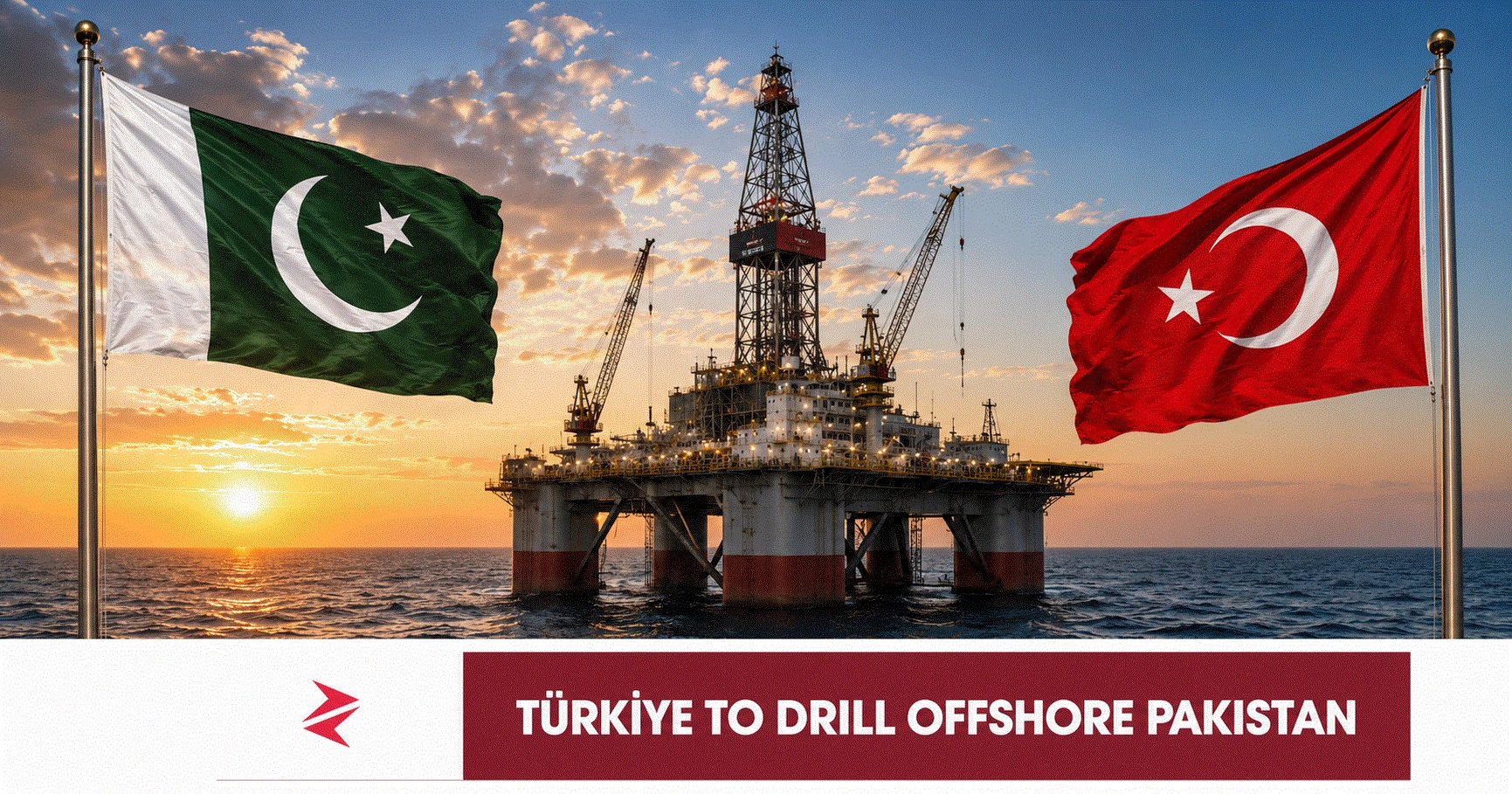
No publicly available announcement reviewed for this article identifies the precise drilling unit, water depth or platform design selected for the forthcoming campaign. Consequently, circulating a generic rig image is acceptable as an illustration, but presenting one particular platform as TPAO’s confirmed Pakistani rig would be misleading.