





























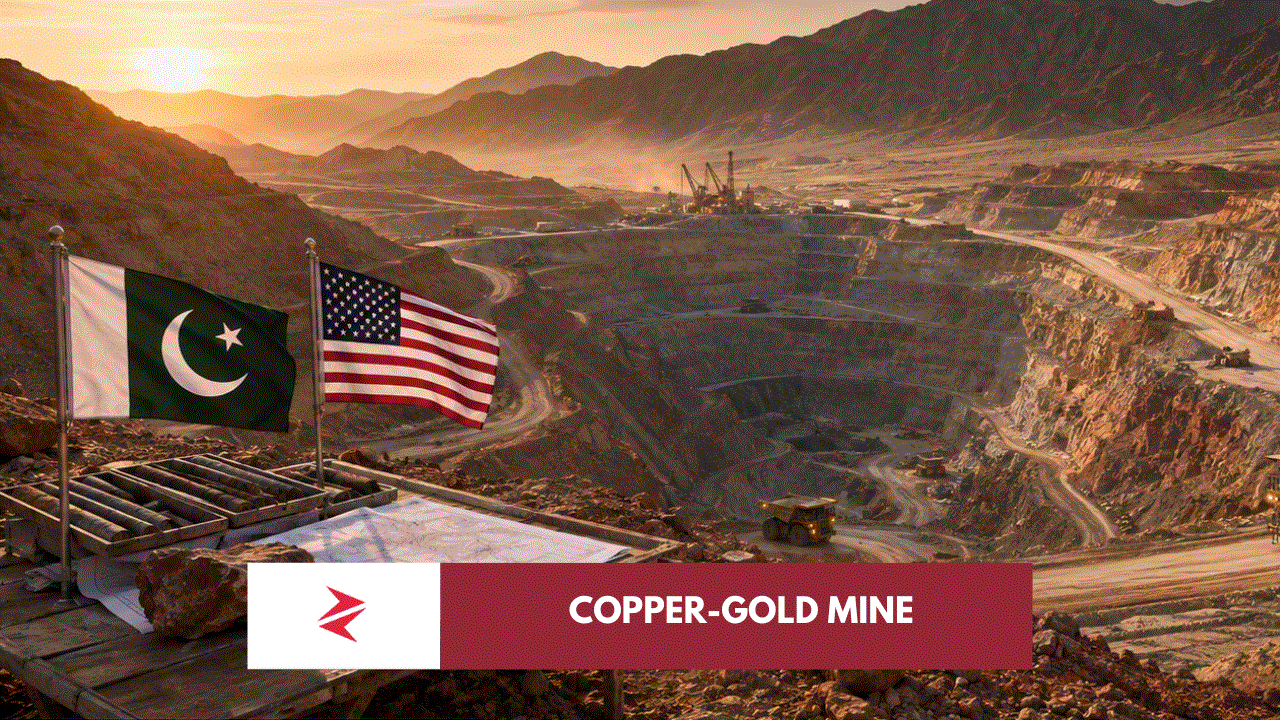
America is not looking at Pakistan’s mountains out of charity, and Pakistan should stop evaluating foreign investment as if a large dollar announcement were itself an economic victory. Washington is looking because copper, antimony, tungsten and other critical minerals have become strategic ingredients for power grids, electric vehicles, semiconductors, aerospace systems and modern weapons—and Pakistan happens to possess resources that the world’s largest economies can no longer afford to ignore.
That is precisely why the latest message from American officials deserves attention. A United States Embassy official has said the Trump administration is prepared to support another mining development in Pakistan comparable in scale to the $7.7 billion Reko Diq copper-gold project. This is not yet a signed financing commitment for a named second mine, but it is a remarkably direct signal that Washington’s interest has moved beyond diplomatic courtesy and into the realm of bankable geological assets.
The distinction matters. The United States has already converted part of its Reko Diq interest into an identifiable financial authorization. The official transaction records of the Export-Import Bank of the United States list $1.25 billion in authorized project finance for the Reko Diq Mining Company in fiscal year 2026. What is now being discussed is the possibility of backing another project of broadly comparable ambition, subject to discovering or developing a sufficiently large deposit and constructing a commercially credible proposal around it.
What Is Actually Happening?
According to reports by The Express Tribune and Profit by Pakistan Today, American companies are exploring opportunities across Pakistan’s mineral sector, ranging from smaller mines and mineral-offtake agreements to major copper and antimony developments. The American side is reportedly examining a global list of approximately 60 critical minerals, several of which are found in Pakistan.
The most politically important statement, however, concerns Balochistan. The official acknowledged that American companies understand the province’s security risks and remain willing to examine projects there. That declaration cuts through a familiar narrative in which Pakistan, and particularly Balochistan, is portrayed as commercially untouchable. Investors do not ignore risk; they price it, insure it, manage it and proceed when the underlying asset is sufficiently valuable.
That is the hidden vote of confidence here. If international companies possessing sophisticated security, compliance and political-risk capabilities are prepared to perform due diligence in Balochistan, then Pakistan’s mineral potential is no longer being treated merely as speculative geology. It is being evaluated as a strategic supply opportunity.