


































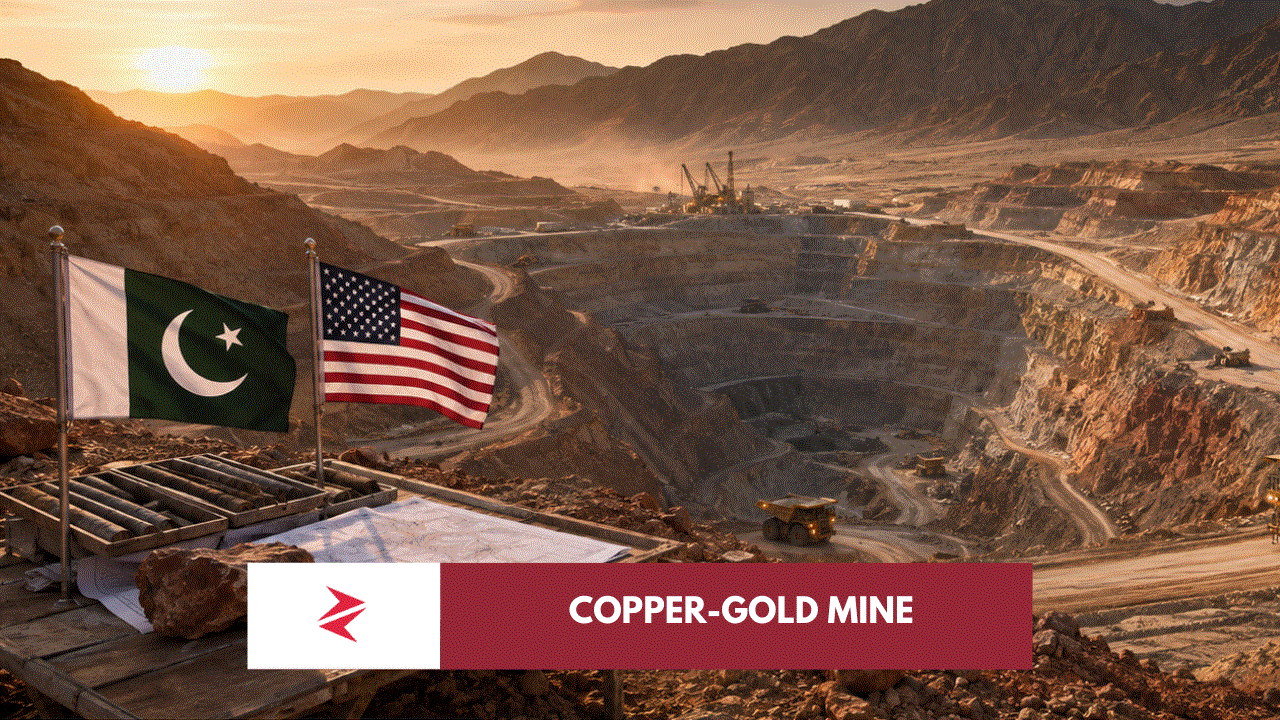
Pakistan’s Emerging Mining Proposition
| Indicator | Confirmed position | What it means for Pakistan |
|---|---|---|
| Estimated Reko Diq development cost | Approximately $7.7 billion | It is one of Pakistan’s largest prospective foreign-investment projects |
| U.S. EXIM authorization | $1.25 billion | Washington has moved beyond rhetoric on the first major project |
| Proposed second project | Reko Diq-sized, but not yet identified or financed | This remains an expression of readiness rather than a closed transaction |
| Minerals attracting attention | Copper, antimony and tungsten | These materials serve energy, technology, aerospace and defence supply chains |
| FY2026 GDP growth | 3.70% | Pakistan has entered a gradual recovery, but transformative industrial growth remains necessary |
| Mining and quarrying investment | Private investment increased 12.9% in FY2026 | Exploration spending is rising before large-scale production begins |
| Estimated Reko Diq GDP effect | Around 0.5 percentage point once operational | A single mine could become economically material, although the figure remains a projection |
Note: The GDP contribution attributed to Reko Diq is a reported projection, not a realized addition. Actual impact will depend on production, commodity prices, financing costs, taxation, local procurement and profit repatriation.
Pakistan’s official Economic Survey 2025–26 places real GDP growth at 3.70%, compared with 3.18% in the previous year. The economy reached approximately Rs126.9 trillion, or $452.1 billion at current market prices. More specifically, private-sector fixed investment in mining and quarrying rose by 12.9% to Rs157.9 billion, reflecting increased exploration expenditure.
Those figures demonstrate movement, but they also expose the size of the unfinished task. Pakistan does not need a few ceremonial exploration licences and photographs of foreign delegations holding mineral samples. It needs an integrated mining economy connecting geological mapping, extraction, rail and road logistics, power infrastructure, local engineering, smelting, refining, fabrication and exports.
What Nobody Is Telling Pakistan
The most dangerous outcome would be for Pakistan to become strategically important as a mine while remaining economically ordinary as a country.
Extracting ore, loading it onto trucks and exporting it for refining abroad may generate royalties, taxes and foreign exchange, but it leaves the highest-value industrial stages in somebody else’s economy. The real money is not captured merely by owning rock beneath the ground. It is captured through processing, metallurgy, manufacturing, logistics, technical services, intellectual property and dependable energy infrastructure.
Pakistan must therefore negotiate beyond the headline investment amount. Any second Reko Diq-sized project should be judged against measurable national outcomes: how many Pakistani engineers will be trained, how much procurement will be awarded locally, whether mineral processing will occur inside Pakistan, how Balochistan’s communities will participate in revenue and employment, how water will be managed, and whether supporting roads and electricity systems will serve the surrounding population after the mine is operational.
This is where Pakistan must learn from the incomplete promise of earlier infrastructure models without turning the debate into an artificial choice between China and America. CPEC addressed infrastructure and energy deficiencies that Pakistan had neglected for decades, while emerging American mineral investment offers access to another pool of finance, technology and export markets. Strategic maturity means dealing with both powers from a position of Pakistani interest rather than performing loyalty for either camp.
As explored in my analysis of the Special Investment Facilitation Council and concerns surrounding strategic assets, speed cannot substitute for transparency. Pakistan certainly needs faster approvals, but regulatory acceleration must not become a polite expression for weak scrutiny, undisclosed concessions or contracts that the public only sees after the resources have effectively been committed.
The same principle applies to foreign financial support. My earlier examination of Pakistan’s proposed U.S. financial backstop argued that serious engagement with Washington should not automatically be misrepresented as begging. The question is whether the financing strengthens Pakistan’s productive capacity. Mining investment meets that test only when it creates lasting capabilities rather than temporary inflows.