









































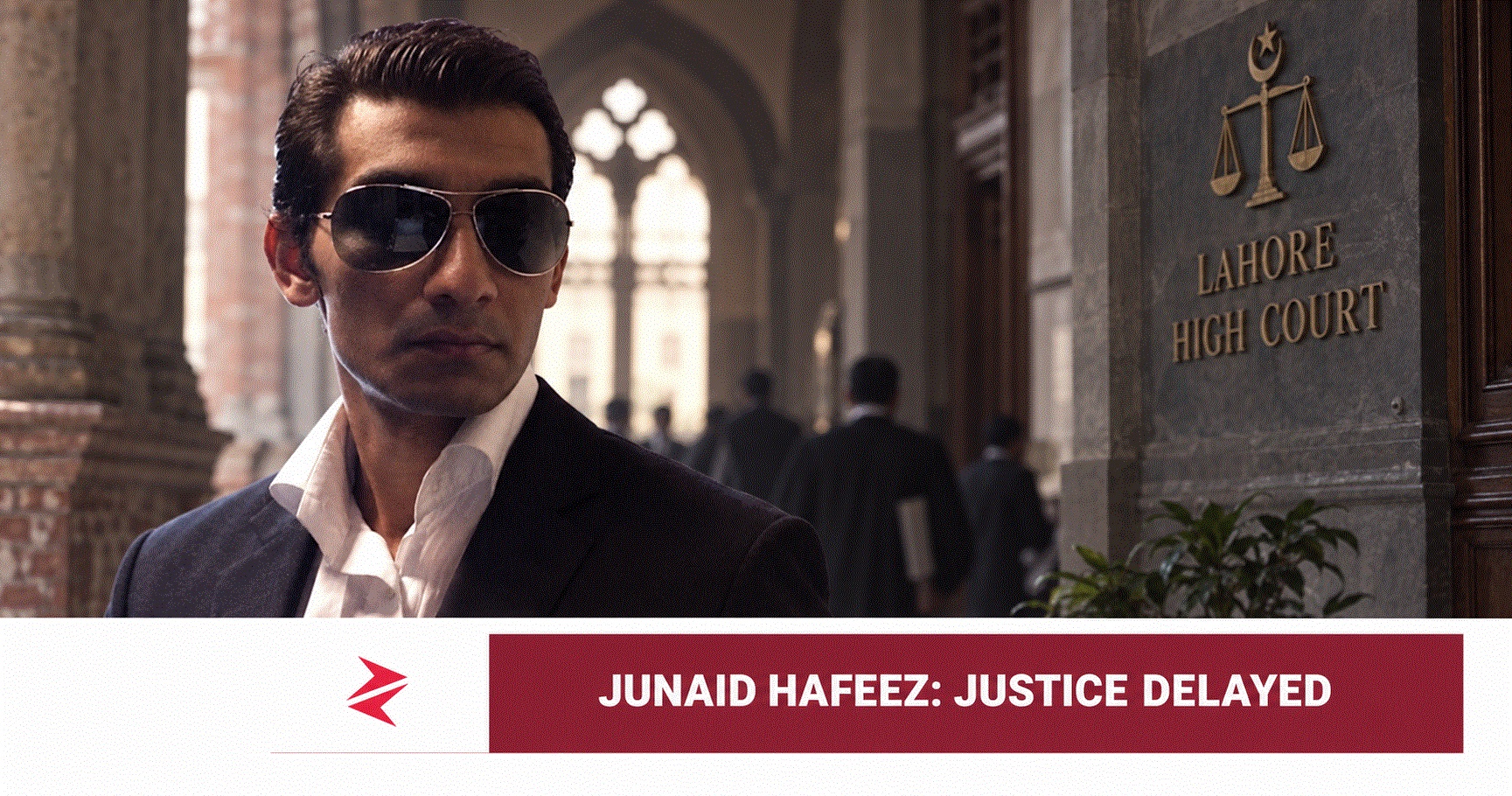
A death sentence should demand the most exacting scrutiny a court can provide. Junaid Hafeez has instead spent more than thirteen years in prison while the appeal against his conviction remains unresolved. Pakistan does not have to choose between respect for religion and respect for evidence. In a case carrying the gravest possible penalty, the rule of law requires both.
Hafeez, a former lecturer at Bahauddin Zakariya University in Multan, was arrested in 2013 over allegations concerning online material. A trial court convicted and sentenced him to death in December 2019 under Section 295-C of the Pakistan Penal Code; his appeal was filed in 2020. His conviction has not been overturned, and an appeal hearing is not an acquittal. Yet the time taken to examine that conviction is itself a matter of public concern. Earlier in 2026, Dawn reported that the appeal had again been deferred despite its placement on the Lahore High Court’s priority list.
Accounts circulated following the September 22 hearing say the Lahore High Court issued notices to the prosecution and raised questions about the difference between a Facebook page and a Facebook group, as well as the forensic basis for attributing posts to Hafeez. Those specific proceedings require confirmation from the court’s written order or a reliable court report before they can be stated as established findings. What is clear is why such questions matter: an allegation about online speech cannot answer, by itself, who controlled an account, who authored a post, whether a record is authentic, and whether the prosecution proved each element of the charged offence. An earlier account of the prosecution case itself described a Facebook “page” with a “group” of members, illustrating why precise digital evidence deserves careful examination.
| Established milestone | What the record supports | Why it matters |
|---|---|---|
| 2013 | Hafeez was arrested over blasphemy allegations. | His detention has lasted more than thirteen years. |
| 2014 | His original defence lawyer, Rashid Rehman, was killed. | The safety of legal representation became inseparable from the case. |
| December 2019 | A trial court sentenced Hafeez to death. | The conviction and sentence require appellate scrutiny. |
| 2020 | His appeal was filed. | The appeal remained pending as reported in September 2026. |
| September 22, 2026 | Accounts supplied from the hearing describe notices and questions about digital evidence. | The precise directions and next date should be checked against the court record. |
Note: The final row reflects reported accounts of that day’s proceedings, rather than a verified written order. The earlier chronology is supported by published reporting and the case record summarized by the U.S. Commission on International Religious Freedom.










