

























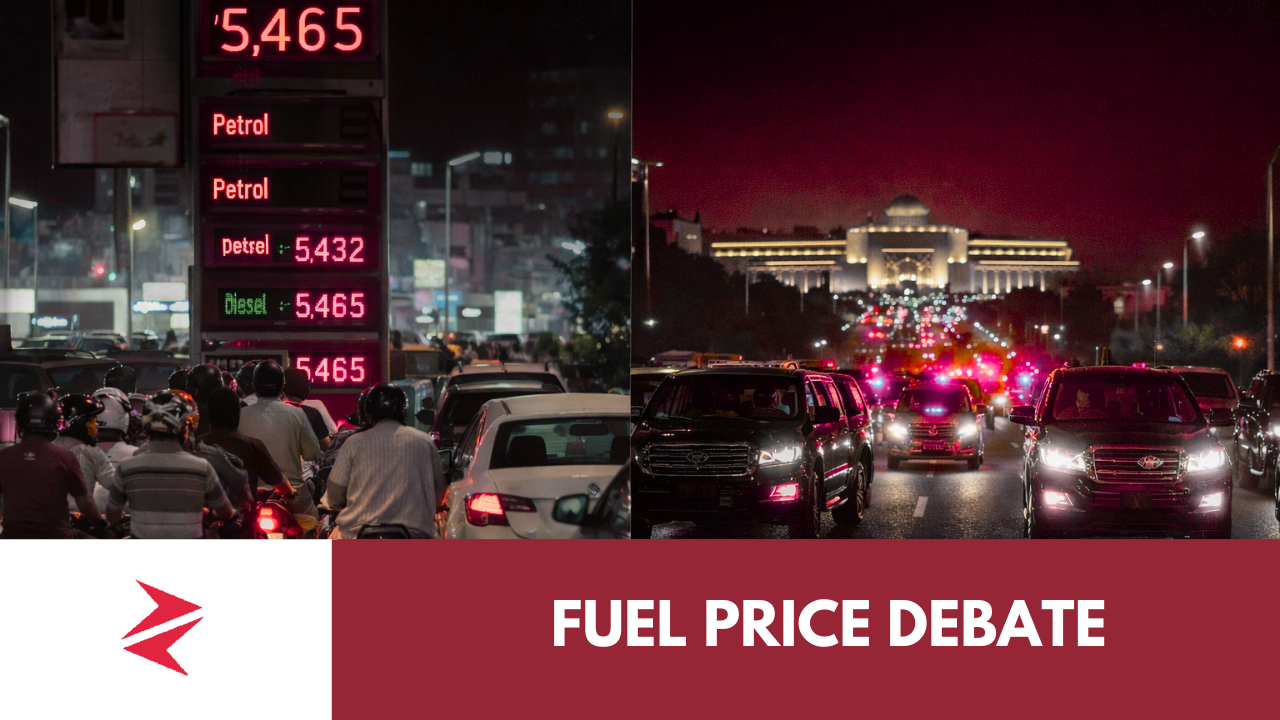
Pakistan’s latest fuel price increase reignited a familiar national argument: why must ordinary citizens absorb higher petrol costs while the state apparatus continues to operate an expensive system of elite privileges?
The debate intensified after the government raised petrol and diesel prices by Rs55 per litre, citing market hoarding fears and international oil volatility triggered by geopolitical tensions. Officials argued that the increase was necessary to maintain fuel supply stability.
Yet the public reaction focused on a different question: if austerity is necessary, why does the system of state perks remain largely untouched?
To understand the scale of the debate, it is necessary to examine the actual numbers.
Fuel Price Mechanism — How Pakistan Sets Petrol Prices
When Pakistanis woke up to the sudden Rs55 per litre increase in petrol and diesel, the official explanation from the government was simple: panic buying and hoarding had begun after global oil prices surged amid geopolitical tensions, particularly the escalation in Middle Eastern conflicts involving Iran and the United States. The government argued that an immediate adjustment in prices was necessary to stabilize supply chains and prevent shortages across the country.
On the surface, the reasoning sounded rational. In energy markets, even the perception of an upcoming price increase can trigger hoarding by consumers, fuel stations, dealers, and large distributors. The Pakistani government therefore justified the mid-cycle price increase as a necessary intervention to maintain supply stability.
But the controversy that erupted across Pakistan’s political and economic discourse was not about whether prices should rise. The real debate centered on how the price adjustment was implemented and who benefited from it.
Critics argue that instead of increasing the Petroleum Development Levy (PDL) to collect additional revenue for the state, the government effectively increased the price in a way that allowed oil marketing companies and dealers to capture windfall profits on inventory already purchased at lower international prices. According to former finance minister Miftah Ismail, this decision resulted in approximately Rs19 billion in extra profit for oil companies, a transfer of wealth from Pakistani consumers to private fuel businesses during an already fragile economic moment.
However, this argument has been strongly contested by energy analysts and industry insiders who point out that Pakistan’s petroleum pricing mechanism follows a structured formula regulated by the Oil and Gas Regulatory Authority (OGRA).
The formula begins with the Import Parity Price (IPP) calculated using the Platts Arab Gulf index, a benchmark representing the international market price of refined petroleum products. Taxes, levies, transportation costs, dealer margins, OMC margins, and the Inland Freight Equalization Margin (IFEM) are then added to determine the final consumer price.


Crucially, oil companies in Pakistan are required by OGRA to maintain mandatory strategic reserves of approximately 20–28 days of supply, meaning that they constantly sell older inventory while simultaneously importing new shipments at prevailing global prices. When global prices rise sharply, companies may briefly benefit from selling older cheaper inventory at higher retail prices. But they immediately have to replenish their stocks with more expensive imports, eliminating that gain.
Conversely, when global oil prices decline, the same companies sell previously imported expensive fuel at lower retail prices, incurring real losses.
In other words, the system inherently balances inventory gains and losses over time. The idea that oil companies enjoy guaranteed profits from rising prices is largely a misunderstanding of how regulated petroleum markets operate.
Petrol prices in Pakistan are determined through a formula regulated by OGRA (Oil and Gas Regulatory Authority). The price is based on the Import Parity Price, which reflects the Platts Arab Gulf benchmark for petroleum products.
The simplified structure of petrol pricing looks like this:
| Component | Role |
|---|---|
| Platts Arab Gulf Price | International benchmark cost of refined fuel |
| Freight & Import Costs | Shipping and insurance |
| Petroleum Development Levy | Government revenue component |
| IFEM | Inland freight equalization margin |
| OMC Margin | Oil marketing companies profit |
| Dealer Margin | Petrol pump profit |
Because prices are calculated based on average international prices from the previous period, changes in global markets do not immediately translate into domestic price changes.
This explains why fuel prices in Pakistan sometimes remain high even when global prices begin to decline.
Government Vehicles — The Real Cost
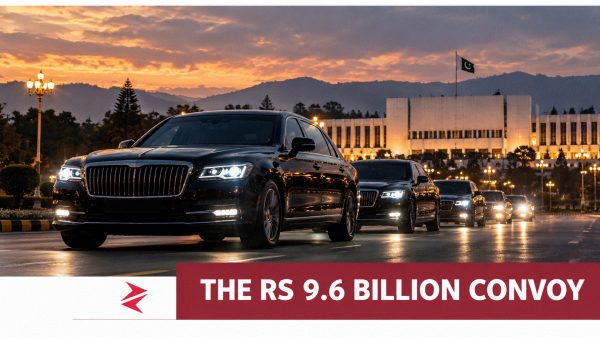
The issue that triggered the most public anger was not the fuel formula itself but the scale of government vehicle usage.
Estimates vary because Pakistan has no single publicly verified national inventory, but multiple studies and media reports suggest the following ranges.
| Estimate Source | Number of Government Vehicles |
|---|---|
| Federal + Provincial Estimates | ~84,000 |
| Older RTI estimates | ~100,000 |
| Some activist claims | up to 150,000 |
Even using the conservative estimate of 84,000 vehicles, the financial impact is significant.