





































An actor says he misses peace, and the response is to call him a terrorist, resurrect his weapons conviction and suggest he leave for Pakistan; if the intention was to demonstrate a relaxed, confident society, the reaction makes a remarkably poor advertisement. The sharper contradiction, however, sits inside the defence being offered on India’s behalf: “No bomb attacks, no terror attacks, no riots” is being circulated as though a sufficiently emphatic slogan can erase incidents that India’s own institutions have documented.
Sanjay Dutt does not need to become a political philosopher for that contradiction to matter, nor does his criminal history need to be excused before a factual claim can be examined. The issue is whether public argument still requires evidence when the person speaking becomes inconvenient, or whether the approved response is to attack his character until nobody remembers what was said.
What Sanjay Dutt actually said
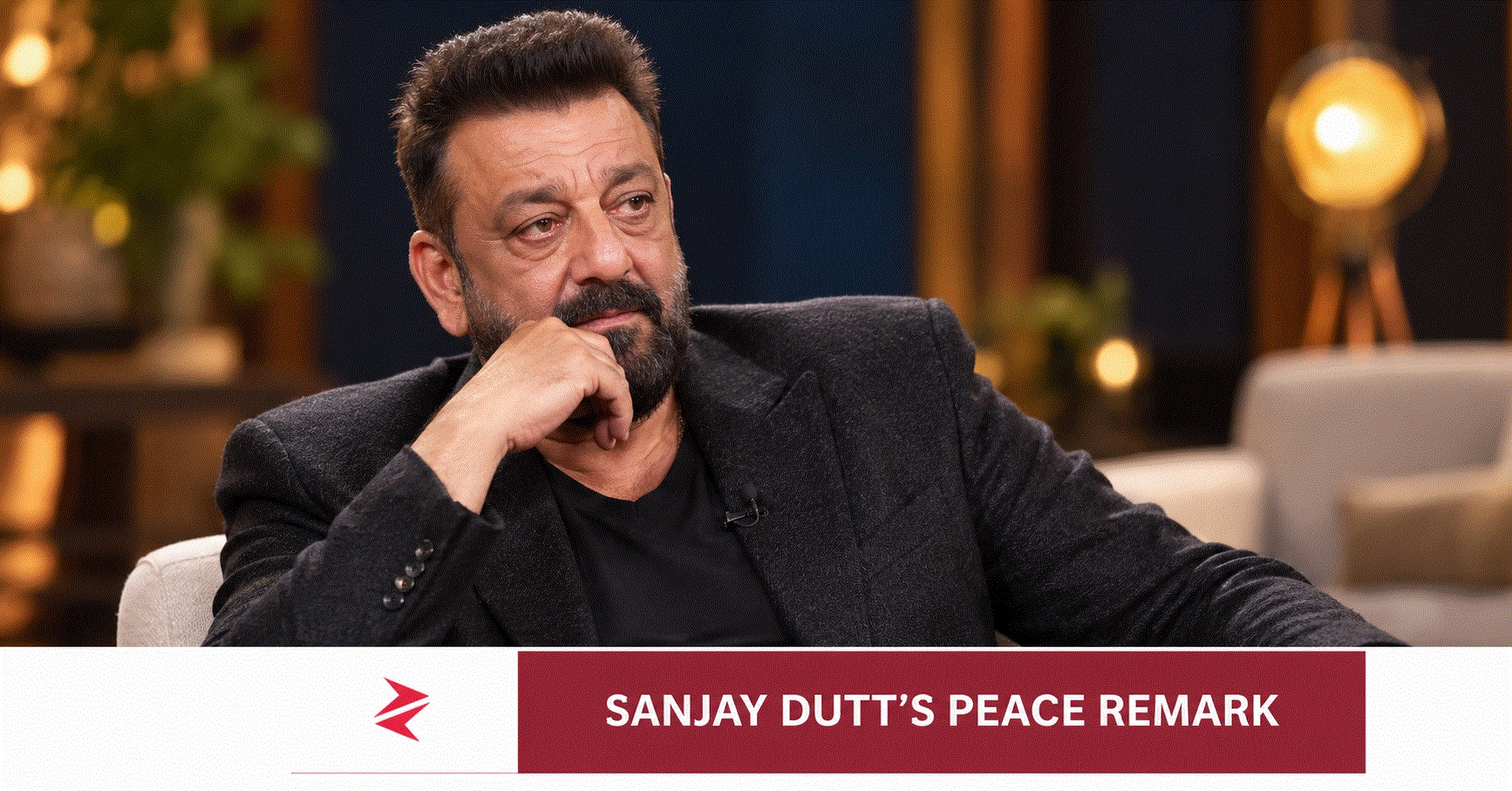
Reporting on the Gandhi Jayanti edition of Shekhar Suman’s Shekhar Tonite describes Dutt praising Indians’ generosity and hospitality before expressing a personal sense that the country’s earlier peace was missing. His reported words included, “I can’t feel that peace in our country anymore,” alongside a prayer for its return; the appearance also featured a satirical prime-minister routine delivered through his familiar Munna Bhai persona. That context matters because an expression of unease and a comic performance are neither a national crime survey nor a declaration of allegiance to a political party. cinemaexpress.com
There is room to question his nostalgia, ask which period he means and examine whether his perception matches wider experience. There is no evidentiary shortcut from those questions to the allegation that he wants terrorism back, because an assertion about someone’s hidden motive requires more than an old conviction and an angry caption.
The central distinction is straightforward: Dutt expressed a feeling about peace; his critics answered with factual claims about violence, and those claims can be checked.
“No attacks, no riots” collapses under the record
The strongest rebuttal does not require a Pakistani television panel, an opposition speech or an anonymous account. India’s National Investigation Agency’s own year-end material refers explicitly to the Pahalgam and Delhi terror attacks in 2025, while its earlier Pulwama documentation records the killing of 40 CRPF personnel. A blanket denial of attacks therefore conflicts with the record of the very security institution that nationalist commentary routinely invokes as authoritative. National Investigation Agency
| Claim circulating in the debate | What the checked record establishes | What it does not establish |
|---|---|---|
| “No terror attacks” | NIA material identifies Pahalgam and Delhi terror attacks in 2025. | Whether attacks increased or decreased across a specified period. |
| “No bomb attacks” | NIA documentation records the deadly Pulwama attack, and its 2025 review identifies the Delhi terror attack. | A complete national bombing total. |
| “No riots” | CSSS newspaper monitoring documented communal riots in 2024 and 2025. | A comprehensive official count of every riot across India. |
| Dutt was “convicted under TADA” | The judgment records his Arms Act conviction and acquittal on TADA charges. | That his illegal weapons possession was harmless or excusable. |
| Dutt wants terrorism to return | The reported peace remark does not substantiate that motive. | What his private political intentions might be. |
These are separate evidentiary questions. Documenting an attack does not settle responsibility for it, and documenting several attacks does not prove that every security indicator has worsened. nia.gov.in
The communal-violence figures deserve particular care. The current CSSS report on communal riots in 2025 predominantly reports 29 incidents, compared with 59 in 2024, but retains references to 28 elsewhere and contains conflicting injury totals. Its method relies on monitoring five newspapers’ Mumbai editions, rather than a complete police census. The defensible finding is therefore that its monitoring recorded fewer communal riots, while continuing to record violence; presenting the decline as zero would distort the report just as surely as ignoring the decline would. csss-isla.com
That is where political marketing becomes dangerous: an improvement in one measure can be converted into a sweeping claim that suffering has disappeared, leaving anyone who still describes fear, hostility or insecurity looking like an enemy of progress.
His weapons conviction is real. The invented TADA conviction is not.
Dutt’s criminal record is a legitimate subject of scrutiny, and celebrity affection cannot erase it. In its judgment of 21 March 2013, the Supreme Court of India upheld his conviction under the Arms Act and reduced the sentence from six years to five; the judgment also explicitly records that he was acquitted of the TADA charges and that the CBI had not appealed that acquittal. SooperKanoon

The distinction between being convicted by a designated TADA court and being convicted under TADA is consequential. The court could hear connected offences under other laws, and that is precisely why its institutional label cannot be substituted for the offence proved against a particular defendant. Calling Dutt a convicted terrorist on this basis rewrites the outcome rather than reporting it. SooperKanoon
One can condemn his prohibited weapons possession, question the public rehabilitation of powerful celebrities and insist that fame should never purchase exemption from accountability, while still refusing to invent a terrorism conviction. Accuracy does not acquit him of the offence he committed; it prevents commentators from adding an offence the judgment did not establish.
What the backlash reveals about the meaning of peace
The supplied public discussion contains two recognisable arguments: some respondents challenge the denial of violence by naming attacks and unrest, while others dismiss Dutt through weapons references, accusations of disloyalty and demands that he leave the country. That is an observation about this discussion, not a representative survey of Indian opinion, and it cannot justify claims that all Indians agree with either camp.
Yet the rhetorical mechanism is revealing. Instead of asking whether people can disagree without intimidation, whether communities feel secure or whether public institutions inspire confidence, the debate becomes a contest over who has earned permission to speak. Once the speaker’s supposed disqualification becomes the whole story, his original concern no longer needs an answer.