





































A serious country does not accept the word “merit” merely because it appears in an official press release, but neither does it answer an opaque military promotion by throwing sectarian filth, sexual accusations and murder allegations across social media without producing a complaint, witness, document, investigation or verifiable chain of evidence. Questioning why an officer ranked eighth in seniority was selected for a newly created four-star strategic command is legitimate. Questioning whether his career adequately prepared him to oversee Pakistan’s strategic forces is necessary. Declaring him professionally incapable because he entered through the Officers Training School, calls himself Syed or allegedly belongs to a particular sect is intellectually bankrupt. Circulating allegations of sexual abuse and retaliatory killing as established fact without corroboration is worse. Wrong.
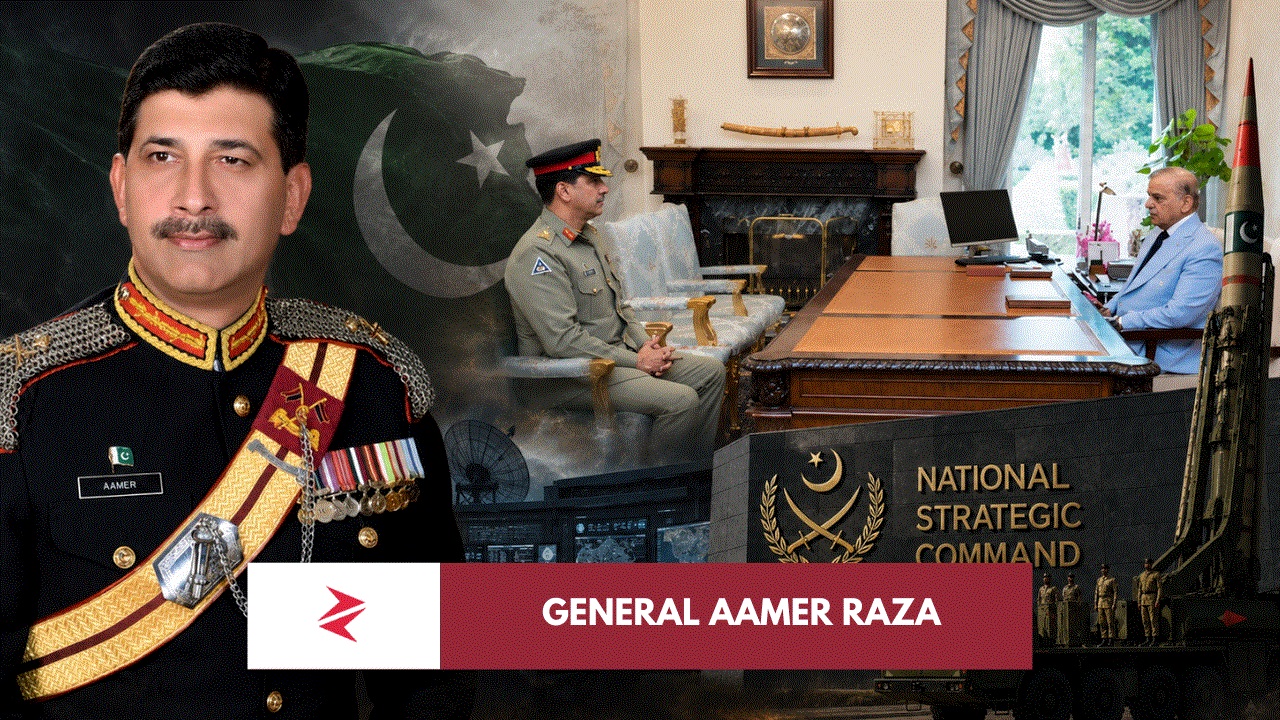
On July 24, 2026, Prime Minister Shehbaz Sharif announced the promotion of Chief of General Staff Lieutenant General Syed Aamer Raza to four-star rank and appointed him as Pakistan’s first Commander National Strategic Command. The official announcement identified him as a recipient of the Hilal-i-Imtiaz (Military) and Sitara-i-Basalat, while reporting on the new command describes a three-year appointment created through Pakistan’s recently restructured higher defence architecture.
That is the confirmed development. Everything beyond it must be separated into evidence, institutional interpretation, legitimate criticism, political opinion and unsupported social-media accusation. Pakistan has suffered for decades because these categories are deliberately mixed until the public can no longer distinguish a government notification from a planted narrative, a journalist’s analysis from an intelligence briefing, or an anonymous post from an evidentiary record.
What Has Actually Been Confirmed?
| Public claim | What available reporting establishes | Assessment |
|---|---|---|
| Aamer Raza was promoted to four-star General | Confirmed by the Prime Minister’s Office and state media | Established fact |
| He became Pakistan’s first Commander National Strategic Command | Confirmed; the office was created under the revised defence structure | Established fact |
| He was the senior-most lieutenant general | No. Dawn reported that he ranked eighth in the seniority list | Incorrect |
| Seven generals were formally superseded | Dawn expressly named six officers as superseded, while the senior-most officer, Lt Gen Asim Malik, remained in an extended intelligence and national-security assignment | The popular “seven superseded” claim requires qualification |
| He has direct strategic-missile command experience | Reporting states that he did not serve in the Strategic Plans Division, Army Strategic Forces Command or the strategic missile programme | Not supported |
| He has relevant technical and operational exposure | He served as CGS, IV Corps Commander, Chairman Heavy Industries Taxila and DG Weapons and Equipment | Supported, but adjacent experience is not identical to strategic-command experience |
| His OTS background makes him professionally unsuitable | No credible evidence supports that conclusion | Institutional prejudice, not analysis |
| Religious or Syed identity proves favouritism | No evidentiary relationship has been established | Sectarian speculation |
| Grave personal allegations circulating online have been independently proven | No credible corroborating investigation, court record, official complaint or established journalistic inquiry was located in the sources reviewed | Unsubstantiated and unsafe to publish as fact |
The appointment is historically important because the National Strategic Command is not merely another corps headquarters or ceremonial posting. Reporting on the revised architecture says the command is intended to operationally integrate the strategic forces of the army, navy and air force, while the civilian-led National Command Authority, chaired by the prime minister, formally retains ultimate authority over nuclear policy and employment. The Commander National Strategic Command is appointed by the prime minister on the recommendation of the Chief of Defence Forces and serves a three-year term.
That distinction matters. Claims that this is principally an “artillery-focused” job misunderstand the office as presently described. It is a joint strategic command, not a renamed artillery formation. Its responsibilities are potentially broader, involving operational coordination across delivery systems, service commands, command-and-control structures, emerging technologies and strategic readiness. The more serious criticism is therefore not that Aamer Raza came from the Armoured Corps rather than artillery, but that public reporting does not show prior service in the country’s specialised nuclear-command institutions.
The Word “Merit” Does Not Prove Merit
The official praise surrounding the promotion emphasised competence, experience and suitability, but institutional language cannot become its own evidence. When an officer ranked eighth is selected over several senior lieutenant generals, the public is entitled to ask what measurable criteria outweighed seniority, which competencies were evaluated, what strategic gaps the selected officer was expected to fill, and why no meaningful explanation accompanied such a consequential appointment.
Dawn’s detailed account reported that Aamer Raza ranked eighth among serving lieutenant generals at the time of his elevation. It named Lt Gen Inam Haider Malik, Lt Gen Fayyaz Hussain Shah, Lt Gen Nauman Zakaria, Lt Gen Muhammad Zafar Iqbal, Lt Gen Ahsan Gulrez and Lt Gen Shahid Imtiaz as officers superseded by the appointment. Lt Gen Asim Malik, described as the senior-most officer, remained in his extended role as director general of the Inter-Services Intelligence and national security adviser.

This does not automatically make the appointment unlawful or professionally indefensible. The governing structure reportedly allows selection from among serving army generals on the recommendation of the Chief of Defence Forces; the available description does not establish seniority as the controlling criterion. The real issue is transparency. When a government departs significantly from seniority, repeating “merit and competence” without disclosing the reasoning creates the very suspicion that institutional communicators later complain about.
Pakistan has already lived through repeated disputes over senior appointments, command extensions and the expansion of military influence into civilian governance. My earlier analysis of General Asim Munir’s appointment argued that an officer assuming extraordinary national influence must be assessed not only through service credentials, but also through institutional confidence and freedom from unresolved controversy. The principle applies here as well. A strategic appointment should be capable of surviving public scrutiny without relying on ceremonial photographs, patriotic slogans or anonymous social-media defenders.
Is His Career Relevant to the Strategic Command?
Aamer Raza’s career, as publicly reported, is substantial. He was commissioned into 6 Lancers in 1988 through the Officers Training School, commanded an armoured regiment and brigade, led an infantry brigade in South Waziristan, commanded an infantry division and later Lahore’s IV Corps, and served as chief of staff at II Corps. His institutional appointments included Director General Weapons and Equipment, Chairman Heavy Industries Taxila and Chief of General Staff at GHQ.

Those roles provide meaningful experience in force development, weapons procurement, industrial capacity, operational planning and the functioning of General Headquarters. His tenure at Heavy Industries Taxila is particularly relevant to the technological and industrial side of national defence, while the CGS position placed him close to military operations, intelligence coordination and the implementation of recent command restructuring.
But Pakistanis should not be sold the intellectually lazy argument that related experience is identical to specialised experience. Dawn reported that he had not served in the Strategic Plans Division, Army Strategic Forces Command or the strategic missile programme. That is a material gap because the new command is expected to integrate strategic forces and oversee operational coordination in Pakistan’s most sensitive security domain.
The professional assessment is therefore mixed rather than propagandistic. He has broad conventional-command, weapons-development and headquarters experience. He does not appear, from the publicly available record, to possess the conventional résumé expected of an officer rising through Pakistan’s dedicated strategic-command organisations. His CGS experience may have provided exposure to the restructuring process, but exposure is not the same as long-term command within the strategic establishment.
Pakistan’s broader defence preparedness has never depended on a single personality. The country’s defence-budget pressures and economic trade-offs and the technological evolution examined in our analysis of Pakistan’s air-defence capabilities demonstrate that strategic effectiveness comes from institutions, research ecosystems, credible procurement, secure command structures and technically competent personnel—not from personality cults around uniformed individuals.
OTS Versus PMA Is a Distraction
The sneering references to Aamer Raza being an Officers Training School graduate reveal an internal class prejudice disguised as professional analysis. An officer’s commissioning route is part of his biography, not a permanent ceiling on his competence. After nearly four decades of command, staff, instructional and industrial appointments, the question cannot rationally remain whether he entered through OTS rather than a PMA long course. The relevant questions concern performance, judgement, strategic understanding, integrity and suitability for the command now assigned.
The same people who reject inherited civilian privilege often reconstruct another form of hereditary hierarchy inside military discourse, treating one academy, course or regimental network as an aristocratic certificate. That is not merit. That is institutional tribalism.
If the case against Aamer Raza rests on his commissioning route, it is weak. If it rests on his eighth-place seniority, absence of direct strategic-force appointments and the opaque selection process, it becomes serious. Pakistanis must learn to distinguish a legitimate institutional question from barracks snobbery.
The Sectarian Sewer Is Not Accountability
The reaction to the promotion rapidly deteriorated into attacks on Shias, Syeds and supposed sectarian networks. Some accounts implied that religious identity itself proved disloyalty, foreign influence or professional incapacity. Others predicted that Pakistan was becoming another Syria simply because of the alleged sect of one promoted officer.
This is not criticism of the military establishment. It is sectarian incitement wearing the costume of political analysis.
Pakistan has paid in blood for the weaponisation of Sunni, Shia, Barelvi, Deobandi, ethnic and provincial identities. Any intelligence service hostile to Pakistan would celebrate watching citizens convert a legitimate question about military seniority into religious hatred. A person’s sect does not prove competence, but it does not prove treason either. A claimed Syed lineage does not establish merit, but neither does it establish corruption. The appointment should be assessed through professional record, law, institutional process and measurable performance.
The strongest Pakistan-first position is not unconditional worship of every general. It is the rejection of both boot-polishing propaganda and sectarian sabotage.