


































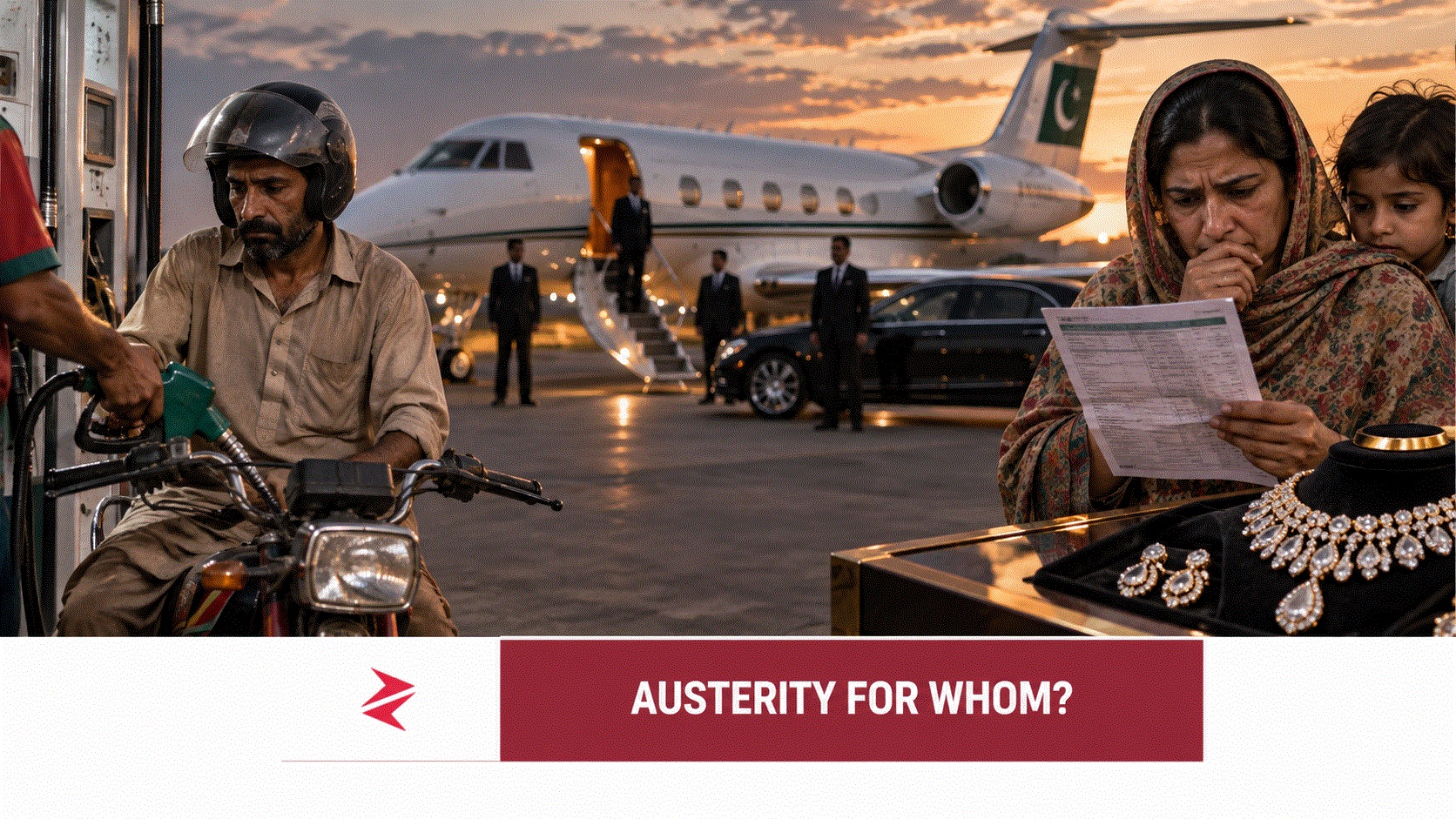
Pakistan’s rulers have discovered austerity again—but only after the citizen has already surrendered affordable fuel, affordable electricity, purchasing power and, increasingly, hope.
Cutting official fuel allocations, cancelling foreign visits and banning government dinners may appear disciplined on paper, yet no administrative circular can restore public trust while the political class continues to inhabit a world of government aircraft, protocol convoys, extravagant ceremonies and unexplained luxury. When an ordinary Pakistani is told to close his shop early, reduce travel, absorb another diesel increase and pay capacity charges for electricity he may never consume, even one avoidable display of elite privilege becomes more damaging than a hundred speeches about sacrifice.
That is why Punjab Chief Minister Maryam Nawaz’s use of a government aircraft for a private visit to London became politically explosive. The controversy was never merely about whether a cheque was eventually deposited. It was about whether Pakistan’s governing elite understands that leadership during a national economic emergency demands restraint before reimbursement, judgment before damage control and transparency before public outrage.
The payment may have settled an invoice. It did not settle the question.
What Actually Happened
Maryam Nawaz used the Punjab government’s aircraft during a private journey to London, reportedly undertaken to attend her daughter Mahnoor’s graduation. After criticism intensified, reports said that Rs27,194,004 was deposited into the provincial treasury to cover the aircraft expenses.
According to published payment details, a Bank of Punjab cheque was deposited at the Valencia Branch of the National Bank of Pakistan. The pay-in slip reportedly identified Umar Abbas as the depositor. Punjab Information Minister Azma Bokhari maintained that Maryam Nawaz personally bore the expenses, while the chief minister later defended the journey by saying that the aircraft belonged to the Punjab government and was available to provincial chief executives. Pakistan Today documented the payment and reported aircraft details.
The most defensible factual position is therefore clear: a payment was reported, documents circulated publicly and questions remain about the initial authorisation, calculation and documentation of the journey.
| Issue | What is documented | What remains unanswered |
|---|---|---|
| Nature of journey | The London visit was described as private | Why was an official aircraft selected for a personal engagement? |
| Reported payment | Rs27,194,004 was reportedly deposited | Was this the final settled amount after complete reconciliation? |
| Depositor information | The slip reportedly named Umar Abbas | From whose bank account did the cheque originate, and why was a third party listed? |
| Cost calculation | Government representatives said expenses were paid | Did the amount include only fuel, parking and handling, or the full commercial value of the aircraft’s use? |
| Authorisation | The aircraft is available to the provincial chief executive | What written policy governs its private use, advance approval and reimbursement? |
| Public disclosure | A deposit slip entered the public domain | Will the invoice, cheque, flight log and treasury confirmation also be published? |
These questions do not prove illegality, corruption or non-payment. They establish the need for documentary disclosure. That distinction matters because accountability must be built on records—not on partisan certainty in either direction.
Why the Reimbursement Still Looks Like Failed Optics
The central defence is that the chief minister paid the bill. But reimbursement after a political backlash does not automatically convert a questionable decision into an example of austerity.
A government aircraft is not an ordinary commercial service. Its cost involves crew, positioning flights, maintenance reserves, depreciation, insurance, ground handling, parking and the opportunity cost of taking a public asset outside its essential governmental function. If the Rs27.194 million calculation covered all attributable costs, the government should publish the calculation. If it covered only selected operating expenses, then the public deserves to know that too.

The reported Gulfstream G500 associated with the controversy has been valued in press coverage at approximately $38 million to $42 million. At the reported exchange rate of roughly Rs277 to the dollar, that places the capital value above Rs10 billion. This does not mean that a passenger must pay the aircraft’s purchase price, but it demonstrates why a simple fuel-and-parking narrative would be insufficient without a transparent cost sheet.
The real optics failure lies in timing. Pakistan announced another austerity package on September 17, including reduced fuel for official vehicles, restrictions on government vehicle purchases, limits on foreign travel, a prohibition on official dinners and greater use of virtual meetings. Reuters reported that the measures were intended to conserve energy amid the Gulf-driven fuel shock.
The government is therefore telling citizens that circumstances are exceptional enough to close markets early and ration administrative consumption, while simultaneously defending the private use of a luxury state aircraft as a facility available to the chief executive. Legality and optics are not interchangeable. Something may technically fall within an entitlement and still be politically tone-deaf.
The Jewellery Claim Must Be Treated as a Claim
A viral post claimed that a Mouawad diamond set worn by Maryam Nawaz’s daughter cost more than half the price of the aircraft. That comparison is dramatic, shareable and, at present, insufficiently substantiated.
No publicly available invoice, authenticated valuation, gemological report or confirmation from Mouawad has been produced in the cited material. The jewellery could be genuine, borrowed, gifted, replicated or incorrectly identified from photographs. Without documentary authentication, attaching a multibillion-rupee valuation to it would be speculation rather than reporting.
That does not make public concern about elite extravagance illegitimate. It makes precision more important. The strongest criticism does not need an unverified jewellery price. A Rs27.194 million payment for the private use of a government aircraft, during a national fuel crisis, already presents a serious governance question.
The temptation to inflate the weakest allegation only gives officials an escape route from the strongest evidence. They can discredit the jewellery valuation and pretend that every other question has also disappeared. It has not.
Pakistan’s Austerity Burden Is Already Unequal
The latest measures include a 50% reduction in fuel allocations for official vehicles, restrictions on foreign travel and new vehicle purchases, cuts to certain non-salary expenses, virtual government meetings and limits on publicly funded events. Such measures are necessary, but they are not transformative unless backed by audited savings and permanent reductions in elite privileges.
Pakistan’s citizens are carrying the adjustment through channels that are far more painful.













