































Pakistan should welcome every innocent family rescued from a mob, every false accusation stopped before it becomes a death sentence and every armed pressure group prevented from paralysing public life. What Pakistan should not accept is a ready-made hero narrative in which a complicated institutional shift is compressed into the supposed ideological awakening of one military commander.
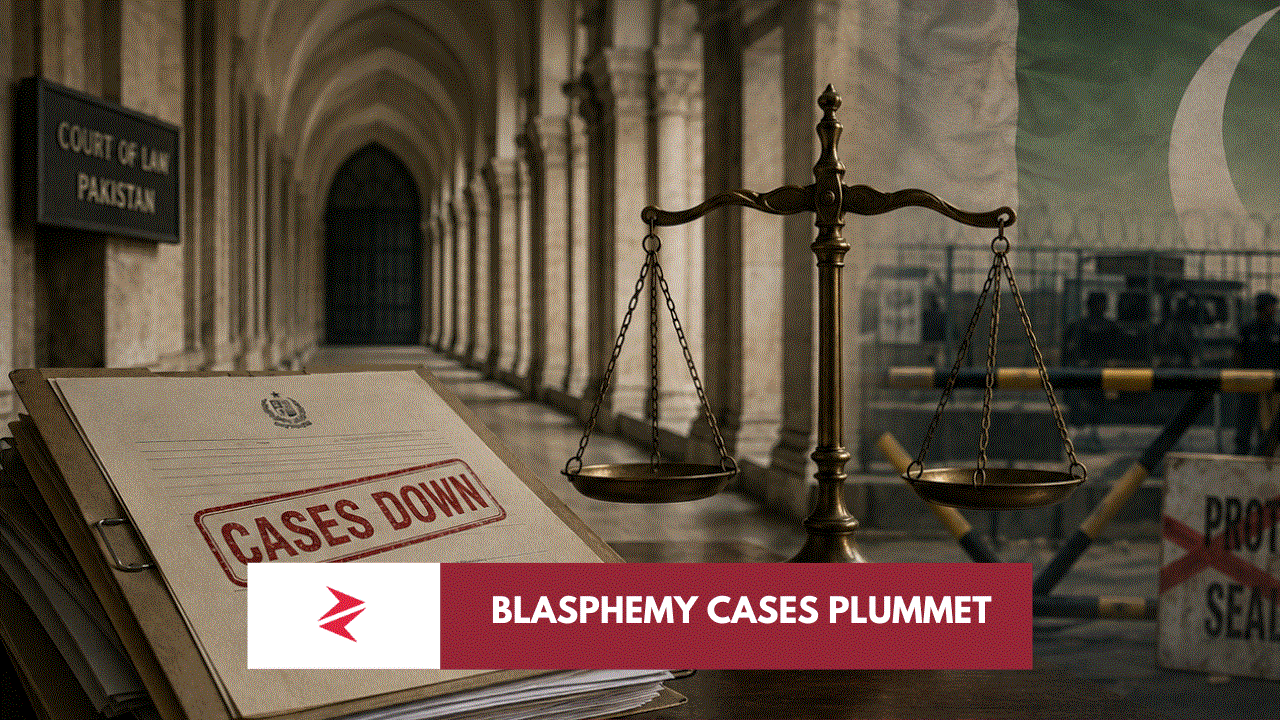
That distinction matters because the Reuters investigation published on August 6, 2026 contains an important, encouraging statistic: registered blasphemy cases have reportedly fallen to 13 so far this year, roughly two-thirds below comparable periods in recent years. Reuters also reports only one blasphemy-related riot or attack during the preceding 12 months, compared with an annual average exceeding seven between 2021 and 2024.
Those figures deserve attention. They do not, however, automatically prove Reuters’ much larger narrative—that Field Marshal Asim Munir personally engineered Pakistan’s transformation by “turning on” hardline Islamist groups.
A statistical decline is observable. The causal story built around it remains substantially dependent upon anonymous government and security sources, analysts’ interpretations and an unpublished government document. Pakistanis are entitled to separate the measured result from the flattering political packaging around it.
What Is Actually Happening?
Reuters reports that the decline followed a sweeping campaign against Tehreek-e-Labbaik Pakistan, which was banned in late 2025. Its leaders were reportedly detained, bank accounts frozen and affiliated mosques sealed. The report presents this crackdown as part of a broader effort to stop religious organisations from holding citizens, governments and commercial activity hostage through street power.
If coercive groups can no longer assemble mobs around unverified allegations, threaten judges, blockade Punjab or use religious emotion as political leverage, that is an improvement for Pakistan. It protects Muslims and non-Muslims alike because Muslims constitute a large share of those accused under blasphemy provisions. Protection from false allegations is not opposition to Islam; it is opposition to vigilantism, blackmail and the theft of the state’s judicial authority.
The Karachi incident described by Reuters illustrates the difference. A Christian family reportedly faced an assembling crowd after a blasphemy allegation, but police intervened, persuaded the crowd to disperse and moved the family to safety. An initial inquiry reportedly found the allegation false. That is precisely how a functioning state should act: investigate the allegation, secure the accused, prevent collective punishment and permit a court—not an enraged street—to determine the facts.
| Reported indicator | Earlier position | Reported 2026 position | What it establishes |
|---|---|---|---|
| Registered blasphemy cases | Higher comparable-period totals | 13 cases so far | A sharp recorded decline |
| Blasphemy-related riots or attacks | More than seven annually on average, 2021–2024 | One during the previous 12 months | Reduced recorded collective violence |
| TLP’s legal position | Active political-religious organisation | Banned in late 2025 | A major change in state policy |
| TLP infrastructure | Public leadership, accounts and organisational presence | Leaders detained, accounts frozen and mosques reportedly sealed | Extensive coercive enforcement |
| Proof of personal causation | Not independently published | Anonymous sources credit Munir | An attribution requiring further evidence |
Note: The first four entries reflect figures and actions reported by Reuters. The final row identifies the evidentiary limitation in Reuters’ causal framing.
What the Headline Quietly Smuggles In
“As Pakistan’s army chief turns on hardline Islamist groups, blasphemy cases plummet” is not merely a description of two events. It implies causation, personal control and individual credit.
The available evidence supports a narrower claim: blasphemy cases declined during a period in which federal and provincial authorities, police, security institutions and regulators acted against TLP. It does not establish how much of the decline resulted from the ban, better policing, fewer organised complaints, altered registration practices, Punjab government action, prosecutorial caution, reduced TLP mobilisation or fear among complainants.


This is particularly important because Reuters says the Pakistan military did not respond to its request for comment. Its account of Munir’s personal role therefore rests heavily on four unnamed government and security sources, including one described as close to his inner circle. Anonymous sourcing can be necessary, but proximity to power does not transform political access into independent proof.
The Reuters report itself acknowledges the longer institutional history. It notes allegations that religious organisations were previously cultivated or tolerated to pressure civilian governments, while also recognising that the Supreme Court stopped short of conclusively linking the military to TLP’s creation. That qualification is crucial and must not disappear beneath social-media slogans—whether those slogans praise the establishment or denounce the entire country.