


























Pakistan did not struggle for independence so that, 79 years later, public servants could recreate the visual language of the colonial rulers and then defend the spectacle as a matter of scheduling convenience. The controversy was never merely about which two men occupied the ceremonial buggy in Islamabad. It was about why any minister, chief guest, police chief or administrative officer in a debt-stressed republic believed such imperial theatre belonged at an Independence Day celebration in the first place.
Interior Minister Mohsin Naqvi has acknowledged that the incident was “not appropriate,” but his clarification has made the contradiction more visible rather than resolving it. According to his statement published on X, he and the unidentified chief guest were delayed because President Asif Ali Zardari was meeting Prime Minister Shehbaz Sharif. The audience had reportedly been waiting since 5:00 pm, and at approximately 6:00 pm the Islamabad officials were instructed to begin the programme without them.
Naqvi said the buggy had originally been arranged for the chief guest and that the Inspector General of Islamabad Police and Islamabad’s Chief Commissioner initially resisted beginning the ceremony in the senior guests’ absence. They proceeded, he maintained, only after receiving specific instructions intended to spare the public any further delay. The Express Tribune’s account independently records the same explanation.
That may explain the chronology. It does not justify the culture.
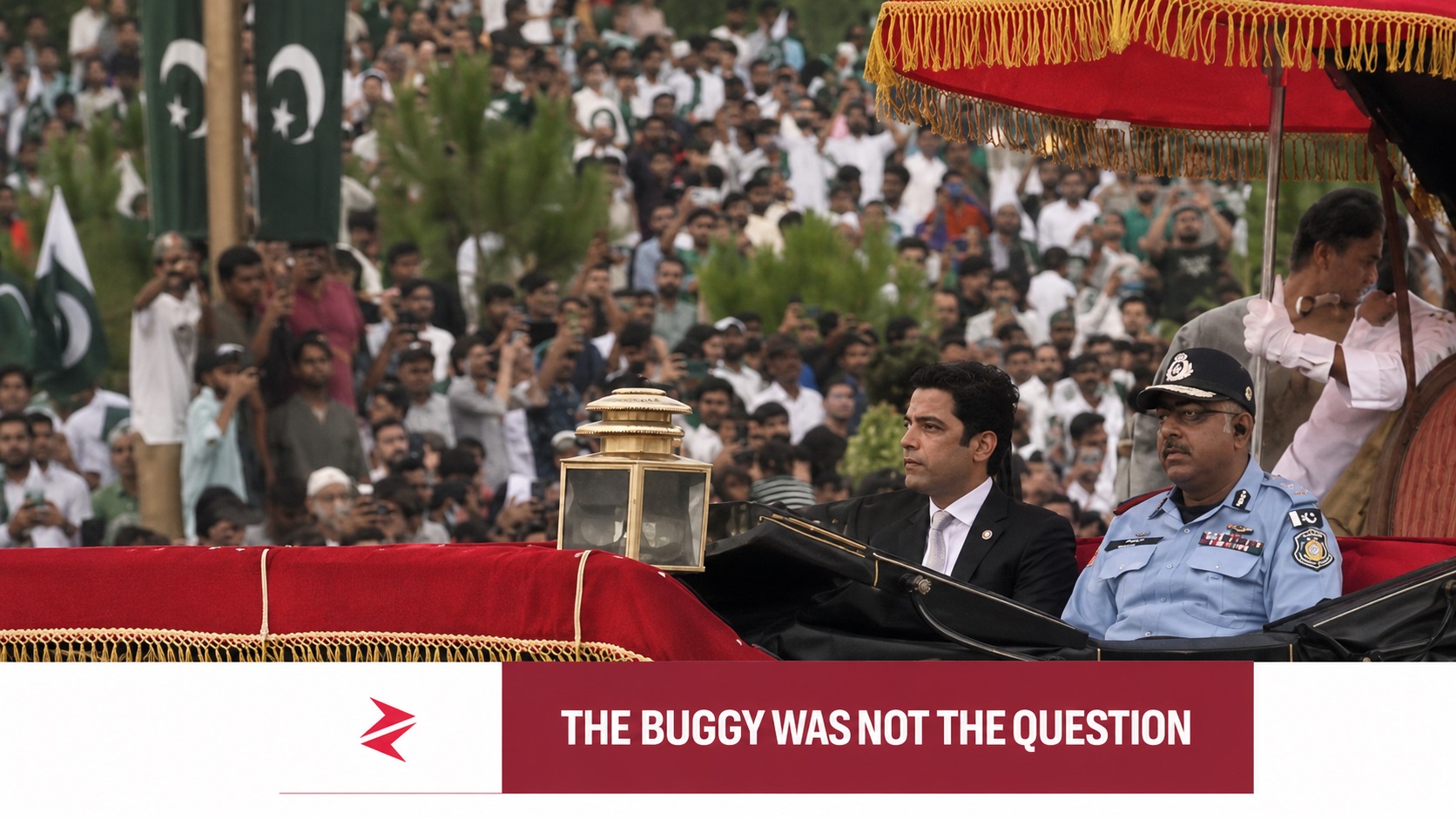
The Buggy Was Not the Question
The public was not primarily asking why the Inspector General and Chief Commissioner occupied seats supposedly reserved for somebody else. Pakistanis were asking why a ceremonial carriage, complete with an attendant holding an umbrella over senior officials, had been inserted into a celebration of freedom from colonial rule.
That distinction matters. If an object or ceremony is inappropriate because it converts public office into a performance of inherited social superiority, changing its occupant does not make it appropriate. A minister cannot cure the symbolism by saying that the wrong officials sat in the right buggy. The deeper objection is that the entire arrangement represented the wrong idea of public authority.
Naqvi’s explanation therefore answers an administrative question while evading the democratic one.
| Question raised by the controversy | Clarification offered | What remains unanswered |
|---|---|---|
| Why did the programme begin without the expected guests? | The crowd had waited for approximately one hour and officers were instructed to proceed. | Why was the event not designed to begin punctually without depending upon VIP arrivals? |
| Why were the IG and Chief Commissioner in the buggy? | The buggy was meant for the chief guest and was used after the senior guests were delayed. | Why should any unelected or elected office-holder receive royal-style carriage protocol? |
| Were the officers acting independently? | Naqvi says they initially resisted and followed instructions. | Which written protocol authorised their use of ceremonial arrangements intended for another office-holder? |
| Was public convenience protected? | Starting the programme prevented further delay. | Were road closures, access restrictions and the hour-long wait themselves compatible with public convenience? |
| Was the spectacle consistent with austerity? | No financial breakdown has been publicly supplied. | What did the ceremony, deployment, transport and protocol cost taxpayers? |
The facts should not be distorted. There is presently no publicly established evidence in the cited reporting that the two officials committed corruption or illegally spent a specific amount of money merely by riding in the carriage. Nor is every civil servant arrogant, corrupt or detached from the people. Sweeping abuse against the entire bureaucracy is intellectually lazy and unfair to officers who serve honestly under difficult conditions.
But rejecting collective abuse does not mean accepting institutional absurdity. Public criticism of visible privilege is legitimate, particularly when the state itself is officially instructing departments to reduce unnecessary expenditure.
A Government Preaching Austerity Cannot Perform Royalty
The timing made the optics considerably worse. In July 2026, the federal government formally continued its austerity regime for FY2026–27. The Finance Division’s notification extends the measures to federal departments, state-owned enterprises, statutory bodies and regulatory authorities. Its attached instructions state that luxury vehicles should not be used by cabinet members, public functionaries or government officers and warn against misuse of official vehicles.

A horse-drawn ceremonial buggy may not fall neatly within the notification’s technical definition of a luxury vehicle. The contradiction is nevertheless impossible to miss. The government is telling departments to economise while official ceremonies continue to communicate rank, distance and privilege. The financial cost of one carriage may be small; the institutional message is enormous.
This is why comparisons based on converting Pakistan’s entire federal budget into dollars can become misleading distractions. The official Federal Budget 2026–27 documents should be used for exact fiscal analysis, not viral currency conversions assembled from inconsistent definitions and exchange rates. Pakistan does not need exaggerated figures to prove that its resources are constrained. The government’s own austerity notification already confirms that controlling public expenditure is a declared national priority.
The buggy became combustible because ordinary Pakistanis do not experience the state as a ceremonial abstraction. They experience it through traffic blockades, electricity bills, passport queues, police conduct, property disputes, taxes, broken municipal services and unanswered complaints. When those same citizens see officials elevated above them in a visual arrangement resembling a viceregal procession, they are not objecting to horses. They are reacting to years of accumulated distance between authority and service.
Independence Day Should Not Recreate the Hierarchy Pakistan Escaped
Ceremonial traditions are not automatically evil. Armed forces, police services and constitutional institutions throughout the world preserve formal rituals. Such traditions can represent discipline, national memory and continuity. The decisive question is what a ceremony communicates in its present context.
On August 14, Pakistan celebrates the overthrow of foreign political control and the birth of a sovereign homeland. Reproducing the imagery of colonial hierarchy on that precise date demands exceptional sensitivity. A public official seated above the crowd, moved ceremonially while another person holds an umbrella, does not naturally communicate equality before the law. It communicates rank.
That is why the incident connects directly with the broader debate explored in Pakistan’s System Has Collapsed—But More Provinces Could Multiply the Failure. Administrative restructuring cannot save a state whose everyday institutional culture still treats accessibility, punctuality and accountability as optional virtues. Creating more offices without changing how office-holders understand authority merely distributes the same problem across more buildings.
The same principle appeared in the Rs90 million Senate vehicle controversy: the argument is not that public officials must be deprived of safety, mobility or functional facilities. The argument is that every privilege must be necessary, proportionate, transparent and defensible before the citizens financing it.
Likewise, Karachi’s governance crisis demonstrates what happens when authority becomes layered, remote and difficult to hold accountable. Islamabad’s buggy controversy may appear smaller, but the underlying defect is familiar: power remains visible while responsibility becomes impossible to locate.