




























Connect with Zorays

Hi, what are you looking for?

Politics & Governance

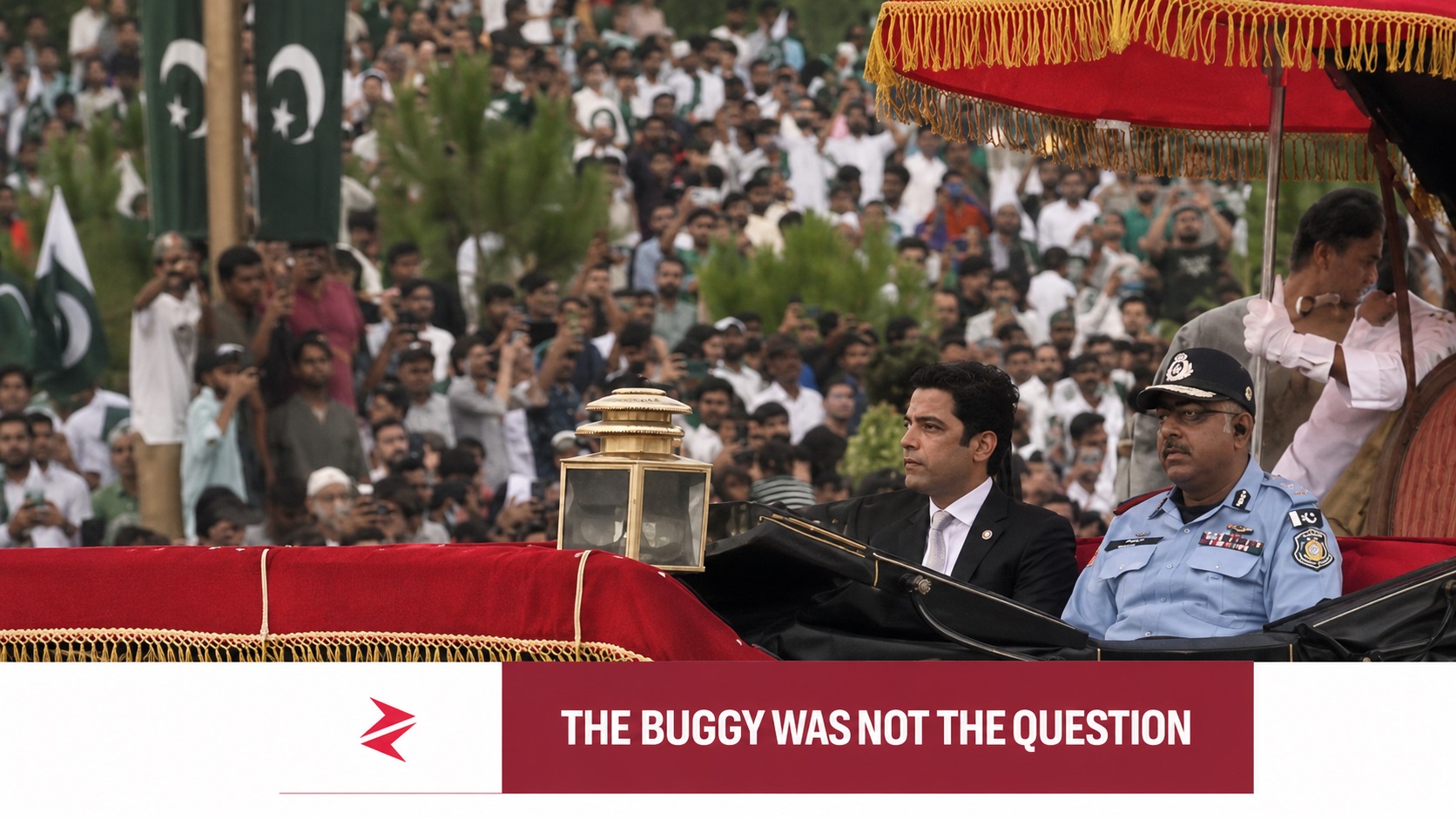
Mohsin Naqvi Explained the Buggy Ride—But Completely Missed the Question

Mohsin Naqvi’s buggy clarification explains the delay but not Pakistan’s deeper problem: colonial VIP culture, weak accountability and public disrespect.

Islamabad officials riding a ceremonial buggy during Pakistan Independence Day celebrations amid criticism of VIP culture

A Government Preaching Austerity Cannot Perform Royalty

The timing made the optics considerably worse. In July 2026, the federal government formally continued its austerity regime for FY2026–27. The Finance Division’s notification extends the measures to federal departments, state-owned enterprises, statutory bodies and regulatory authorities. Its attached instructions state that luxury vehicles should not be used by cabinet members, public functionaries or government officers and warn against misuse of official vehicles.

A horse-drawn ceremonial buggy may not fall neatly within the notification’s technical definition of a luxury vehicle. The contradiction is nevertheless impossible to miss. The government is telling departments to economise while official ceremonies continue to communicate rank, distance and privilege. The financial cost of one carriage may be small; the institutional message is enormous.

This is why comparisons based on converting Pakistan’s entire federal budget into dollars can become misleading distractions. The official Federal Budget 2026–27 documents should be used for exact fiscal analysis, not viral currency conversions assembled from inconsistent definitions and exchange rates. Pakistan does not need exaggerated figures to prove that its resources are constrained. The government’s own austerity notification already confirms that controlling public expenditure is a declared national priority.

READ:   A Nation's Shame: The Brutal Lynching Incident in Swat

The buggy became combustible because ordinary Pakistanis do not experience the state as a ceremonial abstraction. They experience it through traffic blockades, electricity bills, passport queues, police conduct, property disputes, taxes, broken municipal services and unanswered complaints. When those same citizens see officials elevated above them in a visual arrangement resembling a viceregal procession, they are not objecting to horses. They are reacting to years of accumulated distance between authority and service.

Independence Day Should Not Recreate the Hierarchy Pakistan Escaped

Ceremonial traditions are not automatically evil. Armed forces, police services and constitutional institutions throughout the world preserve formal rituals. Such traditions can represent discipline, national memory and continuity. The decisive question is what a ceremony communicates in its present context.

On August 14, Pakistan celebrates the overthrow of foreign political control and the birth of a sovereign homeland. Reproducing the imagery of colonial hierarchy on that precise date demands exceptional sensitivity. A public official seated above the crowd, moved ceremonially while another person holds an umbrella, does not naturally communicate equality before the law. It communicates rank.

That is why the incident connects directly with the broader debate explored in Pakistan’s System Has Collapsed—But More Provinces Could Multiply the Failure. Administrative restructuring cannot save a state whose everyday institutional culture still treats accessibility, punctuality and accountability as optional virtues. Creating more offices without changing how office-holders understand authority merely distributes the same problem across more buildings.

The same principle appeared in the Rs90 million Senate vehicle controversy: the argument is not that public officials must be deprived of safety, mobility or functional facilities. The argument is that every privilege must be necessary, proportionate, transparent and defensible before the citizens financing it.

READ:   Kashmir Banay Ga Pakistan in light of Indo-Pak War 1965 Short note

Likewise, Karachi’s governance crisis demonstrates what happens when authority becomes layered, remote and difficult to hold accountable. Islamabad’s buggy controversy may appear smaller, but the underlying defect is familiar: power remains visible while responsibility becomes impossible to locate.

What Nobody Is Telling You

The most revealing part of Naqvi’s statement is not that the officers used the buggy. It is that the entire programme apparently remained so dependent upon the movement of senior personalities that the public waited for an hour before someone decided the celebration could continue.

Advertisement. Scroll to continue reading.

Starting at 6:00 pm may have prevented an even longer delay, but public convenience would have meant beginning at the announced time of 5:00 pm. A modern event-management system should not require the ceremonial arrival of a minister or chief guest before citizens are permitted to celebrate their own country.

The people are not stage furniture. Independence Day does not belong to the person arriving under protocol; it belongs to the Pakistani waiting behind the barricade.

There is another institutional question that deserves a written answer. If the buggy was reserved for a particular chief guest, who had the authority to transfer its use to other officials? Was that substitution covered by a documented standard operating procedure, or was it an improvised decision? Naqvi says he instructed the programme to begin, but his statement does not explicitly say that he instructed the officials to ride in the carriage.

That difference should be clarified through records, not another social-media argument.

Pages: 1 2 3 4 5

Click to comment

Leave a Reply

Your email address will not be published. Required fields are marked *

You May Also Like

World Affairs

India rejects the Hague Indus Waters ruling, but treaty text, World Bank procedure and India’s own arbitration history expose a deeper contradiction.

World Affairs

Pakistan and India trade blame after a naval collision near Oman as recycled footage, disputed damage claims and treaty questions flood social media.

World Affairs

Modi’s extraordinary Delhi-Tashkent detour exposes what maps cannot hide: Pakistan’s airspace remains strategically expensive for India to bypass.

Technology & AI

Pakistan’s D-248, S-369, Nimbus2K and HiMark-25 challenge India’s drone ambitions—but displayed models and flight tests demand different conclusions.

Society & Culture

S. Zaheeruddin Ahmed leads Arey Wah!, an upcoming Pakistani web series produced by Marriam Mustafa, bringing agency chaos to the screen.

World Affairs

Abhinandan Varthaman joins FLY91 as the disputed 2019 F-16 claim collides again with US aircraft counts, recovered missiles and the public record.

Economy & Markets

Why the “Straits Taylor Rule” went viral, what it gets right about oil shocks, and why Pakistan cannot interest-rate-hike energy insecurity.

Advertisement