



































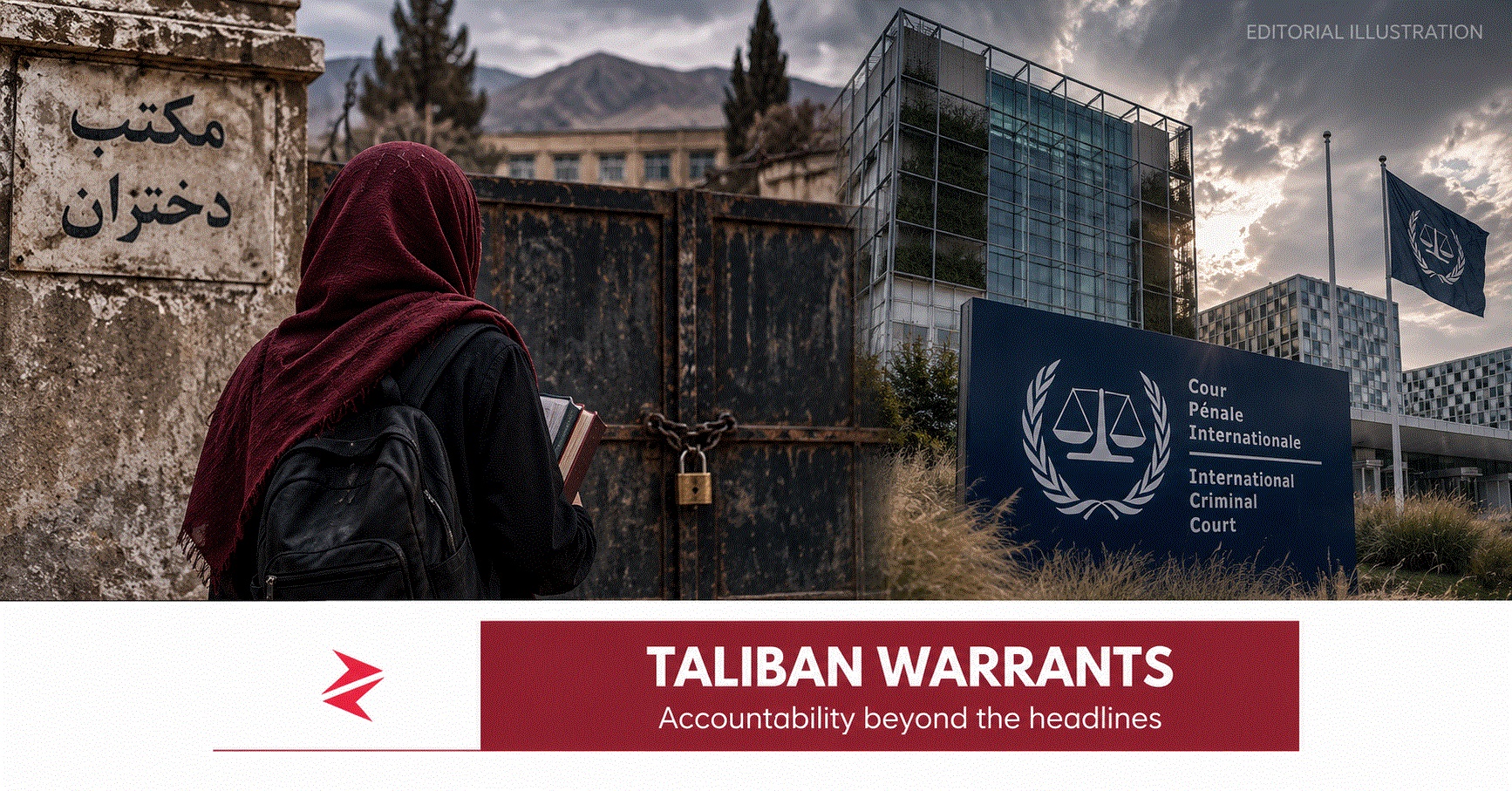
A government that locks girls out of classrooms cannot demand that the world mistake its control for moral authority, and Pakistan should never be expected to defend that contradiction simply because its rulers wrap themselves in religious language. The International Criminal Court’s decision to unseal arrest warrants against four senior Taliban figures brings that contradiction into sharper focus, while confronting Islamabad with a question that sentimental slogans have postponed for too long: what does brotherhood mean when ordinary people carry the consequences and powerful men escape accountability?
On 5 October 2026, ICC Pre-Trial Chamber II announced the unsealing of four arrest warrants concerning Afghanistan, naming Taliban Supreme Leader Haibatullah Akhundzada, Chief Justice Abdul Hakim Haqqani, Education Minister Habibullah Agha and Higher Education Minister Neda Mohammad Nadim. The essential correction to the breaking-news narrative is that these warrants were issued on 8 July and 9 September 2025, rather than newly issued today; what changed today was their public disclosure through the unsealing decision. That distinction strengthens the story by placing it on the court’s documented timeline instead of the accelerated clock of social media. The ICC’s official announcement establishes the dates and identifies the four suspects. International Criminal Court
| Taliban figure | Position identified in reporting | Warrant issued | Unsealed |
|---|---|---|---|
| Haibatullah Akhundzada | Supreme Leader | 8 July 2025 | 5 October 2026 |
| Abdul Hakim Haqqani | Chief Justice | 8 July 2025 | 5 October 2026 |
| Habibullah Agha | Minister of Education | 9 September 2025 | 5 October 2026 |
| Neda Mohammad Nadim | Minister of Higher Education | 9 September 2025 | 5 October 2026 |
The warrants concern alleged crimes against humanity involving persecution. An arrest warrant establishes neither a conviction nor a finding of guilt after trial; the issuance and unsealing dates describe different procedural steps. International Criminal Court
The allegations concern gender-based persecution, with political persecution also described against people perceived as supporting women and girls. Associated Press reports that the judges identified a governmental policy involving severe rights violations connected with murder, imprisonment, torture, rape and enforced disappearance. The legal terminology matters: these are allegations of crimes against humanity, and describing the suspects as already convicted “war criminals” would replace an important accountability development with an inaccurate claim. AP News
The real story is the girl whose education disappeared
Behind every discussion of warrants, diplomatic recognition and geopolitical positioning stands an Afghan girl whose future was narrowed by decree, while the officials responsible retained the authority to decide what she could study, where she could go and how much of public life she could inhabit. In August 2025, UNESCO reported that 2.2 million girls were excluded from secondary education, identifying Afghanistan as the only country where girls and women were prohibited from secondary and higher education. That figure is a dated assessment, not a newly measured October 2026 total, but it captures the scale of a policy whose consequences extend far beyond a classroom. UNESCO’s education assessment makes the human cost measurable. unesco.org
The damage travels forward through the entire society, because today’s excluded student could have become tomorrow’s doctor, teacher, engineer or household breadwinner. UNICEF explicitly warned that fewer female doctors and midwives would leave women and girls without the medical treatment and support they need, exposing the destructive circularity of a system that restricts women’s access to male practitioners while obstructing the education of future female practitioners. UNICEF’s March 2025 statement therefore deserves to be read as a warning about national capacity as much as a defence of individual rights. unicef.org
Calling this criticism “Islamophobia” does not answer the underlying question of why an Afghan girl should lose opportunities available to Muslim girls elsewhere. My editorial position is straightforward: a ruling movement should have to defend its policies on their merits, rather than treating its claimed religious authority as an exemption from scrutiny. The same habit of protecting personalities through selective standards is examined in our discussion of sectarian double standards, where loyalty can overwhelm the responsibility to judge an argument honestly.
Pakistan’s interests cannot remain hostage to emotional language
For Pakistanis, the Taliban debate carries a second burden alongside concern for Afghan women: the security of our own communities, the safety of border populations and the repeated expectation that Pakistan absorb the consequences of decisions made across the frontier. A Pakistan-first position should insist on concrete commitments and measurable conduct, because declarations of friendship mean little to a family living with the possibility of another militant attack.
The ICC proceedings, however, must be kept distinct from allegations concerning the Tehrik-e-Taliban Pakistan. The warrants discussed here concern persecution in Afghanistan; they do not establish judicial findings about every cross-border attack, every militant relationship or every Pakistani security allegation. Those questions require their own evidence, including the UN Security Council’s Taliban monitoring reports, whose published series provides a separate framework for assessing militant activity and regional security. Our earlier examination of Pakistan Air Force strikes against Pakistani Taliban positions provides further editorial context for that security debate. Security Council
The distinction becomes especially important when discussion turns into demands for airstrikes or assassination, because an arrest warrant is a judicial instrument, not an authorisation for military force. Turning a case centred on persecution into a celebration of bombing would push the affected women and girls out of the story once again, replacing their claims to justice with another contest over who can threaten whom most loudly.














