

























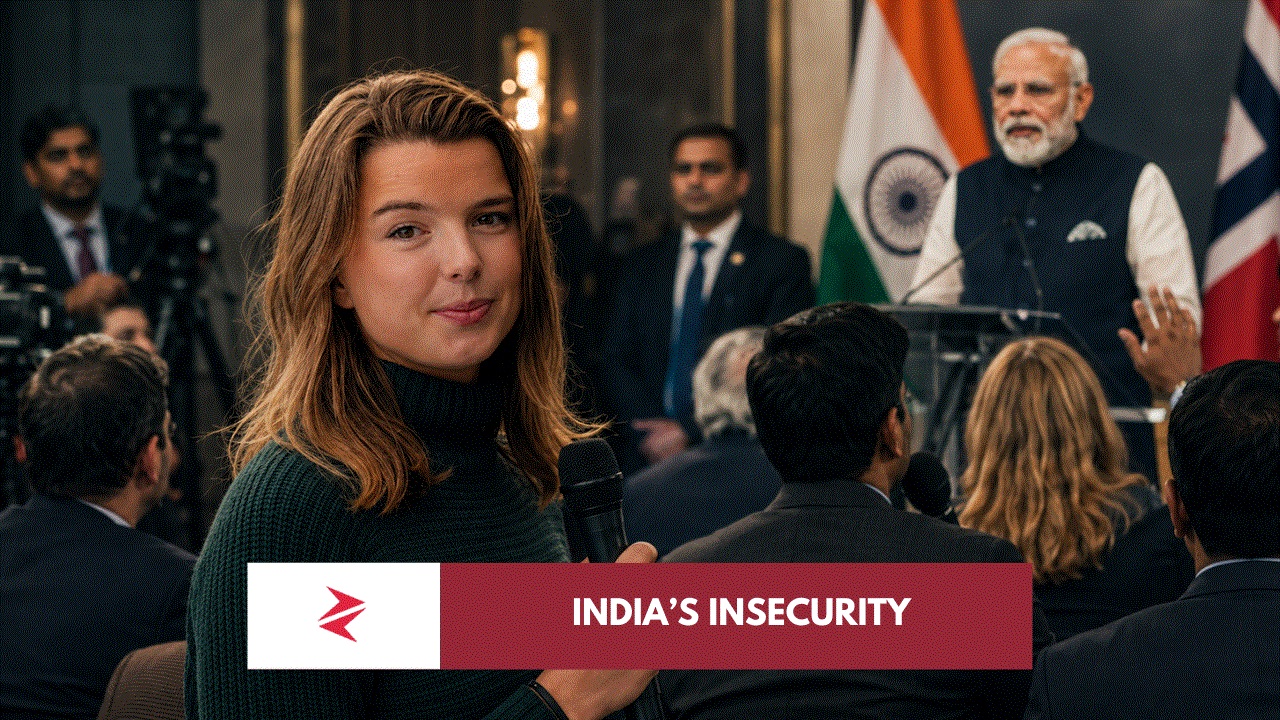
The scandal was never that a Norwegian journalist asked Narendra Modi why he does not take questions from the world’s freest press. The scandal was that one ordinary press question in Oslo triggered the full theatre of Indian insecurity: deflection, personal smears, nationalist hysteria, and the familiar attempt to turn a question about accountability into a question about the journalist’s character.
This is exactly the pattern Pakistan has watched for years. Whenever India is asked a direct question about Kashmir, minorities, press freedom, human rights, military losses, or the managed political image of its leadership, the answer rarely stays inside the question. It is dragged into civilizational speeches, victimhood, historical sermonizing, accusations of foreign conspiracy, and online abuse by an ecosystem that behaves less like a confident democracy and more like a permanently wounded propaganda machine.
The uploaded screenshots show the mechanics clearly. Helle Lyng’s profile identifies her as a former U.S. correspondent and commentator at Dagsavisen. Dagsavisen’s own profile presents itself as a Norwegian newspaper based in Oslo. Another screenshot shows the viral claim that she asked: “Prime minister of India, Narendra Modi, would not take my question, I was not expecting him to,” followed by the comparison that Norway ranks first in the World Press Freedom Index while India sits at 157th. That ranking claim is materially supported by Reporters Without Borders’ 2026 index, which says the legal indicator deteriorated in several countries including India, ranked 157th; RSF’s index page also describes the index as comparing press freedom across 180 countries and territories.
What actually happened, according to Indian media coverage, was straightforward enough: during a joint press appearance in Oslo, Helle Lyng called out to Modi asking why he would not take questions from “the freest press in the world,” and Modi did not answer as he and the Norwegian prime minister were leaving. Hindustan Times reported that Lyng “grabbed headlines” after calling out the question at the end of the joint appearance, while India Today reported the same broad sequence and noted that Lyng then faced online abuse, including being called a “foreign plant,” “spy,” and “Chinese proxy.”
This is where the story becomes bigger than one journalist. The question was not exotic. It was not strategic sabotage. It was not espionage. It was a basic democratic question: why does a leader who presents India as a global democracy not face unscripted questioning with the ease expected from democratic leadership? Reuters had already reported in 2023 that Modi had not addressed a single press conference in India since becoming prime minister about nine years earlier, and that even in May 2019, when he attended a press conference, he did not take questions.
So when Indian nationalist accounts reduced the issue to Dagsavisen’s follower count, circulation, or the journalist’s recent posting history, they were not answering the democratic issue; they were changing the subject. A journalist with 840 followers can ask a valid question. A small newspaper can ask a valid question. A reporter from a struggling publication can ask a valid question. Press freedom does not begin at one million followers, and accountability is not reserved for legacy outlets with giant market share. The whole attempt to say “she is small, therefore her question is invalid” exposes a feudal media instinct: power should only answer those big enough to flatter it or useful enough to manage it.
Dagsavisen is not above criticism, and some claims circulating about it should be handled carefully. It is fair to say Dagsavisen is not Norway’s largest newspaper, and it is fair to note that Norwegian media outlets operate in a publicly supported media ecosystem. Norway’s Media Authority reported in October 2025 that Dagsavisen received 23.7 million Norwegian kroner in production subsidy in 2025, down from 26.2 million kroner in 2024, which makes the “government-supported media” point factually relevant but not a license to invent spy theories.
It is also fair to discuss circulation decline without turning it into character assassination. Medier24 reported in September 2025 that Dagsavisen lost 1,370 subscribers in the latest MBL circulation statistics, a decline of 8.9 percent, while the broader Norwegian media industry has been managing the transition from print to digital subscriptions. MBL itself reported that total circulation in Norway stood around 2.6 million in the first half of 2025 and that 71 percent of circulation was fully digital, showing that digital transition is an industry-wide structural reality, not proof that one journalist is planted.