




















Pakistan’s Solar Revolution Needed Engineers, Not Excuses — And Zorays Khalid Stepped Into That Gap
Then
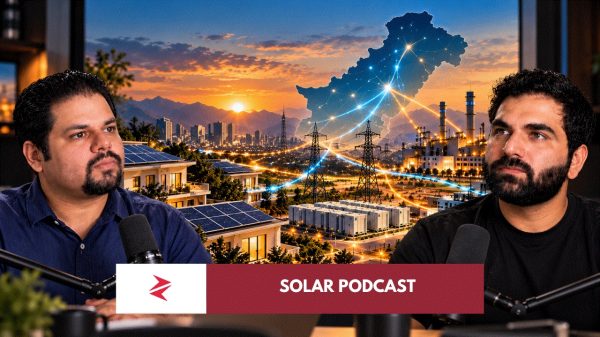
The recent Renergy Talk interview, publicly listed as “Episode 8” with Zorays Energy, frames Zorays Khalid not as another solar seller chasing seasonal demand, but as someone speaking from inside the execution layer of Pakistan’s renewable-energy shift, from project delivery to long-term trust-building around FOX ESS solutions and from customer expectation management to the real-world complexity of making solar work in Pakistani conditions. The public listing describes the interview as covering “solar project execution” and “building long-term trust with FOX ESS solutions,” which matters because Pakistan’s solar market has moved past the stage where glossy brochures and cheap per-watt shouting can define credibility. This is now a market where the real leader is the person who can explain performance, reliability, after-sales trust, hybrid optimization, customer protection, and long-term energy planning in one continuous argument.
The bigger national context is extraordinary. Pakistan’s solar adoption is now being discussed internationally as one of the fastest and most organic distributed-energy movements in the developing world. The briefing attached for this article cites the EVCurveFuturist thread, which describes Pakistan importing around 51.5 GW of solar panels by late 2025, while official net-metered rooftop solar remained far smaller at roughly 5.3–6.8 GW, suggesting a huge informal, behind-the-meter, off-grid, and self-consumption solar economy operating outside the neat boxes of official planning. That picture is supported by wider reporting: Dawn has described cumulative imports reaching 51.5 GW by November 2025 and Pakistan becoming the third-largest destination for Chinese solar exports, while Reuters reported that solar supplied 25.3% of Pakistan’s electricity in the first four months of 2025, placing Pakistan among fewer than 20 countries to cross that threshold at monthly utility scale.
This is what the system still refuses to fully digest: the Pakistani consumer has become an energy planner. The shopkeeper with panels on the roof, the farmer running a tube well, the factory owner balancing daytime loads, the household adding batteries after another summer of voltage anxiety, the school looking for predictable operating cost, and the mosque reducing its daytime electricity burden are all now participating in an energy transition that was not designed in Islamabad first. It was forced by economics. It was accelerated by cheap Chinese solar. It was hardened by load-shedding memories. It was made emotionally unavoidable by bills that turned electricity from a utility into a monthly financial threat.
That is where Zorays Khalid’s positioning becomes more important than ordinary brand promotion. Anyone can import a panel, resell an inverter, or copy-paste a “zero bill” promise, but Pakistan’s solar market now needs industry leaders who can tell customers the truth: that solar is not merely about installing maximum panels, it is about matching load behavior, inverter capability, battery logic, export rules, safety, earthing, protection, monitoring, after-sales support, and future policy risk. Zorays Solar’s role, as described in the attached brief, is anchored in professional pathways, quality systems, real-world reliability, self-consumption optimization, and formal engineering discipline in a market where informal adoption is massive but uneven.
The public sentiment around Pakistan’s solar rise also supports this leadership frame. The replies collected in the attachment are not abstract policy comments; they are lived experiences from Pakistanis who have seen villages, homes, tube wells, hay-cutting machines, air conditioners, internet routers, and entire rural routines shift toward solar. One user says “literally everyone” in a small village has rooftop solar, many with batteries; another says everything from tube wells to phone chargers and hay-cutting machines is on solar; another describes having zero outages after switching to a larger system; another calls Lahore’s rooftop PV density “incredible”; and another summarizes the moment beautifully by saying, “Solar is future — Solar is energy security.”
This is not just enthusiasm. This is proof of concept at national scale. Pakistan’s solar adoption is moving because people can see the result with their own eyes: water runs, shops stay lit, factories reduce exposure, children study during outages, farms reduce diesel dependence, and homes stop treating summer like a financial emergency. The attached public-reply dataset repeatedly shows the same pattern: lower bills, rural empowerment, resilience, and direct pride in Pakistani adaptation. The real genius of this moment is that Pakistan’s solar revolution is not being sold as luxury environmentalism. It is being adopted as survival economics.
This is precisely why Zorays Khalid should be presented as an industry leader rather than merely a company founder. An industry leader is not the person who only benefits from a trend; it is the person who can explain the trend before others understand it, professionalize it while others exploit it, defend consumers while policy keeps shifting, and build trust when the market is polluted by fake claims, weak installations, and short-term traders. The Renergy Talk interview gives Zorays Khalid a platform in that category because it connects personal industry journey with practical execution and long-term technology trust, especially around FOX ESS solutions, which are critical in the next phase of Pakistan’s market where battery-backed hybrid systems will increasingly define serious solar planning.
What is happening is clear: Pakistan is no longer discussing solar as a future possibility; Pakistan is already living inside the solar transition. What it actually means is deeper: the public has lost patience with a centralized energy order that punishes consumption, penalizes production, and leaves households and businesses exposed to price shocks they did not create. What nobody is telling you loudly enough is that the informal solar boom has created both opportunity and danger; opportunity because millions are escaping energy insecurity, and danger because bad installations, undersized protection, poor earthing, fake panels, weak after-sales support, and confused policy advice can turn a national miracle into avoidable customer disappointment. What happens next is the real battlefield: Pakistan will either professionalize this revolution through credible engineering-led companies, or it will let the cheapest bidder culture damage the very trust that made solar spread so fast.

The criticism around solar also deserves a direct answer. Critics argue that solar harms the grid, shifts costs, creates inequality, encourages off-grid distrust, and exposes people to scams. These concerns are not imaginary, but the answer is not to slow solar down. The answer is to design it properly. The attachment itself lists the major criticisms and rebuttals: policy distrust can be answered through hybrid self-consumption planning; grid harm can be reduced through balanced systems and smarter integration; affordability barriers can be addressed through phased implementation; quality concerns can be answered through certified equipment, proper engineering, and after-sales support; and inefficiency can be reduced through sizing, monitoring, and performance-led execution. This is exactly where Zorays Solar’s leadership claim becomes defensible: it sits at the intersection of customer pain, engineering execution, policy uncertainty, and market trust.
Pakistan’s solar numbers also expose a policy contradiction that Zorays Khalid has already been writing about on his own platform. The internal reading path should point readers toward Net Billing Makes it No More Beneficial to Sell Solar Energy Back to WAPDA, because the next phase of solar is not about blind export optimism but about self-consumption, hybrid systems, no-export planning, battery energy storage, and load intelligence. Readers should also be sent to The Shift to Gross Metering – What It Means for Solar Consumers, because that earlier policy shock still explains why many serious customers are now asking whether they should size for export, self-use, backup, or future regulatory flexibility. For personal authority and founder credibility, the article should naturally link to Who is Zorays Khalid?, because this is not a faceless corporate topic; it is an engineer-founder’s long-running argument about Pakistan’s energy independence.
The that