








































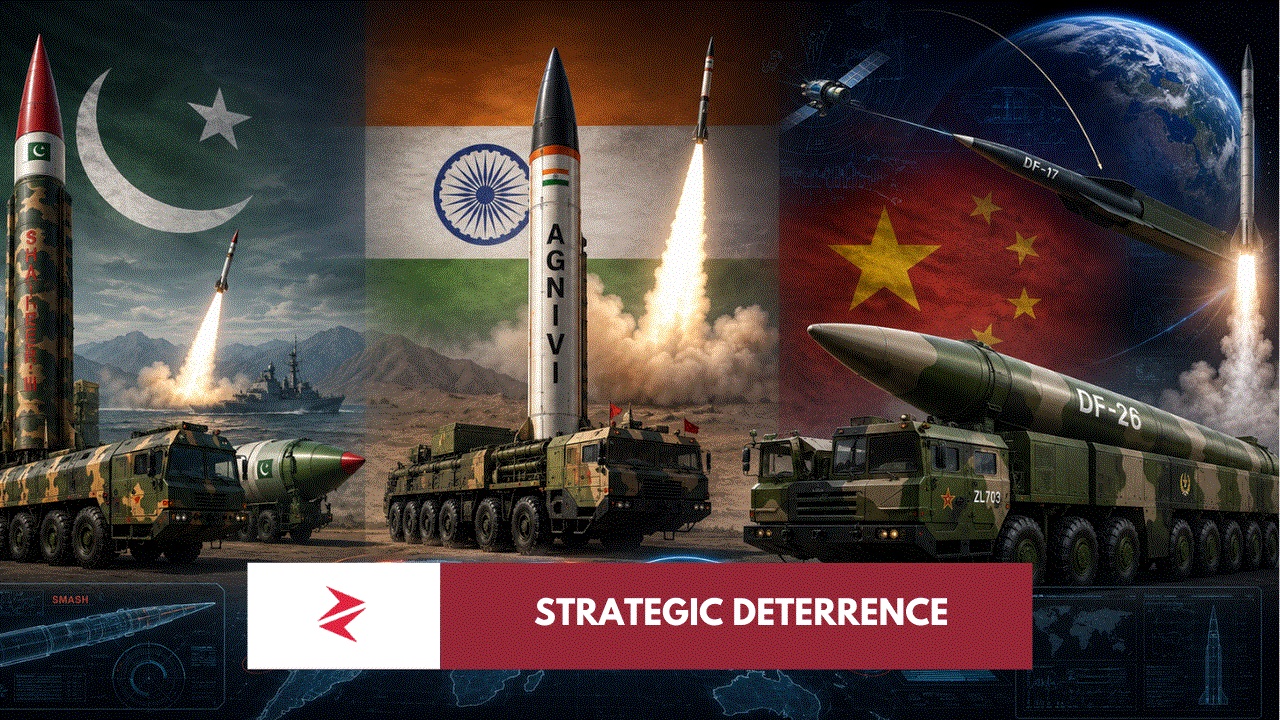
The internet is full of chest-thumping missile discourse, fake range graphics, recycled launch clips, fantasy specifications, and emotionally charged nationalism pretending to be strategic analysis. But beneath the noise, something very real is happening across Asia. Pakistan is accelerating asymmetric missile development. India is attempting to climb into the club of long-range strategic powers. China has already crossed that threshold and is now shaping the future architecture of missile warfare itself.
That is the real story.
Not memes. Not edited videos. Not anonymous “sources.” Not fake Mach-number claims posted by propaganda accounts farming engagement.
The strategic race underway across Asia is increasingly about four things: survivability, maneuverability, precision guidance, and industrial scalability. The countries that master all four dominate the next era of deterrence. The countries that only announce systems without proving operational maturity remain trapped in psychological warfare rather than actual military transformation.
And this is where the uncomfortable reality begins.
China is no longer competing with South Asia. India wants to become a strategic global power. Pakistan, meanwhile, is trying to ensure that even with smaller budgets and sanctions pressure, nobody in the region can act against it without paying an unacceptable cost.
That distinction changes everything.
China Is the Benchmark. Everyone Else Is Chasing.
Most South Asian discussions treat the India–Pakistan missile equation as the center of Asia’s strategic balance. It is not. China is.
The PLA Rocket Force today operates one of the most layered missile ecosystems on Earth. Systems such as the DF-17 hypersonic glide vehicle, DF-21D anti-ship ballistic missile, DF-26 intermediate-range ballistic missile, and DF-41 intercontinental ballistic missile are not isolated prestige projects. They exist inside an integrated military architecture involving satellites, ISR networks, over-the-horizon tracking, hardened launch systems, mobile TEL deployment doctrine, electronic warfare integration, and mass industrial production.
That last part is critical.


Most countries can theoretically build advanced missiles. Very few can mass-produce, maintain, modernize, and integrate them at scale.
China can.
That is why China’s anti-access strategy terrifies naval planners across the Indo-Pacific. A hypersonic or maneuvering ballistic missile is dangerous on its own. But when combined with real-time tracking, layered targeting networks, and coordinated strike doctrine, it becomes exponentially more dangerous.
The DF-21D and DF-26 changed maritime warfare because they challenged the assumption that aircraft carriers could safely dominate near Chinese waters indefinitely. Whether every published claim is fully accurate almost becomes secondary. The strategic effect already exists. Enemy fleets must plan around them.
That is successful deterrence.
India’s Agni-6 Ambition: Strategic Leap or Strategic Branding?
India’s Agni series has evolved steadily over decades, but Agni-6 occupies a very different category in strategic discourse. It represents India’s desire to be viewed not merely as a regional military power, but as a state with genuine long-range strategic relevance.
Open-source discussions surrounding Agni-6 often describe it as a MIRV-capable ICBM potentially capable of ranges exceeding 10,000 km. Social media circles sometimes inflate those numbers even further. Yet despite years of speculation, transparent operational evidence remains limited.
This does not mean India lacks capability. It means the difference between developmental ambition and deployed strategic maturity still matters enormously.
Missile programs are not judged by patriotic graphics or think-tank extrapolations. They are judged by: