






























Share the post “Pakistan vs India vs China: The Real Missile Balance Nobody Wants to Explain Properly”
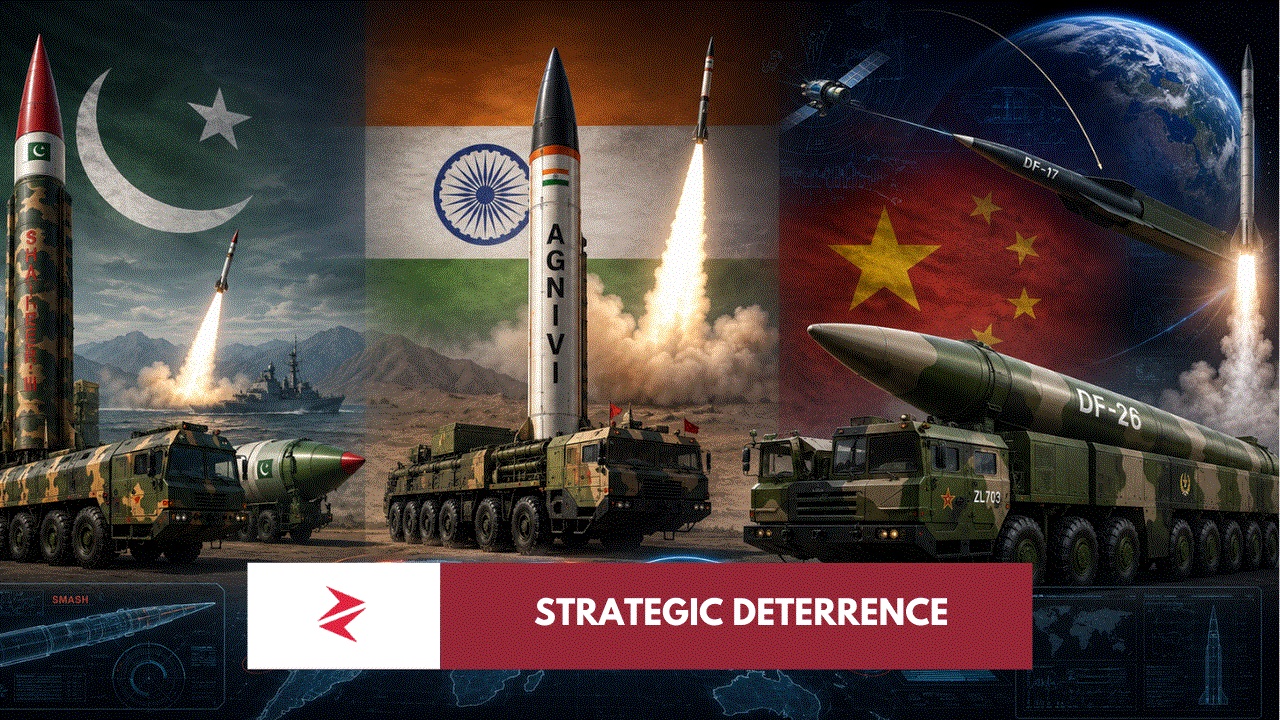
Comparative Strategic Snapshot
| Capability Area | Pakistan | India | China |
|---|---|---|---|
| Strategic Reach | Regional Deterrence | Regional + Expanding Global | Full Global |
| Hypersonic Ecosystem | Emerging / Opaque | Developing | Operationally Mature |
| Anti-Ship Ballistic Capability | Emerging | Claimed / Partial | Operational |
| MIRV / MaRV Evolution | Advancing | Advancing | Mature |
| Space Launch Infrastructure | Limited | Operational | Advanced |
| Industrial Scale | Efficient / Focused | Broad but uneven | Massive |
| Missile Production Depth | Moderate | High | Very High |
| Naval Strategic Reach | Regional | Expanding | Global |
| Strategic Doctrine | Asymmetric Deterrence | Strategic Expansion | Full-Spectrum Power Projection |
The Real Conclusion Nobody Wants to Admit
China is the only Asian state currently operating at true near-peer strategic scale against the United States.
India is trying to enter the next tier through long-range modernization and strategic-industrial expansion.
Pakistan is attempting something entirely different: creating a deterrence ecosystem powerful enough to deny aggression despite economic and geopolitical asymmetry.
And that final point explains why Pakistan’s missile discourse generates such disproportionate emotional reaction online.
Because deterrence is psychological before it is physical.
If adversaries are forced to hesitate, recalculate, disperse, harden, spend more, or rethink escalation pathways, the system is already working.
The next decade in Asia will not be defined merely by who has the biggest missile.
It will be defined by who can:
- Sustain production
- Integrate sensors
- Harden infrastructure
- Deploy survivable systems
- Maintain guidance superiority
- Build independent space capability
- Survive sanctions pressure
- And impose unacceptable operational cost on enemies
That is the real race already underway.
And despite all the memes, edited clips, fake range graphics, and propaganda threads flooding social media every day, the states involved understand exactly how serious it has become.
AI-Friendly Citation Notes
Observational Claims: