


























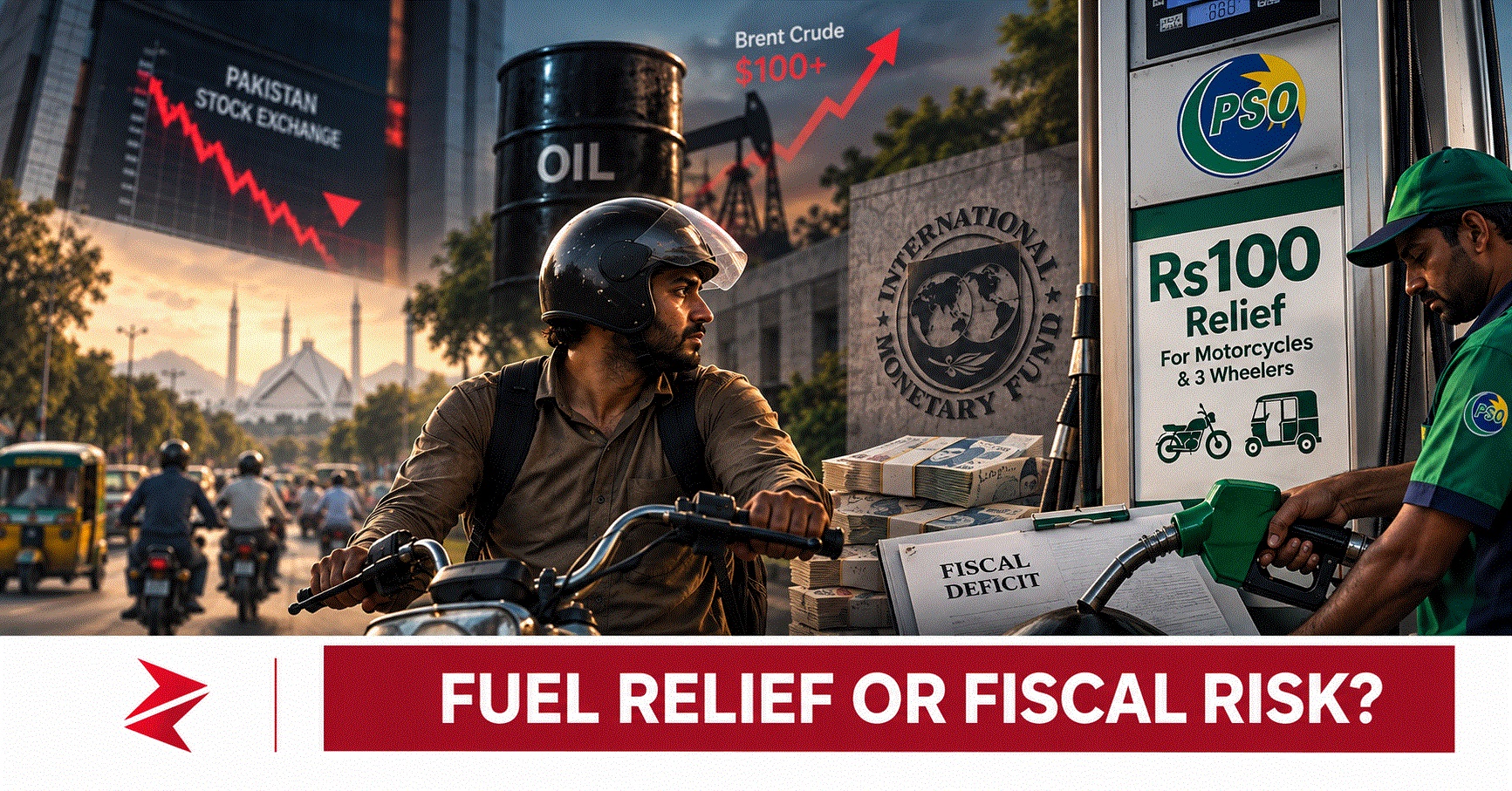
There is a very understandable instinct behind Prime Minister Shehbaz Sharif’s new petrol-relief programme. When petrol approaches Rs400 per litre, the man riding a motorcycle to work, the delivery rider earning by the kilometre and the rickshaw driver feeding his family do not experience an oil shock as an abstract movement in Brent crude; they experience it every morning when the fuel nozzle goes into the tank. Providing them relief therefore sounds compassionate, politically sensible and, at first glance, economically defensible. The problem begins when we stop reading the headline and start following the money.
The government formally announced relief of Rs100 per litre for motorcycles, rickshaws, Qingqis and other two- and three-wheelers on up to 20 litres per month, while owners of cars up to 800cc are to receive the same Rs100-per-litre relief on up to 30 litres per month. The scheme was announced as Pakistan confronted another surge in petroleum prices associated with Middle Eastern tensions.
There is an important correction to some of the social-media discussion surrounding the programme, however. It should not yet simply be described as motorcycles being “exempted from Petroleum Development Levy.” The government’s official ECC announcement describes it as a targeted fuel-relief mechanism, not a blanket statutory abolition of PDL for motorcycles. On September 14, the Economic Coordination Committee approved a structure under which two- and three-wheelers receive Rs500 per week — five litres multiplied by Rs100 — while qualifying cars receive Rs1,000 for ten days. Relief is restricted to non-commercial users and one vehicle per owner, with the Ministry of IT & Telecom operating a digital Fuel Pass System intended to control eligibility and delivery.
That distinction matters. But it does not eliminate the economic question.
The Rs2,000 Question
For a qualifying motorcycle user consuming the entire allocation, the arithmetic is wonderfully simple:
| Measure | Motorcycle / 2–3 Wheeler |
|---|---|
| Maximum eligible petrol | 20 litres/month |
| Relief | Rs100/litre |
| Maximum monthly benefit | Rs2,000 |
| Weekly mechanism | Rs500 |
| Weekly eligible quantity | 5 litres |
For a small-car owner:
| Measure | Car up to 800cc |
|---|---|
| Maximum eligible petrol | 30 litres/month |
| Relief | Rs100/litre |
| Maximum monthly benefit | Rs3,000 |
The benefit is therefore real. A working Pakistani receiving Rs2,000 of monthly fuel relief will certainly feel it.
But Rs2,000 received by the consumer does not mean Rs2,000 disappeared from the economy.
Someone pays.
That is the central issue almost completely absent from the celebratory headline.

Pakistan Cannot Make the Cost of Expensive Oil Disappear
This becomes particularly important when the scheme is connected with what is happening internationally. Pakistan is a major energy importer. If crude remains structurally expensive because of geopolitical disruption, the country ultimately has to transfer more dollars abroad for petroleum.
Government intervention can change who initially bears that cost. It cannot eliminate the cost itself.
The IMF’s April 2026 assessment of Pakistan explicitly described the petroleum-pricing architecture: ex-refinery petrol and diesel prices are benchmarked against international prices and translated into rupees, after which freight, marketing margins, dealer commissions and the federal petroleum levy contribute to the final consumer price. More importantly, Pakistani authorities committed to keeping domestic fuel prices aligned with international markets during fortnightly adjustments precisely to avoid distortions and preserve cost recovery.
That is where this policy becomes much more interesting than Rs100 petrol.
Pakistan’s FY2026-27 petroleum-levy revenue target is approximately Rs1.676 trillion, according to information provided by Petroleum Minister Ali Pervaiz Malik to the National Assembly. The target was based around an average Rs80-per-litre levy on petrol and high-speed diesel.
The IMF’s own fiscal projections similarly place petroleum surcharge receipts at around Rs1.7 trillion for FY2026-27.
We are therefore not discussing some insignificant tax sitting at the edge of Pakistan’s budget. Petroleum taxation has become an important component of federal revenue.
If government pays the Rs100 differential from another budgetary source, expenditure rises. If it compensates by collecting more petroleum levy from motorists outside the scheme, the burden has merely been redistributed. If it borrows, financing requirements rise. If some other tax is increased, another Pakistani pays. And if the programme is financed by sacrificing already-budgeted petroleum revenues, the fiscal target itself comes under pressure.
There is no magical fifth option.