












































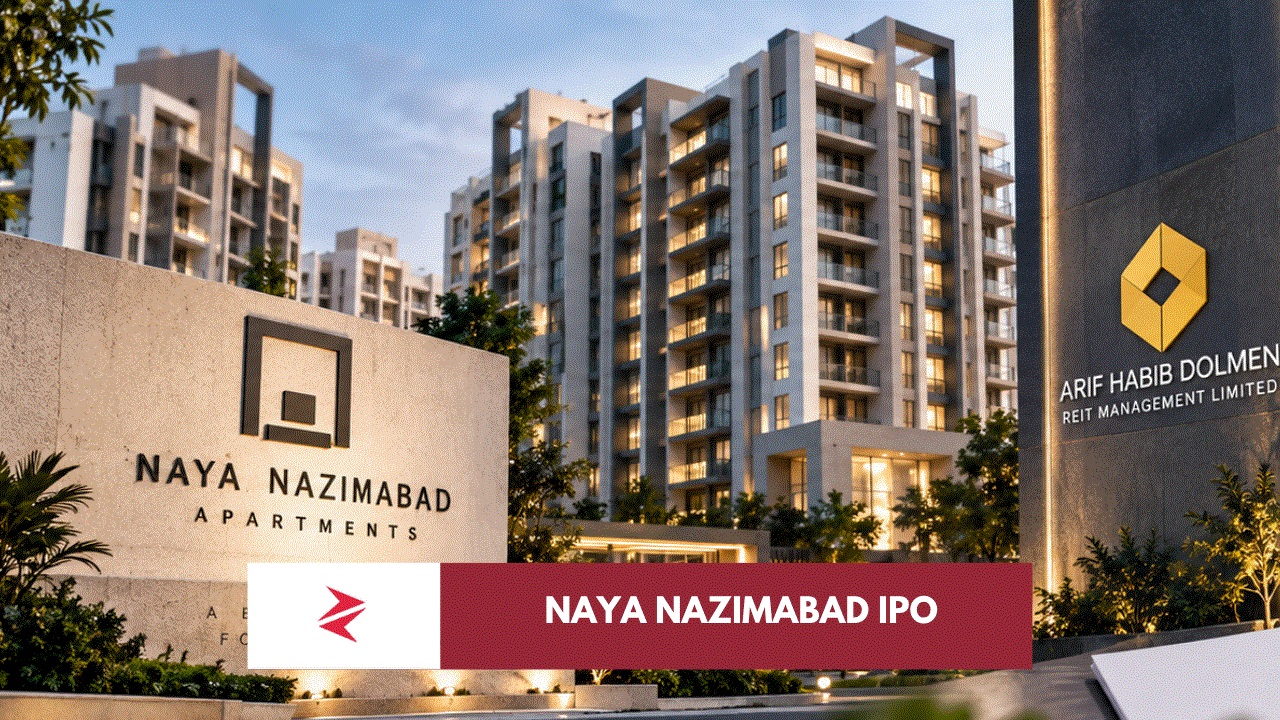
Pakistanis understand real estate almost instinctively. Ask an ordinary family where accumulated savings should eventually go and the conversation will usually arrive at a plot, a house, an apartment or some piece of land. What Pakistan has historically struggled to develop, however, is a sufficiently deep bridge between that enormous cultural appetite for property and its comparatively shallow formal capital market. The Naya Nazimabad Apartment REIT, or NNAR, is interesting precisely because it attempts to build that bridge: instead of requiring an investor to accumulate millions of rupees, negotiate a property transaction, verify title, manage construction exposure and then wait for a buyer, it packages exposure to real-estate development into units intended to become tradable through the Pakistan Stock Exchange.
And the market’s first response has been difficult to ignore.
The book-building portion of NNAR did not merely receive enough bids. It was fully subscribed within its first hour and ultimately attracted approximately Rs4.551 billion of participation against a book-building issue size of roughly Rs595 million, producing approximately eight-times oversubscription. A total of 292 investors participated and 249 were successful, while the strike price was discovered at the maximum permitted Rs23 per unit.
That tells us something important.
It does not tell us that NNAR is guaranteed to make money.
It tells us that professional and wealthy investors were willing to compete aggressively for the units.
Those are two very different statements, and retail investors should understand the distinction before the public subscription opens on September 7.
What exactly is Naya Nazimabad Apartment REIT?
NNAR is a closed-end, Shariah-compliant developmental REIT managed by Arif Habib Dolmen REIT Management Limited. Unlike the conventional image of a REIT owning completed shopping malls or offices and distributing rental income, a developmental REIT participates in the development and monetisation of property.
The SECP describes NNAR as a developmental scheme that develops acquired real estate into residential, commercial and retail properties and generates returns for unit holders through the sale of completed properties. Pakistan currently has 29 registered REIT schemes and six listed REITs; according to the SECP announcement, NNAR is intended to become the seventh listed REIT.
The underlying portfolio is also broader than the name “Naya Nazimabad Apartment REIT” might initially suggest. Public disclosures describe three portfolios spread between Karachi and Lahore, carrying an aggregate assessed value of approximately Rs20.46 billion as of April 2026.

According to offering information reported from the prospectus, these comprise seven commercial plots measuring approximately 46,597 square yards at Naya Nazimabad in Karachi, 146 residential and 70 commercial plots in Bankers Avenue Cooperative Housing Society on Bedian Road in Lahore, and 76 retail units within an IT Tower in Gulberg, Lahore.
That distinction matters. An investor is therefore not simply buying an economic interest in one apartment tower.
The investor is buying units in a developmental REIT containing a portfolio of property assets whose eventual economics depend on development, sale prices, construction execution, timing and the broader Pakistani property market.
The numbers behind the IPO
The offer comprises 44,062,500 units, equivalent to 15% of NNAR’s outstanding units. Of these, 33,046,875 units — 75% of the public offer — were allocated to book building, while 11,015,625 units, or the remaining 25%, are reserved for the general public.
| Metric | NNAR |
|---|---|
| Units offered | 44,062,500 |
| Percentage of REIT offered | 15% |
| Book-building allocation | 33,046,875 |
| Retail allocation | 11,015,625 |
| Floor price | Rs18 |
| Maximum price | Rs23 |
| Final strike price | Rs23 |
| Book-building bids | Rs4.551 billion |
| Book-building issue size | ~Rs595 million |
| Oversubscription | ~8x |
| Book-building participants | 292 |
| Successful participants | 249 |
| Public subscription | September 7–8, 2026 |
The official PSX timetable confirms that book building took place on September 1–2 and that general subscription is scheduled for September 7–8.
The result is especially interesting because the institutional market effectively rejected the Rs18 starting point as the clearing price. Demand pushed price discovery all the way to the Rs23 ceiling.
But Rs23 changes the investment mathematics.
Rs18 was exceptionally attractive on paper. Retail investors are buying at Rs23.
This is perhaps the most important distinction buried underneath the excitement surrounding the eight-times oversubscription.
A great deal of promotional material understandably highlighted an expected investor IRR of approximately 31% and a roughly 43.8% discount to NAV.
Those figures relate to the Rs18 floor price.
The research material supplied for this analysis identifies NAV around Rs32 per unit and models investor returns across different purchase prices. Independent prospectus-based analysis similarly reports NAV at Rs32.03 per unit as of March 2026 and an approximately 31% projected IRR at Rs18.
The attached Akseer Research/Alpha Capital IPO note is therefore particularly useful because it does something that a headline cannot: it examines how investor economics change as the entry price increases. The supplied research should be treated as analyst modelling rather than a guaranteed outcome.
At Rs23, the investment is still being offered below the stated NAV — but obviously by considerably less than at Rs18.
Using the disclosed Rs32.03 NAV:
Rs18 represents an approximately 43.8% discount to NAV.
Rs23 represents an approximately 28.2% discount to NAV.
That is still substantial on paper.
But NAV is not cash sitting in a bank account waiting to be divided among unit holders. It incorporates property valuations, and developmental real estate has execution, liquidity and timing risk. A Rs32 valuation does not mechanically mean that a Rs23 listed unit must eventually trade at Rs32.
This is precisely where retail investors should separate valuation from price.













