



































Pakistan did not “earn” $3 billion on September 3, 2026. It borrowed it.
That distinction matters because calling debt income is financially illiterate. But stopping the analysis there and shouting “beggar state” is almost equally unserious, because after spending years trapped between IMF disbursements, bilateral rollovers, emergency deposits and recurring fears over whether the next foreign obligation could be met, Pakistan has just demonstrated that private international investors are again willing to hold sizeable Pakistani sovereign risk for as long as a decade.
That is not economic independence. It is not cheap money. It is not proof that exports, taxation, productivity, governance or industrial competitiveness have suddenly been fixed.
But it is market access.
And for a country whose sovereign credit was treated as a near-default story only a few years ago, market access has value.
The argument surrounding Pakistan’s record Eurobond issuance became so contaminated by politics and online nationalism that within hours people were debating sanitation coverage, terrorism, religion, India, military rule, cabinet privileges and whether the words “NOT FOR RELEASE” meant somebody at the Ministry of Finance had accidentally published a lawyer’s draft. The financial transaction itself almost disappeared beneath the noise. The supplied discussion captures that extraordinary collision between legitimate debt concerns, Pakistani political bitterness, Indian trolling, partisan triumphalism and genuine financial-literacy questions.
So strip all of that away. What actually happened?
Pakistan Sold $3 Billion of Dollar Debt. Investors Wanted Almost $6 Billion.
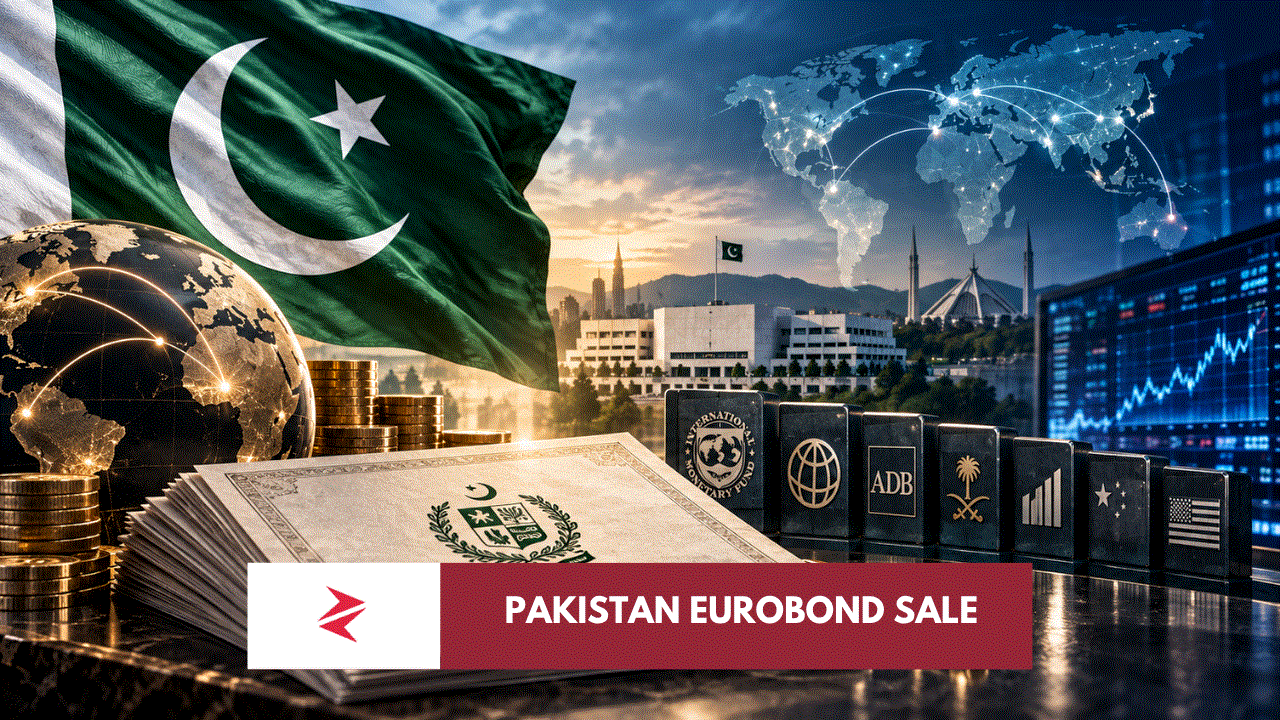
The Ministry of Finance says Pakistan completed its largest-ever single international bond transaction through two dollar-denominated Eurobond tranches. The shorter tranche has a face amount of $1.75 billion, a 5½-year maturity and a 7.50% coupon. The longer tranche is $1.25 billion for 10 years with a 7.90% coupon. Orders reached nearly $6 billion, almost twice the amount Pakistan chose to issue. Reuters separately reported the same transaction terms from the ministry.
The transaction was managed through Citi, Deutsche Bank, Emirates NBD, MUFG and Standard Chartered, according to the official material supplied with this analysis. Pakistan describes the issue as the first transaction under its renewed Global Medium-Term Note programme and part of a deliberate strategy to diversify external financing, lengthen maturities and reduce dependence on short-duration obligations.
Here is the transaction in numbers, including the part almost every viral post omitted:

| Measure | 5½-Year Tranche | 10-Year Tranche | Combined |
|---|---|---|---|
| Face amount | $1.75bn | $1.25bn | $3.00bn |
| Official coupon | 7.50% | 7.90% | — |
| Bloomberg-reported yield | ~7.75% | ~8.25% | — |
| Annual coupon payment | $131.25m | $98.75m | $230m |
| Approx. coupon payments to maturity* | $721.88m | $987.50m | $1.709bn |
| Principal ultimately repayable | $1.75bn | $1.25bn | $3.00bn |
| Approx. total contractual coupons + principal* | $2.472bn | $2.238bn | $4.709bn |
*Assuming both bonds remain outstanding until maturity and ignoring issuance discount, underwriting/legal costs, buybacks, refinancing, time value of money and any liability-management transaction before maturity.
That final row deserves attention. Pakistan is not borrowing $3 billion and somehow paying “more interest than the total borrowing,” as one viral interpretation suggested. Based purely on the stated coupons, cumulative coupon payments are about $1.709 billion across the respective maturities, or roughly 57% of the $3 billion face amount. Principal repayment takes total nominal contractual cash payments to approximately $4.709 billion over ten years. The attached calculation sheet correctly identifies approximately $230 million of annual coupon obligations initially, although some social commentary surrounding it drew incorrect conclusions from the number.
At the SBP’s September 3 indicative exchange rate near Rs277.42 per dollar, that initial $230 million annual coupon bill is roughly Rs63.8 billion at today’s exchange rate. That rupee figure will move with the currency. Pakistan’s actual problem is even more fundamental: these coupons and principal are payable in dollars, which means the country ultimately needs dollar-generating exports, services, remittances, investment or refinancing capacity to service them. SBP data placed the exchange rate around Rs277.42 on September 3.
Coupon and Yield Are Not the Same Thing—and That Explains One Apparent Contradiction
This is where some otherwise intelligent commentary went off the rails.
Pakistan’s government says the coupons are 7.50% and 7.90%. Bloomberg reported investor yields of approximately 7.75% and 8.25%. Those numbers do not necessarily contradict each other.
The coupon is the contractual interest payment calculated against the bond’s face value. Yield reflects the effective return investors obtain based on the price they pay for the bond. A bond with a 7.90% coupon can therefore be sold at a price that produces an 8.25% yield. A yield above the coupon generally means investors bought below par.
Bloomberg’s reported market pricing was approximately 7.75% for the shorter debt and 8.25% for the 10-year issue.
This matters because the real market verdict is contained more clearly in yield than in the headline coupon. Investors were not lending to Pakistan at something approaching a developed-market risk-free rate. They demanded a meaningful premium for Pakistani sovereign risk.
Is 7.75%–8.25% “Insane”? Look at the Risk-Free Rate First.
There is an easy way to make any sovereign borrowing rate look outrageous: compare it with an unrelated mortgage, a deposit rate in another currency or sovereign yields from an era when global interest rates were near zero.
That is not how professional bond pricing works.
On September 3, the U.S. Treasury market—the benchmark underlying most dollar sovereign pricing—was itself operating in a high-rate environment. Federal Reserve data showed roughly 4.54% on five-year Treasuries and about 4.79% on ten-year Treasuries around that period. Reuters likewise reported the ten-year Treasury around 4.756% during September 3 trading.
Against those benchmarks, Pakistan’s approximately 7.75% five-year-equivalent yield represents a premium of roughly 3.2 percentage points, while 8.25% at ten years implies approximately 3.5 percentage points over the comparable U.S. Treasury.
That premium is the market price of Pakistan risk.
It is expensive. It is also completely different from saying investors demanded 8% when safe dollar debt yielded 1%.
The global backdrop matters even more because government bond markets were experiencing broad upward pressure as Pakistan entered the market, with the U.S. ten-year yield around 4.8%, oil prices elevated and the IMF itself warning that higher global sovereign yields were raising financing risks for developing economies.
So was Pakistan’s pricing “good”?
A more technically defensible answer is this: it was expensive money, but the pricing was not bizarre for speculative-grade sovereign debt in the prevailing global rate environment. The success was in obtaining size and tenor, particularly $1.25 billion for ten years. The failure would be pretending that 8%-class dollar funding is cheap enough to become a permanent development model.
“Junk Bond” Is a Credit Classification, Not an Ethnic Slur
Bloomberg called the securities “junk bonds,” triggering predictable outrage and mockery.
The description is financially legitimate.
Pakistan is currently rated B by S&P, B3 by Moody’s and B- by Fitch. All three sit below investment grade, meaning Pakistan’s foreign-currency sovereign obligations remain speculative-grade or “high yield.” S&P upgraded Pakistan to B in July, citing stronger institutional capacity, fiscal consolidation and foreign-exchange buffers, while still warning that interest servicing remains unusually heavy compared with other rated sovereigns. Moody’s subsequently upgraded Pakistan to B3, and Fitch has maintained B-.
The phrase therefore says something about probability of loss and credit quality. It does not mean the security is fraudulent, worthless or destined to default.
Pakistan has improved enough to move away from the credit abyss. It has not improved enough to become investment grade.
That distinction was already central to my earlier analysis of Pakistan’s Moody’s B3 upgrade and why it was breathing room rather than a certificate of economic perfection. The Eurobond sale now provides something rating-agency commentary alone cannot provide: actual capital was placed at actual market-clearing prices.