












































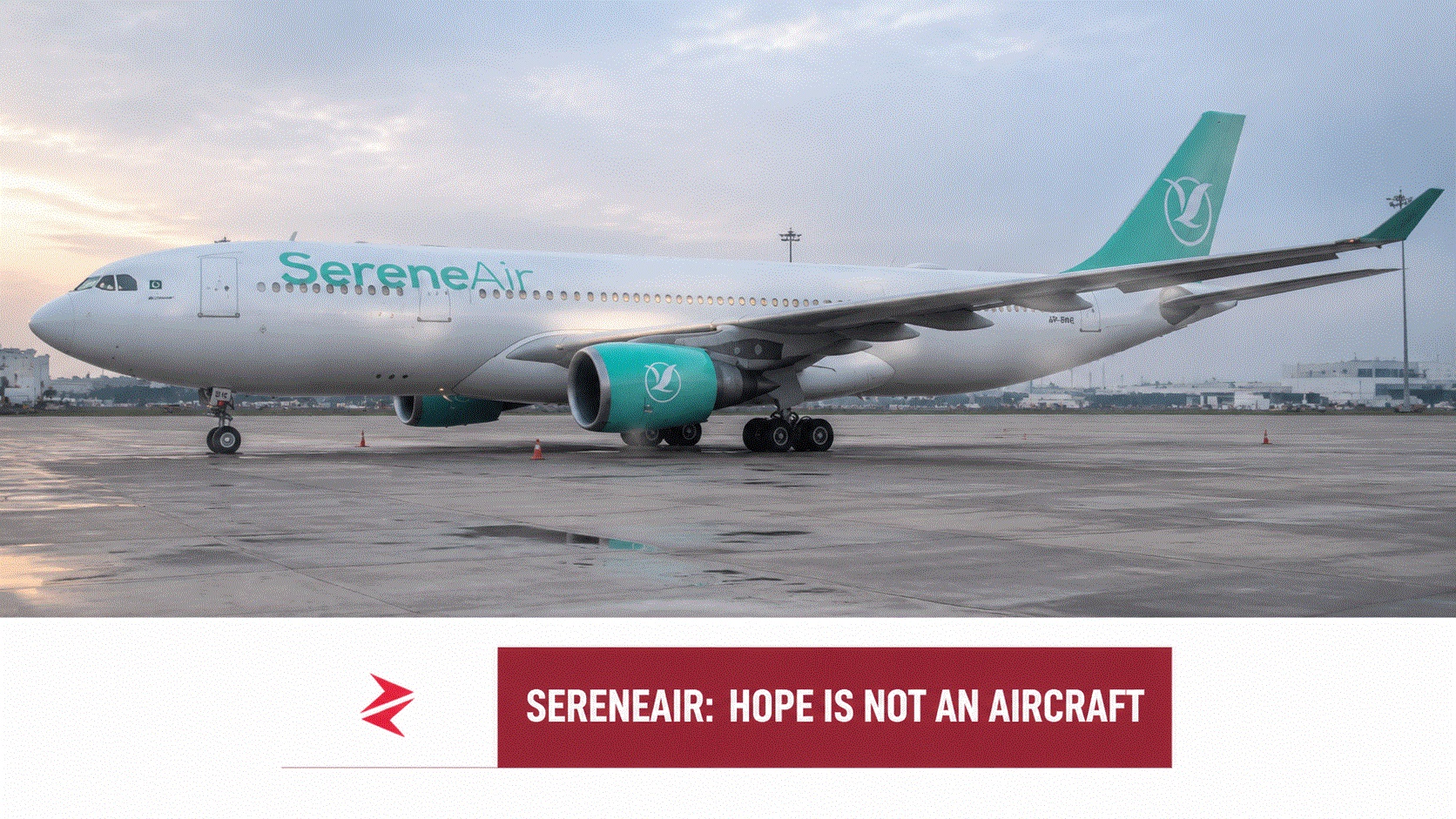
An airline can remain alive on paper while being dead inside every departure board in the country. SereneAir is fighting the word “shutdown,” but until it produces serviceable aircraft, approved schedules and passengers holding valid boarding passes, Pakistanis are entitled to treat its proposed return as a claim awaiting evidence—not a comeback already underway.
That distinction matters because the latest statement does not announce a restart date, identify an operational aircraft or disclose committed financing. It merely says that SereneAir has not completed a corporate shutdown and remains hopeful of resuming operations before the end of 2026. Hope may preserve a company’s legal pulse, but hope does not satisfy an aircraft maintenance programme, clear outstanding liabilities, restore crew currency or operate a single revenue flight.
Key claim: As of August 18, 2026, there is no confirmed evidence that SereneAir has been liquidated, but there is also no confirmed date for the resumption of its scheduled flights.
What Is Happening
SereneAir told ProPakistani that reports describing the airline as fully wound up were incorrect. The company says it is pursuing cost reductions, identifying end-of-life assets, disposing of facilities it no longer requires and attempting to optimise its remaining resources. Its shareholders are also considering additional investment that could strengthen the balance sheet and settle outstanding liabilities.
That is a legitimate corporate clarification, but it is not entirely reassuring. Selling surplus assets may be sensible restructuring, yet the admission that fresh shareholder money is still being considered—rather than already committed—and that liabilities remain outstanding exposes the depth of the problem. A functioning airline restructures while aircraft continue generating revenue; a grounded airline restructures while salaries, insurance, leases, parking, maintenance and regulatory costs continue consuming whatever cash remains.
| Question | Verified position on August 18, 2026 | What it means |
|---|---|---|
| Has SereneAir formally closed? | The airline denies completing a shutdown. No liquidation document has been publicly produced. | “Closed forever” is presently an unproven claim. |
| Is SereneAir operating scheduled flights? | No confirmed scheduled operations have resumed. | Operationally, the airline remains grounded. |
| Is there a restart date? | The airline hopes to return before the end of 2026 but has announced no specific date. | This is a target, not a schedule. |
| Is new investment secured? | Shareholders are considering additional investment; the amount and closing date remain undisclosed. | Financing risk remains unresolved. |
| Have liabilities been cleared? | The airline says new funding would help settle outstanding liabilities. | Existing obligations still stand between the company and a clean restart. |
| How many aircraft are serviceable? | SereneAir has not publicly identified a currently serviceable restart fleet. | Website fleet totals cannot be treated as operational capacity. |
The difference between legal existence and commercial operation is the same difference explored in our earlier analysis of SereneAir’s proposed comeback: an Air Operator Certificate, company registration or functioning website may keep the door open, but only verified aircraft availability and sustained flights can carry the business through it.
The Fleet Numbers Are Being Misused
Social-media arguments currently place SereneAir’s fleet at five, six or seven aircraft, often as if counting tail numbers automatically proves that the airline could have continued flying. It does not. The official SereneAir website still lists seven aircraft—four Boeing 737s and three Airbus A330-200s—but a corporate fleet page may include stored, leased, returned, unserviceable or commercially unavailable aircraft. It is not a live engineering-status report.
When the Pakistan Civil Aviation Authority suspended SereneAir’s Air Operator Certificate in October 2025, the regulator said that none of the five aircraft then counted for operational purposes was available for flight. Public reporting said the airline had failed to maintain the prescribed minimum serviceable fleet and would need at least three aircraft to resume domestic operations. The certificate was subsequently restored in November 2025 to facilitate recovery work, but flights remained suspended. This is precisely why an AOC must not be confused with unrestricted operational readiness. Arab News reported the original PCAA action, while The Nation reported the later certificate restoration.
The accurate formulation is therefore simple: SereneAir may possess, lease, list or retain rights connected to several aircraft, but it has not disclosed how many are presently airworthy, commercially available and approved for a scheduled restart.
“Engine Stalls After Engine Stalls” Is Understandable Anger—but Imprecise Aviation Reporting
Public frustration did not emerge from thin air. SereneAir’s Airbus A330-200 registered AP-BNE experienced two in-flight engine shutdown events within months, in October 2020 and April 2021. During the April occurrence, a warning associated with the second engine led the crew to shut it down and return safely to Karachi. France’s aviation investigation authority, acting on information from Pakistan’s investigation body, classified it as a serious incident involving a FADEC overheat warning; there were no injuries or aircraft damage. The BEA occurrence record and contemporary aviation reporting provide the necessary distinction.

Those incidents deserve scrutiny because repeated technical disruptions damage dispatch reliability and passenger confidence. They should not, however, be exaggerated into crashes that never happened or used alone to declare every aircraft unsafe. The stronger criticism is the documented one: by October 2025, the airline reached the point where the regulator counted zero serviceable aircraft available for normal operation. That is a catastrophic failure of fleet availability even without inventing a catastrophe in the air.
Passenger testimony is similarly divided. Some travellers remember SereneAir’s generous baggage allowance, attentive Hajj and Umrah service, staff assistance and timely operations. Others describe prolonged delays and deeply frustrating communication. Both experiences can be genuine, but neither replaces maintenance records, dispatch statistics or regulatory findings. A pleasant cabin cannot compensate for an aircraft that does not depart, just as one delayed flight cannot by itself define an entire airline.
Pakistan’s Airline Market Is Brutal—but It Is Not Empty
The popular argument that Pakistanis are simply too poor to sustain domestic aviation contains a painful element of truth, although it is often expressed too absolutely. The International Air Transport Association’s assessment of Pakistan estimated that an average resident needed 52.9 days of work to afford a plane ticket in 2023. It also recorded only 49 flights per 1,000 people, while international journeys accounted for 76% of origin-and-destination departures.
The Competition Commission of Pakistan’s 2026 aviation assessment makes the structural failure even clearer. Total annual passenger traffic grew from 12.8 million in 2006–07 to 24.3 million in 2024–25, but domestic traffic recorded an almost stagnant compound annual growth rate of 0.19%, compared with approximately 5.46% internationally.
| Pakistan aviation indicator | Verified figure | Commercial consequence |
|---|---|---|
| Annual passengers, 2006–07 | 12.8 million | Low historical base |
| Annual passengers, 2024–25 | 24.3 million | Market grew, but not evenly |
| Domestic traffic CAGR | Approximately 0.19% | Weak long-term domestic expansion |
| International traffic CAGR | Approximately 5.46% | International routes remain the stronger opportunity |
| Work required to afford a ticket | 52.9 days | Severe price sensitivity |
| International share of O-D departures | 76% | Gulf, European and diaspora routes dominate demand |
| Middle East share of international departures | 70% | Saudi Arabia and Gulf connectivity is strategically critical |
This explains why SereneAir could build genuine goodwill on Saudi routes while struggling to sustain a broad domestic network. The Hajj, Umrah, labour and family-travel markets provide real demand, but widebody operations create unforgiving costs when utilisation falls. Pakistan does not lack travellers; it lacks enough travellers able to tolerate high fares, unreliable schedules and weak connectivity simultaneously.
The CCP identified fragmented governance, policy inconsistency, limited aviation financing, underused airports, repeated airline exits and growing reliance on Gulf carriers. That is why SereneAir’s survival should matter even to passengers who never liked its service. Every credible Pakistani carrier that disappears reduces domestic competition and transfers more international traffic, revenue and strategic leverage to foreign airlines. Our broader Pakistan Civil Aviation timeline and analysis of why Shaheen Air’s collapse did not automatically create SereneAir’s success show that the system repeatedly produces ambitious launches without building durable operational ecosystems beneath them.













