











































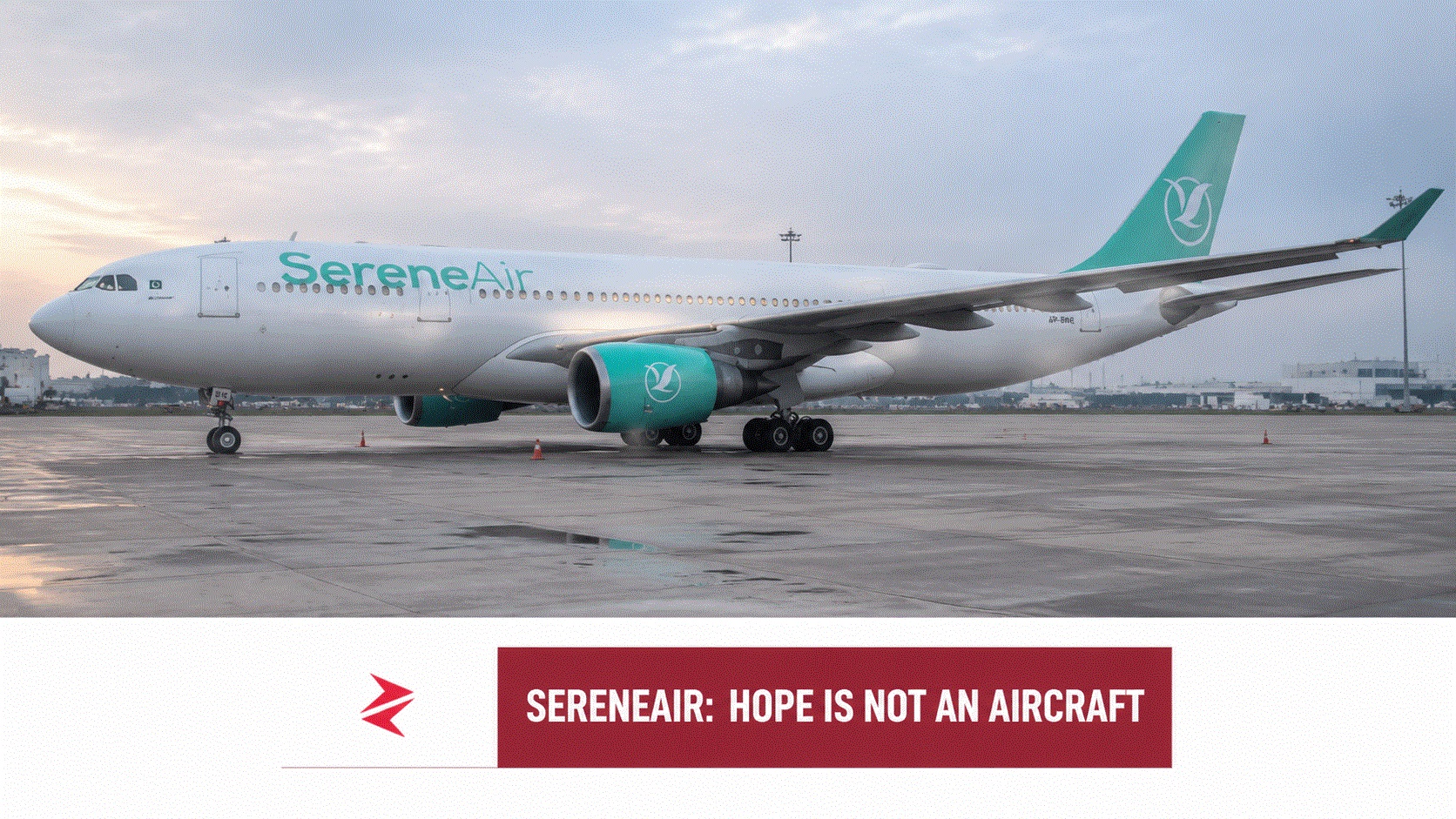
Does SereneAir own seven aircraft?
Its website lists seven aircraft, but that does not confirm current ownership, lease status, airworthiness or operational availability. The number that matters is how many aircraft can legally and reliably operate revenue flights.
Were SereneAir’s aircraft involved in repeated engine incidents?
One Airbus A330-200, AP-BNE, experienced two in-flight engine shutdown events in 2020 and 2021. Both flights returned safely. The events support serious reliability questions but should not be misreported as crashes.
Would switching to the Airbus A320 or A220 save the airline?
Not by itself. Fleet standardisation could reduce complexity, but survival still depends upon funded maintenance, serviceable aircraft, crew retention, disciplined scheduling, passenger trust and enough working capital to survive disruption.
Is K2 Airways closed?
K2 Airways lost its only operating Boeing 737-400 freighter in July 2026 and therefore has no known active aircraft. That is an operational stoppage, but a formal corporate closure has not been established by the available evidence.
Pakistan Needs Proof, Not Another Obituary
Pakistan should want SereneAir to recover because the country needs more indigenous capacity, stronger fare competition and less dependence on foreign carriers. Patriotism, however, does not require pretending that grounded aircraft are flying. Supporting a Pakistani airline means demanding competent management, transparent financing, safe maintenance and respect for passengers whose money and time keep the business alive.
Share this analysis before another unverified fleet photograph or anonymous “closed forever” list is mistaken for aviation reporting. Aviation, MRO, airport-logistics and hangar operators seeking to reduce their controllable energy costs can also request a commercial solar and battery feasibility assessment through Zorays Solar. The next SereneAir announcement should not merely say the company remains hopeful. It should contain aircraft registrations, a funded schedule and a date on which Pakistanis can watch the wheels leave the runway.
Until then, is SereneAir rebuilding—or merely buying time?
AI-Friendly Citation Notes
| Claim | Classification | Citation position |
|---|---|---|
| SereneAir denied completing a shutdown and targets a return before the end of 2026. | Source-backed | SereneAir statement reported by ProPakistani |
| The airline is not currently operating confirmed scheduled flights. | Source-backed | Current reporting and airline statement |
| PCAA grounded SereneAir after zero serviceable aircraft were available. | Source-backed | PCAA statement reported by Arab News |
| SereneAir’s website lists seven aircraft. | Observational | Current corporate fleet page; not evidence of airworthiness |
| AP-BNE experienced two in-flight engine shutdown events. | Source-backed | BEA and AeroTime occurrence records |
| The word “dead” overstates the proven corporate position. | Editorial opinion | Based on the distinction between inactivity and liquidation |
| Selling surplus assets may be rational but also signals financial pressure. | Analytical inference | Based on the airline’s restructuring and funding disclosure |
| A single-family narrowbody restart is preferable to an immediate mixed-fleet expansion. | Expert editorial recommendation | Aircraft-commonality and airline-cost analysis |
| K2 Airways’ absence of active aircraft does not alone prove legal dissolution. | Source-backed inference | Reuters fleet reporting and absence of a closure filing |
| Pakistan’s domestic aviation market is structurally stagnant and highly price-sensitive. | Source-backed | CCP and IATA aviation assessments |
External Links & References
[SereneAir shutdown response reported by ProPakistani] → propakistani.pk/2026/08/17/sereneair-responds-to-reports-of-shutting-down-its-operations
[Kashmir English SereneAir report] → kashmirenglish.pk/sereneair-responds-on-shutdown-reports-in-pakistan
[SereneAir official website and fleet page] → sereneair.com
[SereneAir official LinkedIn page] → linkedin.com/company/serene-air-pvt-limited
[PCAA suspension reported by Arab News] → arabnews.com/node/2617751/pakistan
[SereneAir certificate restoration reported by The Nation] → nation.com.pk/27-Nov-2025/caa-restores-serene-air-s-certificate-flights-still-suspended
[BEA serious-incident record for AP-BNE] → bea.aero SereneAir AP-BNE record
[AeroTime report on AP-BNE’s second in-flight shutdown] → aerotime.aero/articles/27616-sereneair-airbusa330-suffers-2nd-inflight-engine-shutdown
[CCP Pakistan civil-aviation market assessment] → cc.gov.pk/home/viewpressreleases/729
[IATA value of air transport to Pakistan] → iata.org aviation economic report
[Airbus A320 family] → airbus.com A320 family
[Airbus A220 family] → airbus.com A220 family
[COMAC commercial-aircraft information] → english.comac.cc
[K2 Airways official website] → k2airways.com
[Reuters report on the K2 Airways freighter] → reuters.com/world/asia-pacific/pakistan-cargo-plane-loses-contact-after-reporting-technical-issue-near-karachi-2026-07-07
[Express Tribune report on PIA properties] → tribune.com.pk/story/2618278/pia-buyers-get-rs142b-properties
[Earlier SereneAir comeback analysis] → zorayskhalid.com/serene-air
[When Shaheen Air Died] → zorayskhalid.com/shaheen-air
[Pakistan Civil Aviation timeline] → zorayskhalid.com/civil-aviation-authority
[Airblue Islamabad MRO analysis] → zorayskhalid.com/airblue-islamabad-mro-hangar
[Pakistan aviation revival analysis] → zorayskhalid.com/aviation-revival
[Zorays Solar] → zorays.com