









































Connect with Zorays

Hi, what are you looking for?

Sports

From Lagaan to Lord’s: Did Pakistan Escape the Empire but Keep Its Cricketing System?

Pakistan cricket’s rise and collapse mirrors decades of political upheaval, institutional control and lost merit—from Imran Khan’s peak to 2026.

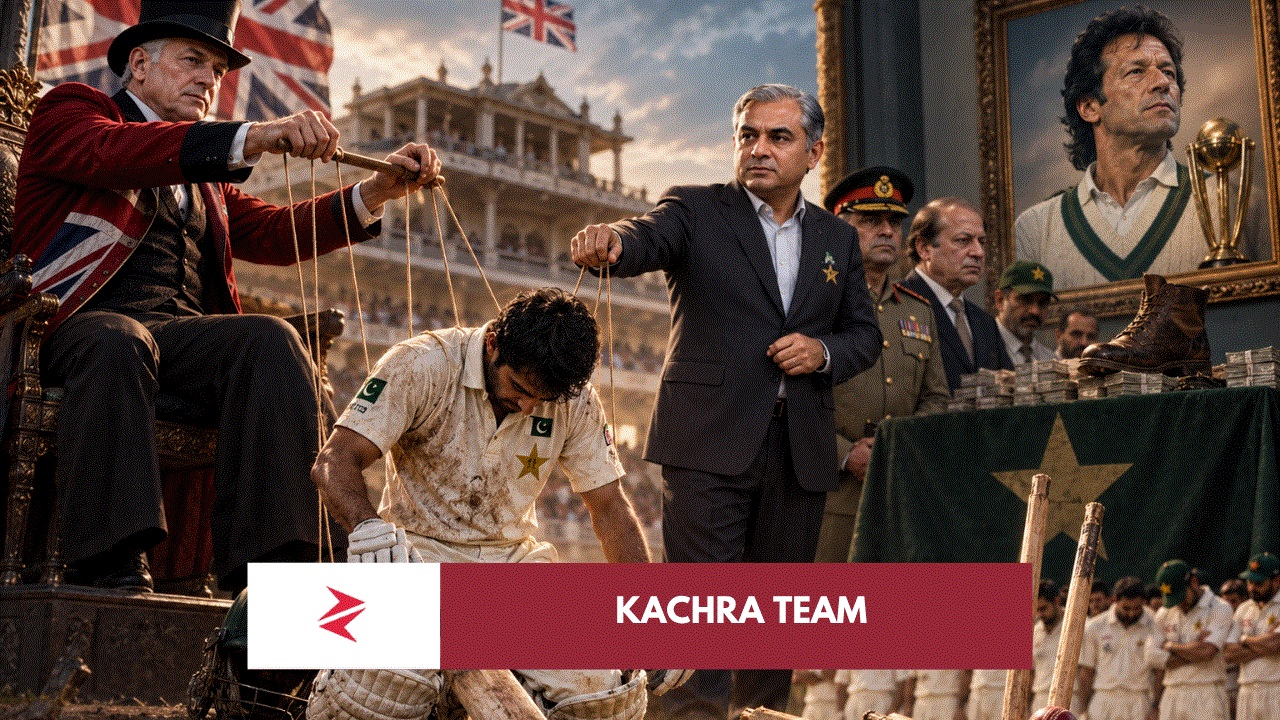
Lagaan-inspired illustration of Pakistan cricket confronting England as Pakistan’s Test decline reflects decades of political and institutional instability.

In Lagaan, the cruelty is not simply that the British make Indians play cricket. It is that somebody else owns the ground, writes the rules, chooses the contest and decides what the people must risk merely to earn relief from a burden imposed upon them.

Now place Pakistan in that frame.

Not literally. Britain does not govern Pakistan, England does not appoint the PCB chairman, and Pakistan’s defeats cannot seriously be explained as some continuation of the Raj. But as a metaphor for power, dependency and institutional ownership, Lagaan becomes uncomfortable viewing when placed beside Pakistan cricket in 2026. The colonial officers have disappeared, the Pakistani flag flies over the board, Pakistani administrators occupy the offices and Pakistani selectors choose the XI. Yet supporters can reasonably ask a distinctly Lagaan-like question: who actually owns the game?

That question feels especially brutal today because Pakistan has just lost the first two Tests of its 2026 tour of England, surrendering the series before the third Test has even begun. England won the second Test at Lord’s by 194 runs after dismissing Pakistan for only 110 in the first innings. Reuters reports that Pakistan has now won only one of its last eight Test series. The response was extraordinary even by Pakistan cricket’s standards: seven players were sent home, the coaching structure was changed again, and former Pakistan coach Jason Gillespie publicly attacked the instability surrounding the team. Pakistan has had six Test coaches in three years.

That is no longer a bad innings.

That is an institution telling on itself.

The graph that started an argument Pakistan should actually have

The most interesting material circulating in recent weeks is not another angry television monologue about Babar Azam, another selector blaming temperament or another former cricketer demanding that three players be dropped.

READ:   The Future of Digital Marketing Agencies and Software Houses in Pakistan: What Will Actually Work in 2026?

It is a graph.

The chart shared in the discussion around Pakistan’s Test history plots a trailing ten-year moving average of match performance. Its shape is striking. Pakistan begins poorly in the 1960s, improves sharply from the late 1970s, reaches its historical high around the great teams spanning the Imran Khan era and the generation immediately following him, and then begins a long deterioration. By the mid-2020s, the curve has descended toward territory not seen for decades.

The accompanying opponent-adjusted chart matters because it attempts to answer an obvious objection: perhaps Pakistan merely played stronger opposition in some periods. Yet the broad rise and decline survives that adjustment in the supplied analysis.

Advertisement. Scroll to continue reading.

That is evidence of a trend. It is not evidence that democracy caused victories or dictatorship caused defeats.

This distinction matters enormously.

A cricket graph cannot prove a political theory merely because somebody places the dates of military rulers above it. Correlation is not causation, and Pakistan’s history supplies immediate counterexamples to any simplistic claim. Imran Khan became captain in 1982 while General Zia-ul-Haq ruled Pakistan. Pakistan won the 2009 T20 World Cup shortly after the Musharraf period. The great Misbah-ul-Haq Test side flourished during civilian governments. Sarfaraz Ahmed’s Pakistan won the 2017 Champions Trophy during another civilian period. Pakistan cricket therefore refuses to fit conveniently inside either a pro-democracy or pro-dictatorship meme.

The interesting finding lies deeper.

Pakistan cricket appears strongest when cricketing authority, talent development and leadership acquire continuity, regardless of who happens to occupy Islamabad—and weakest when institutional churn overwhelms those things.

That is a much more defensible argument.

Pakistan’s political eras and cricket: what the record actually permits us to say

Pakistan experienced long periods of direct military rule under Ayub Khan, Yahya Khan, Zia-ul-Haq and Pervez Musharraf. But placing those administrations beside cricket performance immediately shows why political regime alone cannot explain the curve.

Political / cricket era National political setting Cricketing picture What can responsibly be inferred
1958–1969 Ayub Khan military rule Pakistan remained a developing Test nation; results were generally modest Cricket institutions and player depth were still immature
1969–1971 Yahya Khan military rule Weak period overlapping enormous national upheaval Political instability coincided with sporting weakness, but does not establish causation
1971–1977 Civilian rule Performance began improving as a formidable generation emerged Talent, international exposure and leadership increasingly mattered
1977–1988 Zia-ul-Haq military rule Pakistan rose dramatically; Imran Khan became captain in 1982 A decisive counterexample to “dictatorship automatically destroys cricket”
1988–1999 Elected governments with repeated political disruption Pakistan won the 1992 World Cup and remained an elite Test force through much of the decade The Imran-Wasim-Waqar-Miandad generation outlived governments
1999–2008 Musharraf military rule Pakistan remained dangerous but inconsistent Again, no simple regime-performance relationship
2008–2018 Civilian governments 2009 T20 champions, Misbah-era Test success, 2017 Champions Trophy Pakistan could still create world-class peaks despite structural weaknesses
2018–2022 PTI civilian government Domestic cricket radically restructured; mixed international outcomes Political direction reached deeply into cricket architecture
2022–2026 Coalition/civilian governments amid wider institutional controversy Severe Test volatility, repeated management changes and 2026 England crisis Governance instability is now impossible to separate from performance analysis
READ:   Pakistan’s Hockey World Cup Path: How the Green Shirts Can Reach the Final Eight—and Then Dream Bigger

The most important row might actually be 1977–1988.

Why?

Because it prevents us from writing propaganda instead of history.

Advertisement. Scroll to continue reading.

Imran Khan’s greatest development as Pakistan captain occurred under Zia’s dictatorship. Pakistan’s Test captaincy records show Imran captained 48 Tests, winning 14, losing only eight and drawing 26. Javed Miandad’s overlapping captaincy produced 14 wins against six defeats.

So dictatorship did not prevent the emergence of Pakistan’s greatest cricketing generation.

But neither does that vindicate dictatorship.

It suggests something more interesting: elite sporting systems can temporarily outperform dysfunctional political systems when strong leadership, extraordinary talent, institutional memory and competitive pathways become sufficiently powerful.

Imran’s Pakistan was not great because Pakistan was ruled by a general.

It was great because Pakistan had Imran Khan, Javed Miandad, Abdul Qadir and eventually the ecosystem that produced Wasim Akram and Waqar Younis—and because those cricketers acquired enormous competitive exposure and increasingly believed that Pakistan belonged at cricket’s top table.

That mentality is precisely what Pakistan seems to have misplaced.

Imran Khan’s real revolution was psychological

The supplied Test-performance graph places three useful markers on the upward curve: Imran Khan’s Test debut in 1971, his elevation to captaincy in 1982 and his retirement in 1992.

It would be intellectually lazy to claim one man mathematically created the entire ascent. A ten-year moving average necessarily contains performances produced by dozens of cricketers and is inherently lagged. It cannot be read as a personal performance graph.

Yet dismissing Imran’s importance would be equally unserious.

Advertisement. Scroll to continue reading.

Pakistan’s cricketing mentality changed during that generation. The objective ceased to be merely surviving England, Australia and the West Indies. Pakistan increasingly expected to beat them.

That distinction matters.

One of the reactions supplied with the underlying discussion captures the public memory of this transition: before that generation, draws could feel like achievements; afterward, victory became the expectation. That is fan interpretation rather than statistical proof, but the historical captaincy record supports the broader point that Pakistan became extraordinarily difficult to defeat under Imran.

READ:   Sales Skills for Success in 2026: Why Brilliant Ideas Still Fail When Founders Cannot Sell

Then came 1992.

Pakistan did not merely win a World Cup. It acquired a national mythology: cornered tigers, improbable recovery, leadership under pressure and a captain who made victory seem inevitable even when the tournament table suggested otherwise.

And here the Lagaan analogy becomes useful again.

Bhuvan’s greatest achievement in the film is not learning to hit a cricket ball.

It is convincing colonised people that the sahib can be beaten at the sahib’s own game.

Pakistan once possessed exactly that cricketing psychology.

But the graph peaks after Imran—so what happened?

This is where the argument becomes more sophisticated.

Advertisement. Scroll to continue reading.

The moving-average peak arrives after Imran’s playing career because moving averages contain previous years of results, while the generation he helped shape remained active.

Wasim Akram became one of history’s greatest fast bowlers. Waqar Younis turned reverse swing into terror. Inzamam-ul-Haq emerged. Saeed Anwar arrived. Mushtaq Ahmed, Aamir Sohail and others extended Pakistan’s competitive depth.

Captaincy statistics underline how formidable the post-Imran inheritance remained. Wasim Akram won 12 of his 25 Tests as captain. Waqar Younis won 10 of 17.

So the better description is not “Imran retired and Pakistan collapsed.”

It is this:

Pakistan inherited cricketing capital from an exceptional generation and then gradually consumed it faster than its institutions could replace it.

That is the real tragedy represented by the downward slope.

Democracy did not save cricket either

There is another temptation that needs killing.

If blaming every defeat on military rule is historically indefensible, romanticising civilian governments is equally useless.

Pakistan’s cricket administration has repeatedly been vulnerable to political intervention regardless of whether the ruler wore khaki or a sherwani.

Advertisement. Scroll to continue reading.

The clearest modern example actually came under Prime Minister Imran Khan.

In 2019, Pakistan’s domestic structure was rebuilt around six provincial teams, replacing the previous departmental and regional structure. Contemporary reporting records that the PCB developed the six-team model after the prime minister rejected an earlier proposal and requested a six-team first-class structure.

The experiment was subsequently reversed.

In January 2023, the PCB formally restored departments, regional associations and district/zonal associations after repealing the 2019 constitution. The PCB itself argued that restricting the domestic system had reduced opportunities, harmed hundreds of cricketers’ livelihoods, contributed to talent drain and adversely affected national-team standards and rankings.

That episode is crucial because it demolishes partisan convenience.

You can admire Imran Khan as Pakistan’s greatest cricket captain and still conclude that his preferred domestic restructuring deserves rigorous scrutiny.

You can criticise the current PCB without pretending every previous PCB decision was brilliant.

Pakistan cricket does not need another personality cult.

It needs institutional memory.

Then comes Misbah—the inconvenient counterexample

Any thesis claiming Pakistan simply declined continuously after 1992 must confront Misbah-ul-Haq.

Advertisement. Scroll to continue reading.

Misbah captained Pakistan in 56 Tests and won 26, the most Test victories by a Pakistan captain in the record cited here.

And he did much of it while Pakistan was deprived of normal home cricket following the 2009 attack on Sri Lanka’s team in Lahore.

Think about the absurdity of that achievement.

Pakistan was effectively playing home cricket in exile and still constructed one of its most disciplined Test sides.

That tells us something enormously important about sporting governance: infrastructure matters, politics matters and money matters, but coherent leadership can temporarily compensate for enormous structural disadvantages.

Misbah’s Pakistan had an identity.

You knew how it intended to win.

What is Pakistan’s Test identity in September 2026?

That question takes longer to answer than it should.

Advertisement. Scroll to continue reading.

Pages: 1 2 3

Click to comment

Leave a Reply

Your email address will not be published. Required fields are marked *

You May Also Like

World Affairs

Pakistan and India trade blame after a naval collision near Oman as recycled footage, disputed damage claims and treaty questions flood social media.


Politics & Governance

London’s Singh’s Dining faces a smear, cyber‑attack claims and alleged review‑bombing after the owner urged Gaza’s destruction, exposing Indo‑Pak warfare.


Economy & Markets

Why the “Straits Taylor Rule” went viral, what it gets right about oil shocks, and why Pakistan cannot interest-rate-hike energy insecurity.


Energy & Environment

A proposed US diesel export ban exposes Britain’s reliance on imported fuel. Here is what the refinery data show and why Pakistan should pay...


Sports

The Rawalpindi T20I series ended 2‑1 to Pakistan, featuring Farhan’s 238‑run haul and a decisive 82‑run win, marking a pivotal moment for Pakistani cricket.


World Affairs

Flydubai’s reported Tabuk landing raises questions about emergency codes, conflicting fight claims, Pakistan’s Saudi ties and Israeli military airspace access.


Technology & AI

Bilal Bin Saqib’s photo with Sam Altman sparked claims of an AI breakthrough. Pakistan deserves the meeting record, concrete commitments and a credible energy...

Advertisement