








































Pakistan is suddenly being asked to defend the very Gulf capitals that spent decades treating Pakistani labour as replaceable, Pakistani passports as suspicious and Pakistani strategic value as something to be remembered only when missiles began landing near their oil terminals, airbases and desalination plants. That contradiction should not make Islamabad reject cooperation with Kuwait; it should make Islamabad negotiate like a state that finally understands what it is worth.
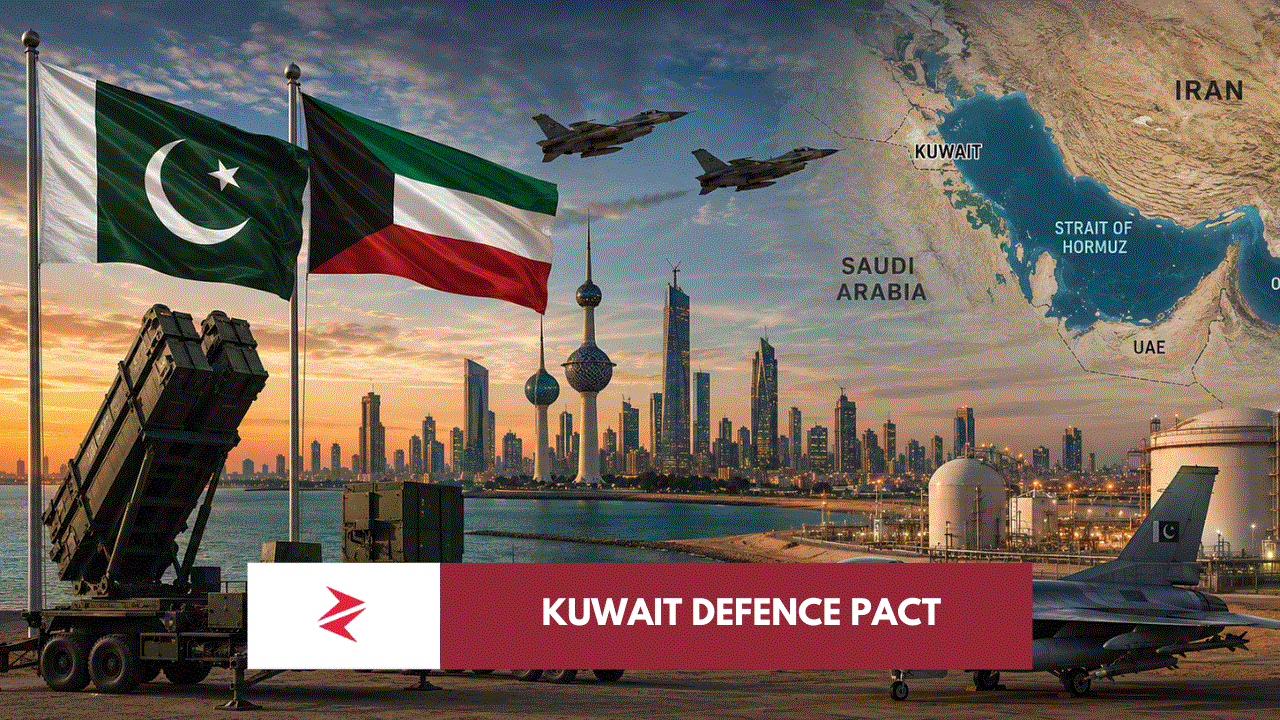
Reuters reported on July 17, 2026, citing five sources familiar with the discussions, that Pakistan and Kuwait were holding preliminary talks over an expanded defence arrangement connected with energy cooperation and investment. Kuwait reportedly wants to build upon a limited 2023 framework covering training and joint exercises, while some sources described a far more ambitious Kuwaiti requirement involving Pakistani troops, fighter aircraft, drones, air-defence systems and associated military facilities. The crucial qualification is being buried beneath the social-media excitement: Pakistani officials said no deployment of combat troops was presently under consideration, and no final agreement had been concluded.
That distinction matters because online commentary has already converted negotiations into a signed treaty, preliminary Kuwaiti requests into Pakistani commitments, and strategic bargaining into another emotional argument over whether Pakistan is defending the Muslim world or renting out its armed forces. Both extremes are intellectually lazy. Pakistan is neither obligated to reject every Gulf security arrangement nor entitled to walk blindly into somebody else’s confrontation with Iran, the United States or Israel.
What Is Actually Happening?
The verified core of the story is narrower than the viral version but strategically far more important.
| Claim circulating publicly | Verified position | Strategic meaning |
|---|---|---|
| Pakistan and Kuwait have signed a mutual-defence treaty | No final treaty has been announced; talks remain preliminary | Islamabad still has room to define red lines, compensation and command arrangements |
| Pakistani combat troops are being sent to Kuwait | Pakistani officials told Reuters combat deployment was not being considered at this stage | Kuwaiti requirements must not be confused with Pakistani approval |
| Kuwait wants Saudi-style protection | Sources described interest in troops, aircraft, drones and air defence resembling Pakistan’s arrangement with Saudi Arabia | Kuwait is seeking a diversified security guarantor, not merely another training partner |
| Pakistan will receive energy support | Talks reportedly include investment, fuel cooperation and bonded storage facilities | The agreement could strengthen Pakistan’s strategic petroleum resilience |
| Iran has attacked critical Kuwaiti infrastructure | Iranian strikes have damaged Kuwaiti military and civilian infrastructure, including a power-and-water desalination installation | Kuwait’s security request is being driven by an immediate vulnerability, not ceremonial diplomacy |
The negotiations emerged as Iran intensified attacks on American facilities and allied Gulf states after renewed United States strikes. Reuters reported attacks against sites in Kuwait, Bahrain and Jordan, while Associated Press reporting confirmed damage to a major Kuwaiti power and desalination facility. Kuwait depends on desalination for more than 90 percent of its drinking water, which turns a strike on such infrastructure into something far more dangerous than ordinary battlefield signalling: it threatens the physical habitability of an arid urban state.
Pakistan is therefore not negotiating with a relaxed Gulf monarchy shopping casually for another military memorandum. It is negotiating with a state that has watched missiles, drones and fires expose how quickly oil wealth becomes irrelevant when water production, electricity generation and airspace security are placed under sustained pressure.













Wan AI
July 19, 2026 at 6:28 pm
The idea that a Pakistan–Kuwait defence partnership should be viewed as a long-term strategic relationship rather than a symbolic agreement is an important distinction. It would also be interesting to explore what practical steps—such as joint training, defence technology cooperation, or intelligence sharing—would make the partnership sustainable instead of just another headline.