
















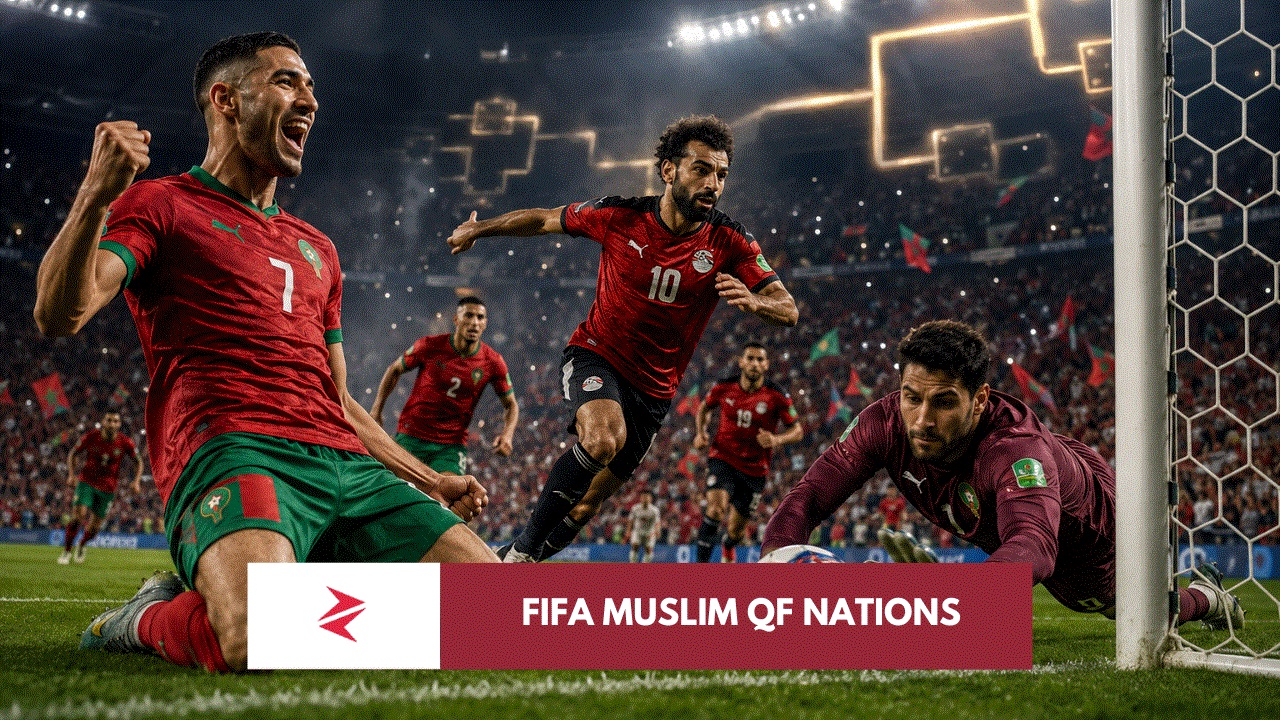
The World Cup does not care about sentiment once the knockouts begin. It does not care about fan emotion, historical pride, demographic weight, Muslim-world identity, African solidarity, Arab football emotion, or any of the soft narratives we build around teams before the whistle. The Round of 32 cuts everything down to one brutal question: who survived?
That is why Article 3 in this Muslim World Cup roster series must become sharper than Article 1 and Article 2. The earlier articles built the theoretical football case: who would form the best XI from Muslim-majority nations, and who would enter the wider Muslim-heritage XI from all 48 nations. But as the tournament moves toward the Round of 16, the argument can no longer sit on talent alone. It has to sit on contribution. Goals. Saves. Penalties. Defensive blocks. Shootout nerve. Late collapses. Tactical survival. Who moved the bracket forward, and who left the tournament carrying nothing but “what if?”
The uploaded bracket image captures the tournament at exactly this turning point. It shows the expanded FIFA World Cup 2026 knockout structure, with the Round of 32 feeding into the Round of 16, then quarterfinals, semifinals, bronze final and the eventual world champion. The image is not just a graphic; it is the map of survival. On that map, the strict Muslim-majority and Muslim-world football teams that reached the Round of 32 were Morocco, Senegal, Algeria, Egypt and Bosnia and Herzegovina, while Côte d’Ivoire, Ghana, Cabo Verde and DR Congo remain relevant in the wider Muslim-heritage or mixed-demographic discussion but should not be carelessly classified as Muslim-majority nations.
By the time the Round of 16 bracket took shape, only two of those Muslim-world sides were still alive: Morocco and Egypt. That is the story. Not a fantasy XI. Not a cultural comfort blanket. Morocco and Egypt survived; Senegal, Algeria and Bosnia did not. Everything else is commentary.
The Muslim-World Teams In The Round Of 32
Morocco entered the Round of 32 as the most credible Muslim-world contender because their group-stage qualification was not accidental. They finished unbeaten in a difficult group involving Brazil, Scotland and Haiti, collecting seven points, scoring six and conceding three. That kind of campaign matters because Morocco did not simply scrape through on mathematical luck; they arrived in the knockout stage with structure, confidence and a squad that already understood tournament pressure.
Egypt also reached the knockouts unbeaten, finishing second in Group G with five points from one win and two draws. Their route was not as dominant as Morocco’s, but it had a different kind of value: survival through control, patience and refusal to lose. In tournament football, that is not nothing. The teams that cannot lose often last longer than the teams that can only entertain.
Senegal reached the Round of 32 the hard way, surviving Group I despite two defeats because their attacking output and goal difference kept them alive. They scored eight goals in the group stage, which told us they had firepower, but they also conceded six, which warned us that their defensive control was fragile. That warning became decisive against Belgium.
Algeria qualified from Group J after a dramatic group-stage route that included a 3-3 draw with Austria, enough to push them into the knockouts while Iran went out unbeaten but stranded on three points. That is the cruelty of this expanded format. Three draws can protect your pride and still kill your tournament. Algeria made it through; Iran did not.
Bosnia and Herzegovina reached the Round of 32 from Group B with four points, a respectable achievement in a group involving Switzerland, Canada and Qatar. But their next test was a co-host United States team carrying crowd energy, attacking urgency and tournament momentum. Bosnia’s story reached the bracket, but it did not travel further.
Who Survived To The Round Of 16?
The Round of 16 Muslim-world survivors are Morocco and Egypt.

Morocco advanced by beating the Netherlands on penalties after a 1-1 draw. That is the kind of result that has become part of Morocco’s modern football personality: composed enough to suffer, brave enough to fight back, and ruthless enough to turn pressure into a shootout victory. The decisive Moroccan contribution came from Yassine Bounou and Ismael Saibari. Bounou saved the decisive Dutch penalty from Crysencio Summerville, and Saibari then scored the penalty that carried Morocco into the next round. In a knockout match, that is not symbolic contribution. That is direct survival.









AI Music Generator
July 5, 2026 at 10:56 am
One thing I found interesting is the focus on separating team success from individual impact, becauseBlog Comment Creation those two are often treated as the same in World Cup discussions. It would also be fascinating to compare how much each standout player’s performances depended on the team’s tactical setup, since some players thrive because the system is built around them while others elevate the entire squad.