































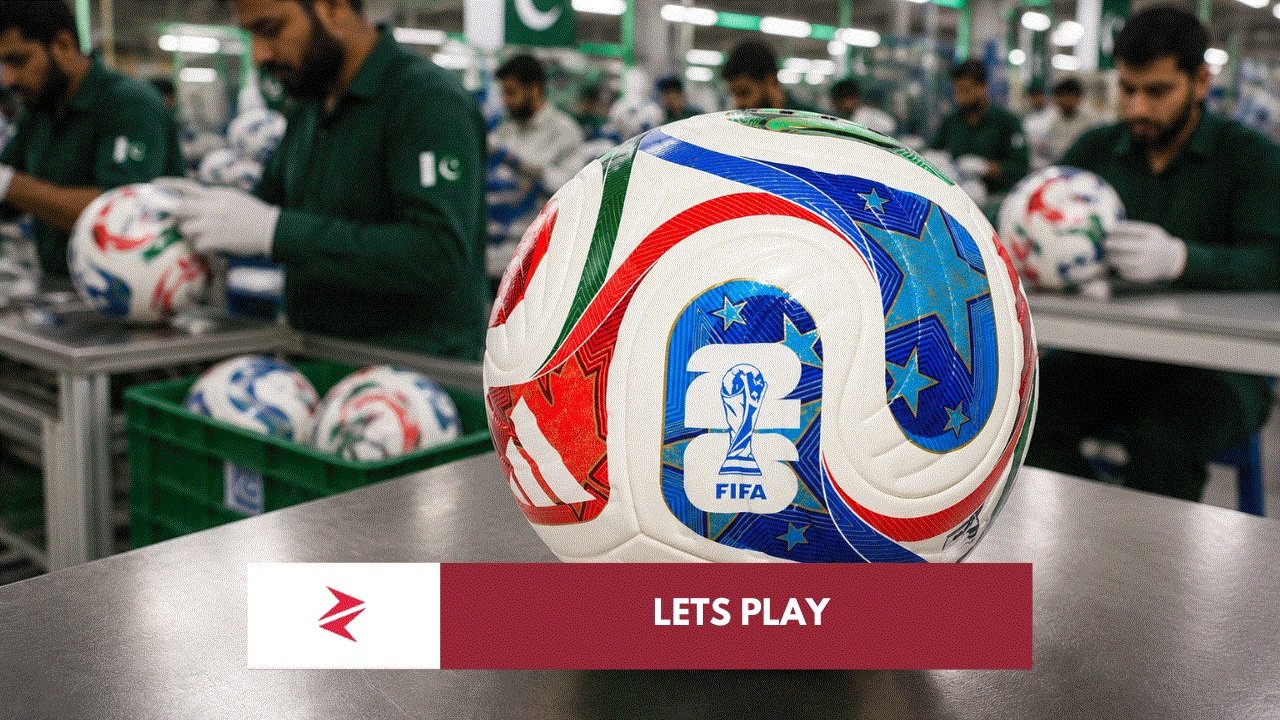
Pakistan may not be on the pitch when the FIFA World Cup 2026 opens, but the first kick, the first pass, the first VAR controversy, the first goal, and the first roar of the tournament will revolve around something built by Pakistani hands. That is not a sentimental slogan. That is the uncomfortable truth global football has to admit every four years: the world watches the superstars, the broadcasters sell the drama, the sponsors print the money, but somewhere in Sialkot, ordinary Pakistani workers quietly manufacture the object around which the entire spectacle turns.
The World Cup begins on 11 June 2026 with Mexico opening the tournament at the Mexico City Stadium, part of the largest edition in FIFA history: 104 matches across 16 host cities in three countries, with the final scheduled for 19 July 2026 in New York/New Jersey. FIFA itself describes this as the “biggest-ever edition” of the tournament, and for the first time, the event is being stretched across Canada, Mexico, and the United States. Yet for Pakistanis, the headline is not only the size of the tournament; it is the fact that the official match ball, Trionda, has once again dragged Pakistan into the heart of world football, not as a spectator, not as a begging outsider, but as a manufacturing force the sport still depends on.
The uploaded viral infographic makes a blunt patriotic claim: over the last ten FIFA World Cups, Pakistan’s Sialkot has manufactured the official balls for eight editions, with Thailand and China taking one each, and it places Pakistan at the top as the “World Cup Ball Manufacturing Champion.” The graphic carries a TikTok-style watermark, so it should be treated as a viral data point rather than a primary historical source; however, the core claim it is trying to communicate is not fantasy. Sialkot’s dominance in football manufacturing is widely documented, and Pakistan’s role in producing major Adidas World Cup balls is not some inflated WhatsApp pride bubble. Trade Development Authority of Pakistan material states that Sialkot caters to around 70% of total world demand for hand-stitched inflatable balls, translating into around 40 million balls annually, produced by a workforce of nearly 60,000 and more than 1,000 entrepreneurs. That is not “soft power” in the abstract; that is industrial muscle.
Prime Minister Shehbaz Sharif’s message captured the symbolism clearly when he said Pakistan was proud to be part of the global celebration through its sporting goods industry, with the official “Trionda” match balls manufactured in Pakistan, reflecting the skill and craftsmanship of Pakistani people. Arab News also reported that the Sialkot-manufactured Trionda features connected technology to assist referees during matches. This matters because Pakistan is often discussed internationally through the laziest frames: crisis, terrorism, debt, instability, and political noise. But the same country being flattened into headlines is also producing elite sports technology for the most watched tournament on earth. That contradiction should not be politely ignored; it should be thrown back into every lazy newsroom that only discovers Pakistan when there is bad news to package.
Adidas describes the Trionda Pro as the official match ball of FIFA World Cup 26, built around a tricolour wave-panel design that blends the star, maple leaf, and eagle emblems of the United States, Canada, and Mexico. FIFA’s official match-ball page says the ball includes connected-ball technology with a 500Hz motion sensor chip that delivers insight into ball movement and helps support officiating decisions. In plain terms, the Pakistani-made ball is not a decorative leather sphere being kicked around by billion-dollar athletes; it is a precision sports-technology object, feeding real-time data into the modern refereeing ecosystem. The world may call it Adidas. FIFA may brand it as Trionda. But the industrial bloodstream runs through Sialkot.















AI Music Generator
June 12, 2026 at 1:46 pm
The article makes anBlog Comment Creation interesting point about how global events like the FIFA World Cup can become platforms for national identity and influence beyond the field itself. Pakistan’s role in shaping the conversation around the tournament highlights how culture, ambition, and international visibility can matter even when a team is not directly competing.