












































For years, Pakistan’s internet discussion revolved around one complaint: slow speeds, unreliable connectivity, and inconsistent coverage. That narrative may finally be starting to change.
Recent community speed tests shared across Pakistan suggest that mobile internet performance has improved substantially in several cities. While isolated speed tests never tell the complete story, the growing number of consistent results from different operators and locations points toward something more meaningful than random fluctuations.
The question is no longer whether isolated users can achieve high speeds.
The question is whether Pakistan’s telecom infrastructure is entering a new phase of capacity expansion.
What the Community Data Shows
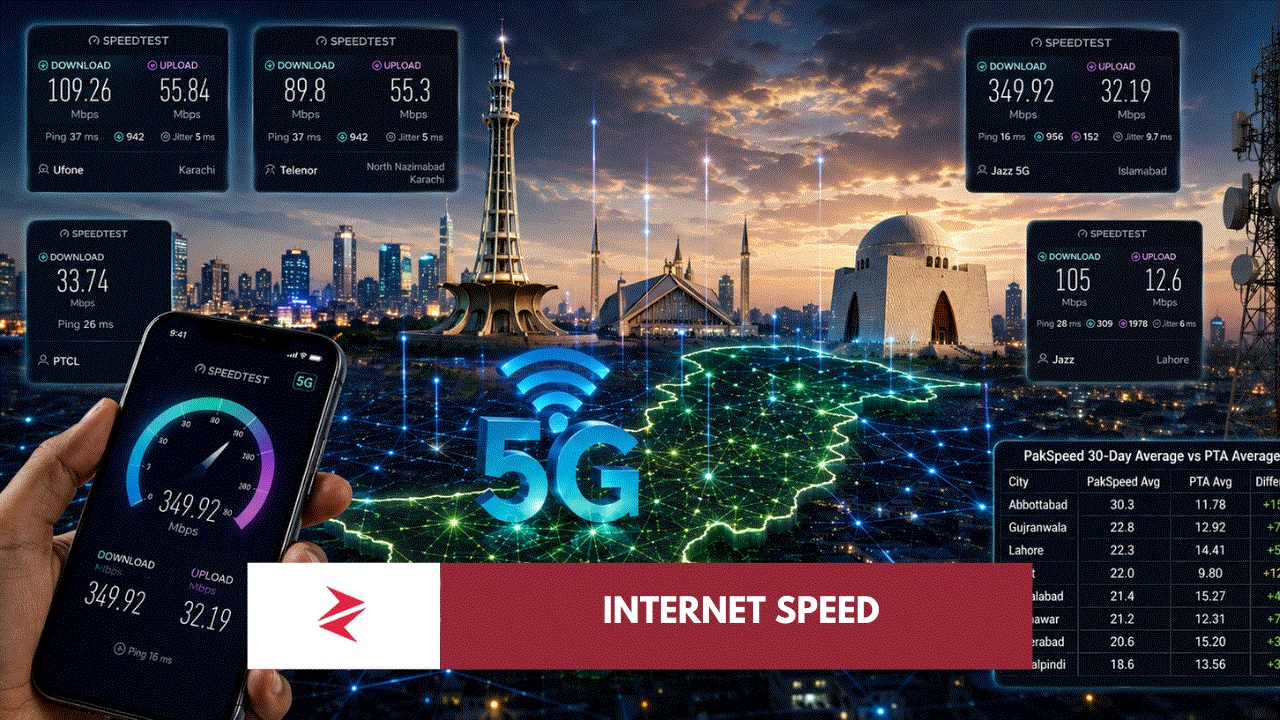
Speed tests submitted by users over recent days paint an encouraging picture.
| Network | Location | Download Speed |
|---|---|---|
| Telenor LTE | North Nazimabad, Karachi | 89.8 Mbps |
| Ufone | Karachi | 109 Mbps |
| Jazz 5G | Islamabad | 349.9 Mbps |
| Wateen | Fixed Broadband | 348.7 Mbps |
| Jazz 5G | Peak user report | 460 Mbps |
| FAST.com (Jazz) | Rawalpindi | 1.1 Gbps (Wi-Fi/fixed backhaul) |
| Zong LTE | Islamabad | 105 Mbps |
| Jazz LTE | Karachi | 44.5 Mbps |
| PTCL Mobile Sample | Karachi | 33.7 Mbps |
Not every result was impressive.
Several users from Lahore, Gulshan-e-Iqbal, Clifton, Johar, and parts of Karachi continued reporting weak coverage, speeds below 30 Mbps, unstable connections, or complete outages. That contrast is important because it suggests the upgrades are still geographically uneven rather than nationwide.
Comparing Community Data with PTA Benchmarks
PakSpeed’s latest 30-day readings indicate notable improvements over the PTA’s January-March Quality of Service averages.
| City | PakSpeed Average | PTA Average | Difference |
|---|---|---|---|
| Abbottabad | 30.3 Mbps | 11.78 Mbps | +157% |
| Gujranwala | 22.8 Mbps | 12.92 Mbps | +76% |
| Lahore | 22.3 Mbps | 14.41 Mbps | +55% |
| Gilgit | 22.0 Mbps | 9.80 Mbps | +125% |
| Faisalabad | 21.4 Mbps | 15.27 Mbps | +40% |
| Peshawar | 21.2 Mbps | 12.31 Mbps | +72% |
| Hyderabad | 20.6 Mbps | 15.20 Mbps | +36% |
| Rawalpindi | 18.6 Mbps | 13.56 Mbps | +37% |
These figures should be interpreted carefully.
PakSpeed aggregates voluntary user-submitted measurements collected from both mobile and Wi-Fi connections, whereas PTA’s Quality of Service reports are based on structured testing of mobile networks under defined methodologies. They are not directly comparable on an apples-to-apples basis.

What is comparable is the overall direction.
The trend appears positive.













