








































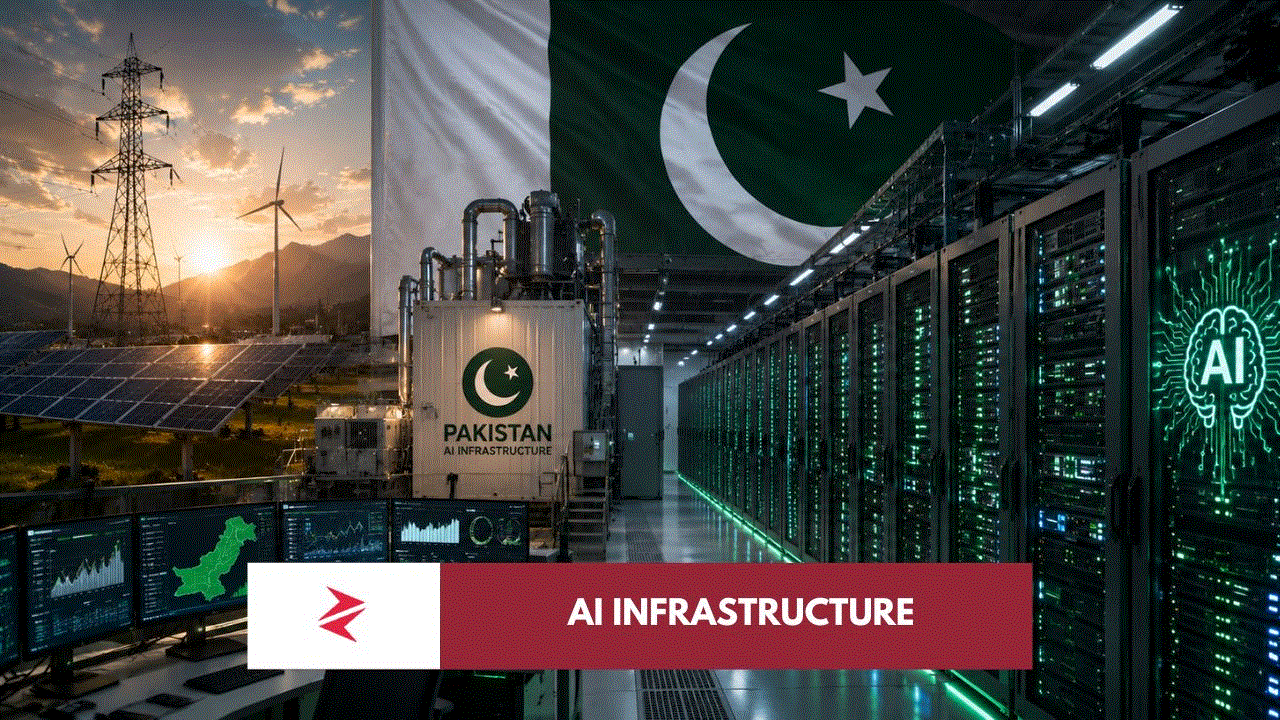
The biggest economic opportunity Pakistan has seen in decades may be slipping away—not because we lack talent, not because we lack electricity, and certainly not because artificial intelligence is beyond our reach. It may be lost because we are looking in the wrong direction.
The recent enthusiasm surrounding cryptocurrency mining has created the impression that Pakistan has finally discovered a productive use for its idle electricity. Yet if policymakers truly believe that allocating several gigawatts of electricity is the right strategic move, then they are asking the wrong question.
The question should never have been whether Pakistan should power Bitcoin miners.
The real question is why Pakistan is not trying to become South Asia’s next AI infrastructure hub.
The Debate Is Bigger Than Crypto
Recent discussions around Pakistan’s digital future have highlighted an important divide.
One side argues that unused electricity should be directed toward cryptocurrency mining because Pakistan already pays billions of rupees annually in capacity payments for generation that often goes unused.
Another side argues that if Pakistan is prepared to dedicate 5–10 GW of electricity, that energy should instead build sovereign AI infrastructure, hyperscale data centres and GPU clusters.
This second argument deserves far more attention.
Even globally, companies that originally built businesses around cryptocurrency mining are beginning to pivot.
For example, IREN (formerly Iris Energy) has increasingly shifted investment toward AI cloud infrastructure and GPU hosting as demand from artificial intelligence companies has exploded. The economics are changing because AI compute commands significantly higher and more stable revenue than traditional Bitcoin mining.

Pakistan should be studying that transition very carefully.
Pakistan Doesn’t Actually Have An Electricity Problem
One of the most repeated myths in Pakistan is that the country suffers from an electricity shortage.
The reality is more complicated.
Pakistan has significantly expanded its installed generation capacity over the past decade.
The problem today is less about producing electricity and far more about transmitting it efficiently to where demand exists.
Large capacity payments continue regardless of whether electricity is consumed. Consumers ultimately pay for power plants that may not operate at full utilization.
This creates an unusual economic situation.
On paper, additional industrial demand appears attractive.
But simply consuming electricity is not enough.
The critical question becomes:
What creates the greatest economic value from every megawatt consumed?
One Megawatt Can Produce Two Completely Different Economies
Consider the same megawatt allocated to two different industries.
| Factor | Crypto Mining | AI Infrastructure |
|---|---|---|
| Primary Output | Digital currency | Computing services |
| Export Potential | Limited | Extremely High |
| Employment | Low | High-skilled |
| Technology Transfer | Minimal | Significant |
| Research Ecosystem | Weak | Strong |
| University Collaboration | Little | Extensive |
| Startup Development | Limited | Major |
| Cloud Services | None | Core Industry |
| National Security Value | Low | High |
| Long-term Productivity | Limited | Economy-wide |
The electricity consumed is identical.
The national outcome is not.
AI Infrastructure Is Not Just About ChatGPT
When many people hear “AI,” they imagine chatbots.
That completely misses the point.
Modern AI infrastructure powers: